

By 2026, enterprise technology has moved into a more stable phase. This stability did not come from one big platform or product. It came from work done steadily across infrastructure, operations, and data. Between 2023 and 2025, companies focused less on major change and more on alignment.
Systems that once worked separately began connecting through shared data and better design. Technologies were judged based on how they helped day-to-day work. Teams looked for tools that were consistent, measurable, and easy to integrate.
Many companies stopped treating digital investments as side projects. Instead, they looked at how tools could support decisions, automation, and process performance. Metrics such as cycle time, resolution time, and system uptime became part of regular reviews.
This way of thinking led to fewer experiments and more structure. Tools that delivered value stayed. Others were phased out or postponed. By 2025, a set of technologies had proven reliable across multiple sectors. These tools supported key workflows in retail, telecom, manufacturing, and technology companies.
Download the full paper: Technology priorities shaped by 2025 that will define enterprise progress until 2030
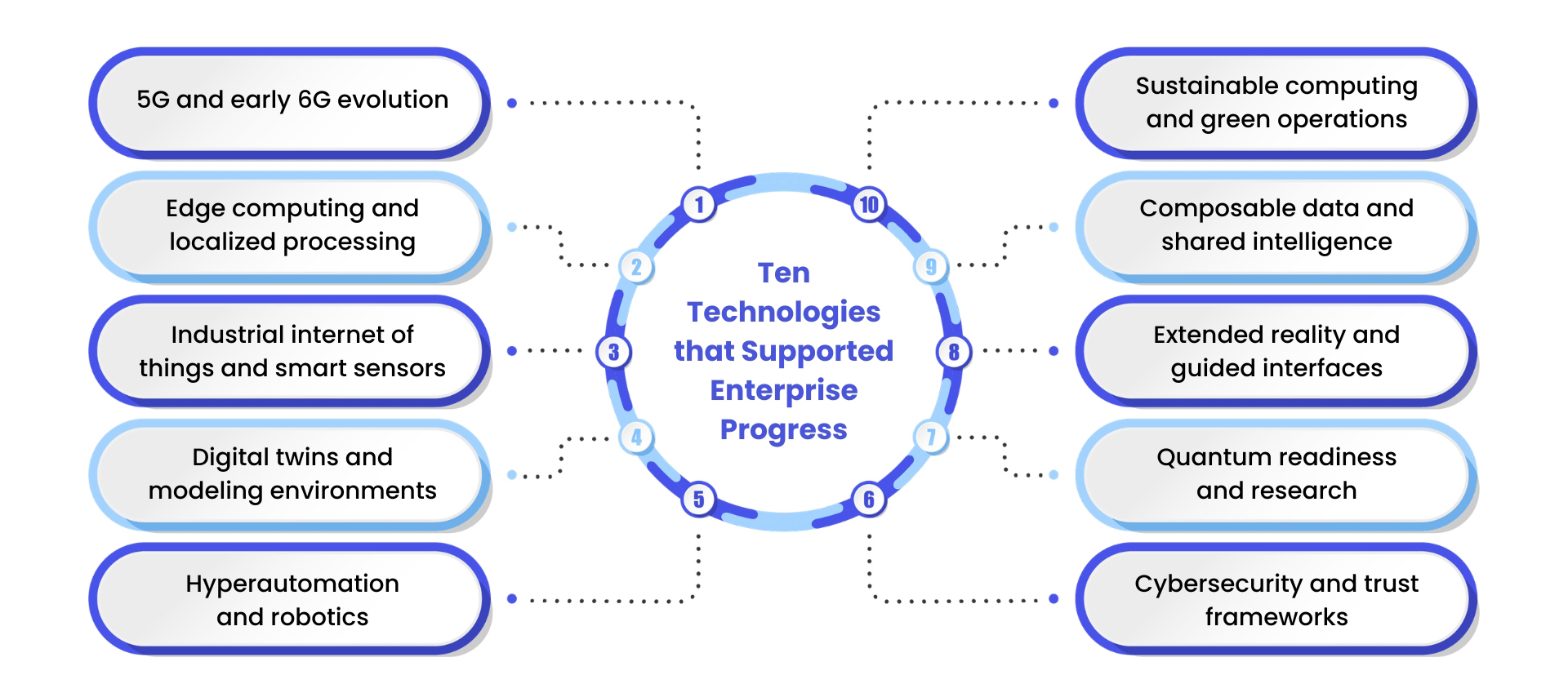
Ten technologies that supported enterprise progress
By the end of 2025, ten technologies were being used in stable, outcome-driven ways. They helped teams improve visibility, response, coordination, and operational control.
-
5G and early 6G evolution: Companies used private networks and expanded coverage to support remote assets, mobile systems, and better device communication.
-
Edge computing and localized processing: Processing was moved closer to physical systems. This reduced wait time and supported faster response across factory floors, stores, and remote locations.
-
Industrial internet of things and smart sensors: Sensors helped track conditions, performance, and use across assets. This made it easier to plan maintenance, reduce waste, and improve safety.
-
Digital twins and modeling environments: Simulations allowed teams to test changes before making them. These tools supported planning, facility design, and equipment adjustments.
-
Hyperautomation and robotics: Companies used automation tools and robotics for repeatable tasks. These tools reduced manual effort and improved consistency.
-
Cybersecurity and trust frameworks: Security became part of system operations. Identity control, access checks, and behavior tracking were added to daily workflows.
-
Quantum readiness and research: Companies began reviewing encryption methods and data risks. This helped teams prepare for future requirements without early adoption.
-
Extended reality and guided interfaces: Teams used headsets and overlays for guided tasks. This supported field work, remote training, and inspections.
-
Composable data and shared intelligence: Data systems became easier to use and share. Teams gained access to timely updates across business functions.
-
Sustainable computing and green operations: Workload design started to include energy impact and resource use. Emissions reporting became part of system planning.
What continues from this foundation
As companies plan their next steps, they are focusing on structure, performance, and control. Technology choices are being guided by how systems behave, how quickly they recover, and how clearly their impact can be measured.
Download the full paper: Technology priorities shaped by 2025 that will define enterprise progress until 2030
Observability is now a basic part of planning. Teams want clear views into system health, data freshness, and load. These views are needed for audits, operations, and planning.
Security is treated as part of system behavior. It is not only about blocking access. It is about understanding how users interact with systems, how risks change over time, and how to keep systems steady.
Quantum computing is not being deployed at scale yet. But teams are preparing for the future. They are reviewing systems that depend on encryption and creating plans to update them when new standards arrive.
Sustainability is becoming part of everyday operations. Energy use, material impact, and emissions are tracked for each workload. This data shapes vendor choices, deployment schedules, and cloud planning.
What companies gained from 2025 is not just access to tools. They gained better control over how systems support business outcomes. Progress is now tracked through uptime, task quality, resource use, and readiness.
FAQs
Q1. What are the top enterprise technology priorities for 2025 and beyond?
The top priorities include edge computing, hyperautomation, industrial IoT, composable data, cybersecurity frameworks, and sustainable computing — all chosen for their proven, measurable business impact.
Q2. How are enterprises preparing for quantum computing in 2025?
Most companies aren't deploying quantum at scale yet. Instead, they're auditing encryption-dependent systems and building roadmaps to adopt updated standards when they arrive.
Q3. Why is sustainability becoming a core part of enterprise tech planning?
Organizations are now tracking energy use, emissions, and material impact per workload. This data directly influences vendor selection, cloud strategy, and deployment decisions.