
.jpg)
A Fortune 500 financial services company recently deployed a cutting-edge large language model for their wealth management division. The AI could write poetry, explain quantum physics, and generate code. But it couldn't interpret their proprietary financial instruments or accurately navigate SEC compliance requirements.
The problem? They had invested in a Ferrari built for highways, but they were trying to drive it on a dirt road designed for a completely different vehicle.
This scenario repeats across industries daily. Companies invest heavily in AI, only to discover their general-purpose models struggle with the specific problems their business actually needs to solve.
The $8.4 billion reality check
Enterprise spending on large language models has more than doubled in just six months, rising from $3.5 billion in late 2024 to $8.4 billion by mid-2025, according to Menlo Ventures' 2025 Mid-Year LLM Market Update. Yet despite this massive investment, most enterprises face a fundamental disconnect.
The enterprise LLM market, projected to grow from $4.84 billion in 2025 to $32.82 billion by 2032 at a CAGR of 31.4% according to Fortune Business Insights, reveals explosive growth. But growth without effectiveness creates expensive disappointment.
Here's the uncomfortable truth: general-purpose AI models excel at broad tasks but falter when faced with domain-specific challenges that actually drive business value.
Why general LLMs fall short
General-purpose language models train on massive public datasets. They're remarkably capable at common tasks like drafting emails or summarizing articles. But when your business needs AI to:
-
Process 20 years of proprietary technical documentation with company-specific terminology
-
Navigate industry-specific compliance frameworks where mistakes aren't acceptable
-
Understand unique customer language patterns from support tickets
-
Handle specialized data formats that don't exist in public training data
...that's where general models hit their limits.
A legal technology company discovered this painfully when their AI system confused everyday language with legal terminology. 'Discovery' meant finding something hidden, not the pre-trial evidence exchange process. 'Motion' referred to physical movement, not formal court requests. These weren't minor inconveniences; they were credibility-destroying errors that damaged client trust.
The root issue? General LLMs lack the specialized knowledge that comes from focused training on domain-specific data.
Fine-tuning: From generalist to specialist
Fine-tuning transforms pre-trained models into domain experts. Rather than starting from scratch, which costs millions and requires months, fine-tuning takes an already capable model and provides targeted, additional training on your specific industry data.
Think of medical education. A medical school graduate has broad knowledge of human anatomy and general medical principles. To become a cardiologist, they need years of specialized cardiovascular training. Fine-tuning does something similar for AI; it takes a 'medical school graduate' model and trains it to become a specialist in your exact field.
The process adjusts internal parameters using domain-specific datasets, teaching the model your industry vocabulary, business context, unique patterns, and workflow requirements.
Why fine-tuning as a service eliminates barriers
Traditionally, fine-tuning required specialized AI engineers, significant computational infrastructure, months of development time, deep machine learning expertise, and ongoing maintenance. These barriers kept fine-tuning out of reach for most organizations.
Fine-Tuning as a Service changes this equation entirely. At CalSoft, we've partnered with leading cloud providers to make enterprise-grade model customization accessible without building an AI research lab.
Our platform combines Next.js for intuitive interfaces, Python FastAPI for robust backend processing, and specialized vector databases (MongoDB and Qdrant) for efficient operations. It integrates seamlessly with existing tools, Amazon S3, Google Drive, Slack, Jira, Confluence, and supports leading AI platforms including OpenAI, Google Vertex AI, and Azure AI Search.
The technical foundation enables rapid deployment without the typical complexity barriers that prevent most enterprises from implementing customized AI solutions.
Four business outcomes that drive ROI
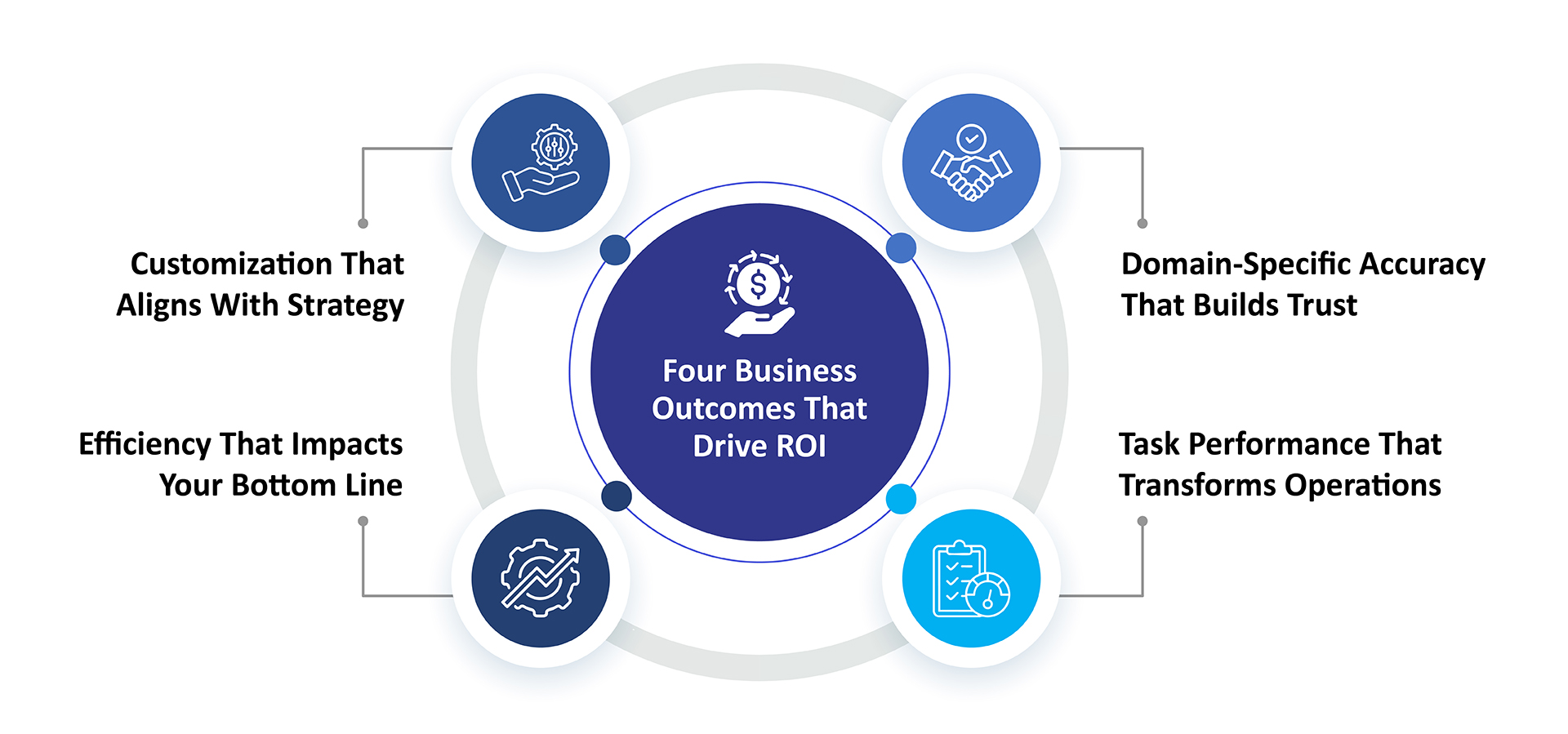
1. Domain-specific accuracy that builds trust
A fine-tuned healthcare model doesn't just understand medical terminology; it grasps treatment protocols, recognizes drug interactions, and navigates HIPAA requirements. A fine-tuned financial model comprehends investment strategies, market analysis frameworks, and regulatory constraints.
This isn't an incremental improvement. It's the difference between an AI system your team trusts and one they constantly work around.
2. Task performance that transforms operations
Whether you need document classification, accurate summarization, or precise question-answering, fine-tuning optimizes for your exact use case.
Consider customer service. A general chatbot provides standardized responses based on broad training data. A fine-tuned system trained on your products, policies, and historical customer interactions delivers contextually relevant answers that reflect your brand voice and business rules, transforming generic interactions into personalized, accurate support experiences.
3. Efficiency that impacts your bottom line
Fine-tuned models require less guidance. They understand context faster, need fewer elaborate prompts, and deliver relevant responses without extensive engineering.
Translation: Your teams spend less time wrestling with AI prompts and more time leveraging AI insights. Deployment accelerates. Operational costs decrease. Time-to-value shrinks from months to weeks.
4. Customization that aligns with strategy
This matters most. Fine-tuning doesn't force your business processes to conform to generic AI capabilities. Instead, it shapes AI to serve your unique requirements, competitive advantages, and strategic objectives.
Your proprietary data becomes your competitive moat. Your specialized knowledge becomes embedded intelligence. Your unique workflows become efficiently automated.
Real-world applications across industries
Healthcare: Fine-tuned models analyze patient records, assist with diagnosis, ensure protocol compliance, and reduce clinical administrative burden.
Financial services: Specialized models handle risk assessment, fraud detection, regulatory reporting, and personalized investment recommendations while maintaining strict data security.
Legal services: Domain-trained AI manages contract review, legal research, case categorization, and document discovery, tasks previously requiring hundreds of attorney hours.
Manufacturing: Fine-tuned systems optimize supply chains, predict maintenance needs, manage quality control, and process complex technical specifications.
Retail: Customized models deliver hyper-personalized recommendations, intelligent inventory management, dynamic pricing, and automated customer support.
What market trends reveal
The data is clear. Enterprise spending on generative AI surged more than 6x in 2024, jumping from $2.3 billion to $13.8 billion, according to Menlo Ventures' 2024 State of Generative AI Report.
More telling: enterprises have shifted from experimentation to production. Companies aren't just testing AI, they're embedding it into core business operations that must deliver measurable ROI.
Application layer investment reached $4.6 billion in 2024, an almost 8x increase from $600 million in 2023, per the same report. This reveals where real value creation happens: not in general-purpose models, but in specialized applications that solve specific business problems.
Three questions every CTO should ask
Before investing another dollar in enterprise AI:
1. Does your AI actually understand your business language? Can it interpret industry terminology, compliance requirements, and proprietary processes, or does it require constant correction?
2. Are you paying for capabilities you don't need? General models are powerful but expensive. Are you funding features that don't serve your specific use cases?
3. Can you prove ROI? Generic AI deployments often struggle to demonstrate clear business value. Specialized, fine-tuned models deliver measurable outcomes: reduced processing time, lower operational costs, improved accuracy, and higher customer satisfaction.
Why act now
AI adoption has moved beyond competitive advantage to competitive necessity. But winners won't be organizations that simply deployed AI first. They'll be companies that deployed the right AI systems that truly understand their business, serve their specific needs, and deliver measurable value.
The infrastructure exists. The technology is proven. The business case is clear. The question is whether you'll continue investing in general-purpose AI that struggles with your specific challenges, or deploy specialized intelligence that understands your business.
Your next step: See how it works
We've developed a detailed use case that walks through CalSoft's Fine-Tuning as a Service approach, including:
-
Technical architecture and integration capabilities
-
Real-world implementation examples across industries
-
Performance metrics and ROI calculations
-
Step-by-step deployment methodology
-
Security, compliance, and governance frameworks
This isn't marketing material. It's a practical blueprint based on work with leading enterprises across healthcare, finance, legal services, and manufacturing.
Download the complete use case here and discover how fine-tuning transforms AI from a promising experiment into a strategic asset that drives real business outcomes.
FAQ’s
1. What is Fine-Tuning as a Service and how is it different from using a general AI model?
Fine-Tuning as a Service takes pre-trained AI models and trains them further on your specific industry data, business processes, and terminology. Unlike general AI models that provide broad, generic responses, fine-tuned models understand your domain's unique language, compliance requirements, and workflows—delivering accurate, contextually relevant results without constant prompting or correction.
Key benefit: Domain expertise without building an AI team from scratch.
2. How long does it take to implement AI fine-tuning, and what data do we need?
Implementation typically takes 4-8 weeks depending on your use case complexity and data readiness. You'll need domain-specific datasets (documents, historical interactions, proprietary content) that represent your business context. CalSoft's platform integrates with your existing tools—Amazon S3, Google Drive, Slack, Jira, Confluence—to streamline data preparation and deployment without disrupting current operations.
Key benefit: Weeks, not months. Works with your existing data infrastructure.
3. What ROI can we expect from fine-tuning our enterprise AI models?
Fine-tuned models deliver measurable improvements: faster deployment (reducing time-to-value from months to weeks), lower operational costs (less prompt engineering and fewer errors), higher accuracy rates for domain-specific tasks, and improved user adoption (teams trust AI that understands their work). ROI varies by use case but typically includes reduced processing time, decreased support costs, and improved compliance accuracy.
Key benefit: Measurable outcomes across efficiency, accuracy, and cost reduction.