

Enterprises have spent the last few years experimenting with AI using chatbots, copilots, and automation tools. Yet, most initiatives remain stuck at the recommendation layer.
The shift now is clear. AI is no longer just assisting. It is planning, deciding, and executing.
This transition is being driven by agentic AI—systems designed to operate with autonomy toward defined business goals. This is not just a technology shift; it’s an operational shift for business leaders.
Agentic AI is a smart digital teammate that acts, learns, and makes decisions in real time.
Many AI initiatives fail because they are too generic. Organizations deploy models without aligning them to specific workflows, leading to low ROI and a lack of trust. However, use-case-specific AI agents address this gap.
This blog explores how agentic AI works, real-world use cases transforming industries, business impact, and what leaders need to know about agentic AI.
Why are enterprises moving toward agentic AI?
AI adoption is accelerating across industries. Organizations are moving from experimentation to production, focusing on measurable outcomes.
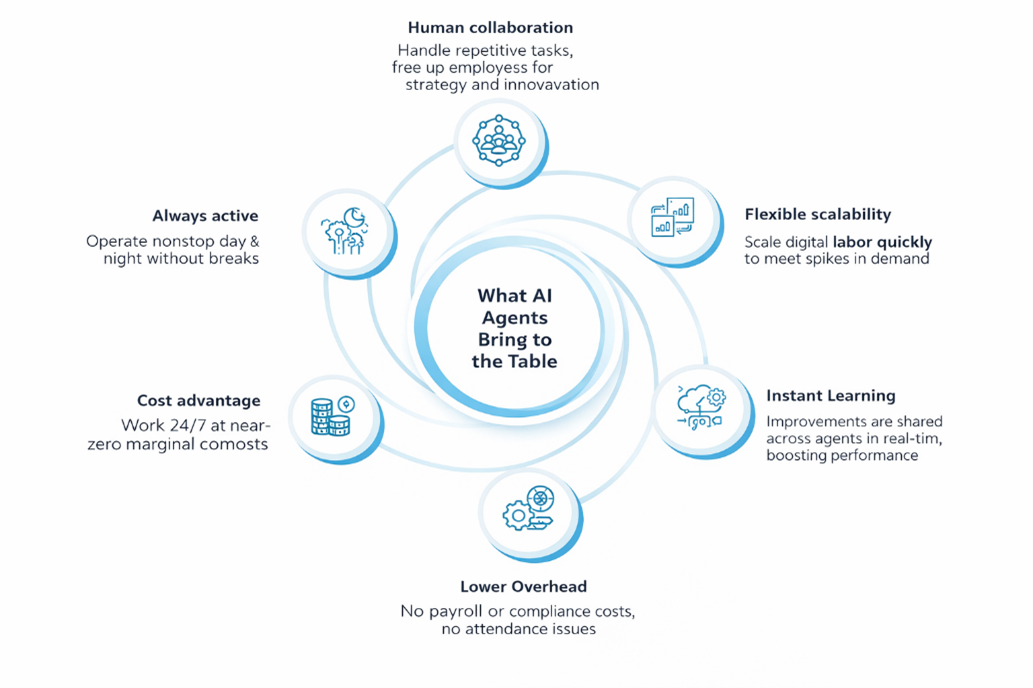
AI delivers value when built into workflows rather than used in isolation. The AI agents are:
- Designed for specific business functions
- Built with domain context
- Integrated into enterprise systems
They move beyond outputs and into execution—where real value is created.
Agentic AI operates through four key stages:
- Understands the goal: Interprets the objective—for example, monitoring heart activity and detecting anomalies.
- Creates a plan: Breaks the goal into clear steps, like tracking vitals and comparing against benchmarks.
- Acts: Executes tasks—sending alerts, updating records, or triggering workflows.
- Learns and improves: Continuously adapts, reduces errors, and delivers more accurate outcomes over time.
Calsoft enables enterprises to design and scale use-case-specific agentic AI systems that go beyond automation into goal-driven execution. By embedding autonomous, context-aware AI agents directly into business workflows, organizations can enable real-time decision-making and seamless operations. Calsoft ensures reliable, scalable AI by combining strong governance with a focus on real business outcomes.
Read our latest blog to learn how AI agents enable next-gen operations.
How use-case specific AI agents transform operations
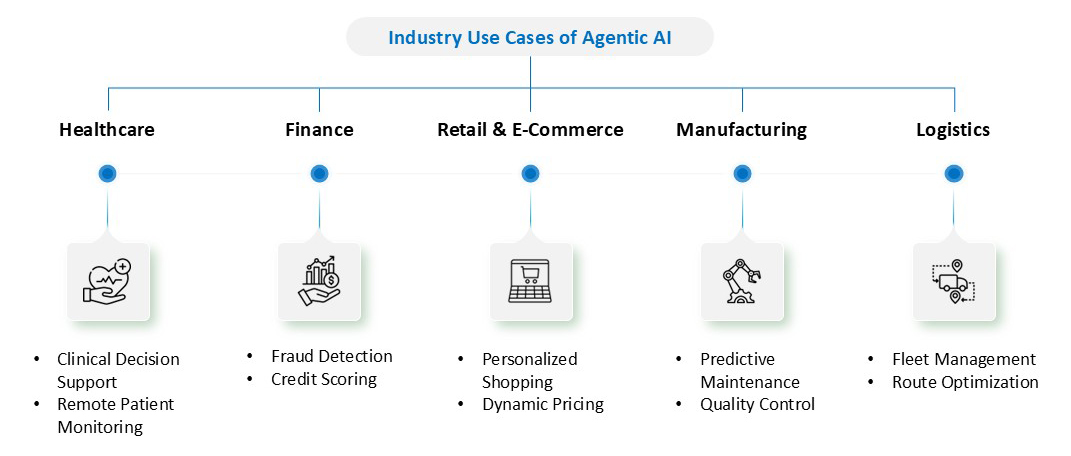
Agentic AI moves beyond automation, delivering efficiency, accuracy, personalization, and real strategic value. The following image illustrates some of the industry use cases of Agentic AI.
Download our latest case study to get more insights
Industry use-case of agentic AI
|
Industry |
Use Case |
Applications |
Impact |
Challenges |
|
Healthcare |
Clinical Decision Support |
Diagnosis assistance, treatment recommendations |
Improves accuracy, reduces workload, and enables evidence-based care |
Regulatory approvals, liability risks, and EHR integration |
|
Personalized Care & Virtual Assistants |
Patient guidance, medication reminders, and remote monitoring |
Better adherence, continuous care, improved engagement |
Data privacy, patient trust, cultural adaptability |
|
|
Workflow & Process Automation |
Claims processing, billing, and scheduling |
Reduces admin costs, improves efficiency, and frees staff time |
Legacy integration, automation accuracy, and staff adoption |
|
|
Finance |
Fraud Detection & Risk Management |
Transaction monitoring, anomaly detection |
Reduces fraud losses, improves trust, real-time detection |
False positives, evolving fraud patterns, compliance |
|
Credit Scoring & Loan Approval |
Risk assessment, loan processing |
Faster approvals, wider access, reduced bias |
Data fairness, explainability, regulatory adherence |
|
|
Retail & E-Commerce |
Personalized Shopping |
Product recommendations, customer targeting |
Higher engagement, increased conversions |
Data privacy, bias, real-time scalability |
|
Dynamic Pricing & Promotions |
Price optimization, targeted offers |
Maximizes revenue, improves targeting |
Customer trust, regulatory scrutiny, transparency |
|
|
Manufacturing |
Predictive Maintenance |
Equipment monitoring, failure prediction |
Reduces downtime, lowers costs, extends asset life |
Sensor accuracy, legacy integration, upfront investment |
|
Quality Control & Defect Detection |
Visual inspection, defect identification |
Improves quality, reduces waste, increases satisfaction |
Data quality, real-time detection, workforce adaptation |
|
|
Logistics & Transportation |
Route Optimization & Fleet Management |
Route planning, fleet tracking |
Reduces delivery time, cuts fuel cost, improves utilization |
Traffic variability, system integration, driver adoption |
Agentic AI offers strong operational value, but successful adoption depends on early management of key risks. A structured approach helps ensure responsible, scalable implementation.
- Data Privacy & Security
High dependence on sensitive data increases the risk of breaches. Strong governance, encryption, and compliance are critical. - Legacy System Integration
Outdated systems limit real-time data access. Requires modern data pipelines and integration strategies. - Overdependence on Automation
Fully autonomous decisions can be risky. Human oversight remains essential in critical workflows. - Bias & Ethical Risks
Biased data can lead to unfair outcomes. Needs regular audits, explainability, and ethical controls. - High Implementation Costs
Initial investment in infrastructure, talent, and training can be significant. Requires clear ROI alignment. - Regulatory Uncertainty
Evolving global regulations create compliance complexity. Continuous monitoring is necessary. - Expectation vs Reality Gap
Overhyped expectations can lead to failed adoption. Success requires phased implementation and clear goals. - Workforce Resistance
Fear of job displacement can slow adoption. Reskilling and clear communication are key.
For Leadership Teams: The Value of Agentic AI
For leadership teams, agentic AI is less about automation and more about operational leverage and decision advantage.
- Moves from reactive to proactive decisions: Agentic AI surfaces insights, trends, and anomalies in real time—helping leaders shift from static reporting to dynamic, data-driven decision-making.
- Reduces bottlenecks and accelerates execution: By removing manual dependencies, organizations improve speed, responsiveness, and accuracy across workflows.
- Unlocks higher-value human work: Teams spend less time on repetitive tasks and more on strategy, partnerships, and innovation.
- Drives smarter, scalable operations: AI agents enable systems to adapt quickly to changing business and customer needs, improving agility at scale.
- Creates a shift in decision-making: Organizations move from human-led, delayed decisions to AI-assisted, real-time execution models.
Final Thoughts
The future of enterprise AI is agentic. Enterprises that move from experimentation to execution will gain a significant advantage. Use-case-specific AI agents are not just improving operations; they are redefining them.
As organizations integrate agentic AI with IoT, robotics, and business platforms, it will enable more personalized services, smarter operations, and new business models, while also bringing important questions around ethics, trust, and regulation into focus.
Build and deploy intelligent agents tailored to real business needs - talk to our experts
FAQs
1. What is agentic AI in enterprise operations?
Agentic AI refers to AI systems that can plan, decide, and act independently within workflows, helping enterprises move from automation to intelligent execution.
2. What are use-case-specific AI agents?
Use-case specific AI agents are AI systems built for defined business workflows, enabling autonomous execution, real-time decisions, and measurable outcomes.
3. How do AI agents improve business operations?
AI agents streamline workflows, reduce manual effort, enable real-time decision-making, and improve efficiency across IT, finance, customer service, and supply chain operations.
4. What are the benefits of agentic AI for enterprises?
Agentic AI delivers faster decisions, scalable automation, lower operational costs, improved accuracy, and enhanced customer experiences.