

In an era where the presence of AI is growing at an accelerated rate, its fusion with edge computing has become impossible to ignore. As AI continues to transform industries, the flexibility of edge computing plays a vital role in enabling faster, more efficient decision-making.
As data volumes increase exponentially and connected devices multiply, traditional cloud computing models struggle to keep up. Challenges such as high latency, limited bandwidth, and data privacy issues are pushing organizations to rethink their data processing strategies. This is where Edge AI comes in. By combining artificial intelligence with edge computing, analytics can be moved to the source — local devices like sensors, gateways, or embedded systems — resulting in real-time AI processing, faster response times, and reduced dependency on the cloud.
In today’s digital landscape, nearly every business function can benefit from adopting Edge AI. Let’s take a deeper look at this transformative technology.
Why Edge AI is Gaining Momentum in Modern Enterprises
According to a Grand View Research report, the global Edge AI market is projected to grow at a compound annual growth rate (CAGR) of 21.0% by 2030.
This rapid growth highlights the increasing adoption of Edge AI, driven by the combined power of artificial intelligence, edge computing, and IoT technologies. By processing data at or near its source, enterprises can overcome latency, bandwidth, and privacy limitations while unlocking faster insights and improved operational efficiency.
For instance, in healthcare, AI-powered edge devices can monitor patient vitals in real time and send alerts within milliseconds — ensuring timely intervention. Since the data is processed locally, it helps maintain privacy and compliance, keeping sensitive data on-site and under control.
Real-World Applications of Edge AI and Edge Computing
Edge AI is creating tangible business value across industries:
- Retail analytics: AI-powered cameras monitor foot traffic, detect long queues, and alert staff for restocking. Explore our article on Retail Store Analytics.
- Autonomous vehicles: Edge AI enables split-second decision-making to avoid obstacles and adapt to changing road conditions.
- Industrial IoT and manufacturing: Monitors machinery and environmental conditions, enabling predictive maintenance and improved safety.
- Smart agriculture: Sensors analyze soil health, detect pests, and optimize irrigation schedules.
All these use cases require ultra-low latency, minimal cloud dependence, and real-time insights — all of which Edge AI delivers efficiently.
How Edge AI Works in Practice
Several components work together seamlessly to enable an effective Edge AI ecosystem, as illustrated below:
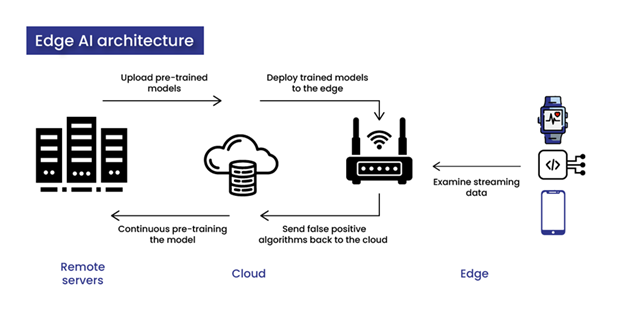
- Local data sources: Sensors, cameras, microphones, and industrial equipment collect raw data.
- On-device AI processing: Machine learning models run directly on edge devices, minimizing cloud dependency.
- Optimized AI models: Techniques like quantization and pruning reduce computational overhead for efficient inference.
- Edge hardware: Devices like NVIDIA Jetson, Qualcomm AI chips, or microcontrollers enable lightweight AI execution.
- Operational insights: Local analytics trigger real-time alerts, summaries, and metrics for cloud-level insights when required.
How Calsoft Supports Edge AI Integration
Implementing Edge AI requires more than just technology — it demands domain expertise, integration experience, and engineering precision. Whether you’re optimizing AI models or designing a resilient edge infrastructure, Calsoft provides the technical depth and strategic guidance to help organizations deploy intelligent edge systems that perform reliably under real-world conditions.
Challenges in Deploying AI at the Edge
While Edge AI delivers compelling advantages, it also presents certain challenges:
- Hardware limitations: Running AI workloads on constrained devices requires model optimization and efficient computing strategies.
- Connectivity constraints: Devices in remote or rugged areas may experience intermittent or low-bandwidth connections.
- Model lifecycle management: Updating and monitoring AI models across thousands of edge nodes demands over-the-air (OTA) updates and central management.
- Security concerns: Protecting data and AI models requires encryption, secure boot mechanisms, and hardware-level security implementations.
How to Get Started with Edge AI for Your Business
To effectively implement Edge AI, enterprises should:
- Identify high-impact real-time use cases (e.g., predictive maintenance, safety monitoring, or customer experience).
- Choose the right edge computing hardware balancing performance, power, and cost.
- Develop and deploy edge-optimized AI models with built-in monitoring and update pipelines.
- Prioritize device security — protecting data-in-transit and on-device model integrity.
Emerging trends like Federated Learning (for privacy-preserving training), TinyML (for ML on microcontrollers), and Unified AI Management Platforms are further accelerating the Edge AI revolution — bridging the gap between cloud, edge, and endpoint computing.
Final Thoughts: Why Edge AI Matters
Edge AI is reshaping how businesses process and act on data. By performing computations where data originates, it reduces latency, strengthens security, and lowers costs. As industries evolve toward distributed, data-driven systems, Edge AI will remain central to creating resilient, responsive, and intelligent infrastructures.
FAQs
Q1: What is Edge AI and how is it different from Cloud AI?A: Edge AI runs AI models on local devices, enabling real-time processing without sending data to the cloud. Cloud AI, on the other hand, relies on centralized data centers for processing.
Q2: What are the key benefits of Edge AI?A: Edge AI reduces latency, enhances privacy, lowers bandwidth costs, and enables instant decision-making closer to the data source.
Q3: How can businesses start with Edge AI solutions?A: Begin by identifying real-time use cases, choosing suitable hardware, optimizing models for edge deployment, and ensuring robust device security.