
Digital product engineering services are entering a decisive phase. For enterprise leaders, digital product engineering is about aligning customer needs, business operations, engineering, security, and compliance. Generative AI is becoming the connective intelligence across that system. The strongest digital product engineering services models apply AI across discovery, architecture, development, testing, release, and lifecycle management. Technology leaders face a harder question in the boardroom: how is generative AI reshaping the way enterprises build products, not as a chatbot secured onto a roadmap, but as a force running through digital product engineering itself? For CXOs evaluating digital product engineering services, the answer is no longer optional.
Generative AI has moved from experimentation to expectation, and the enterprises pulling ahead are the ones treating digital product engineering services as a single, AI-infused engineering discipline rather than a set of outsourced tasks. That is where generative AI changes digital product engineering from a sequence of handoffs into a unified, learning process, and that’s why enterprises are rethinking digital product engineering services.
The boardroom question every CTO is asking
Enterprise buyers assume AI is present somewhere in the stack; the real differentiator is whether it’s embedded across the lifecycle or stitched on as a demo feature. McKinsey estimates generative AI can automate up to 70% of engineering tasks, with productivity gains compounding at roughly 3.3% a year. Most enterprises aren’t capturing that number, because AI is applied to isolated stages: a copilot here, a test generator there, while requirements, compliance, and security signoffs still move through disconnected tracks. The result: faster typing on top of the same slow pipeline.
Why Enterprises Need AI-Powered Digital Product Engineering Services
The board-level question is not whether developers have an AI tool. It is whether the product operating model can convert AI-powered software development into business outcomes. AI-powered digital product engineering services connect five priorities:
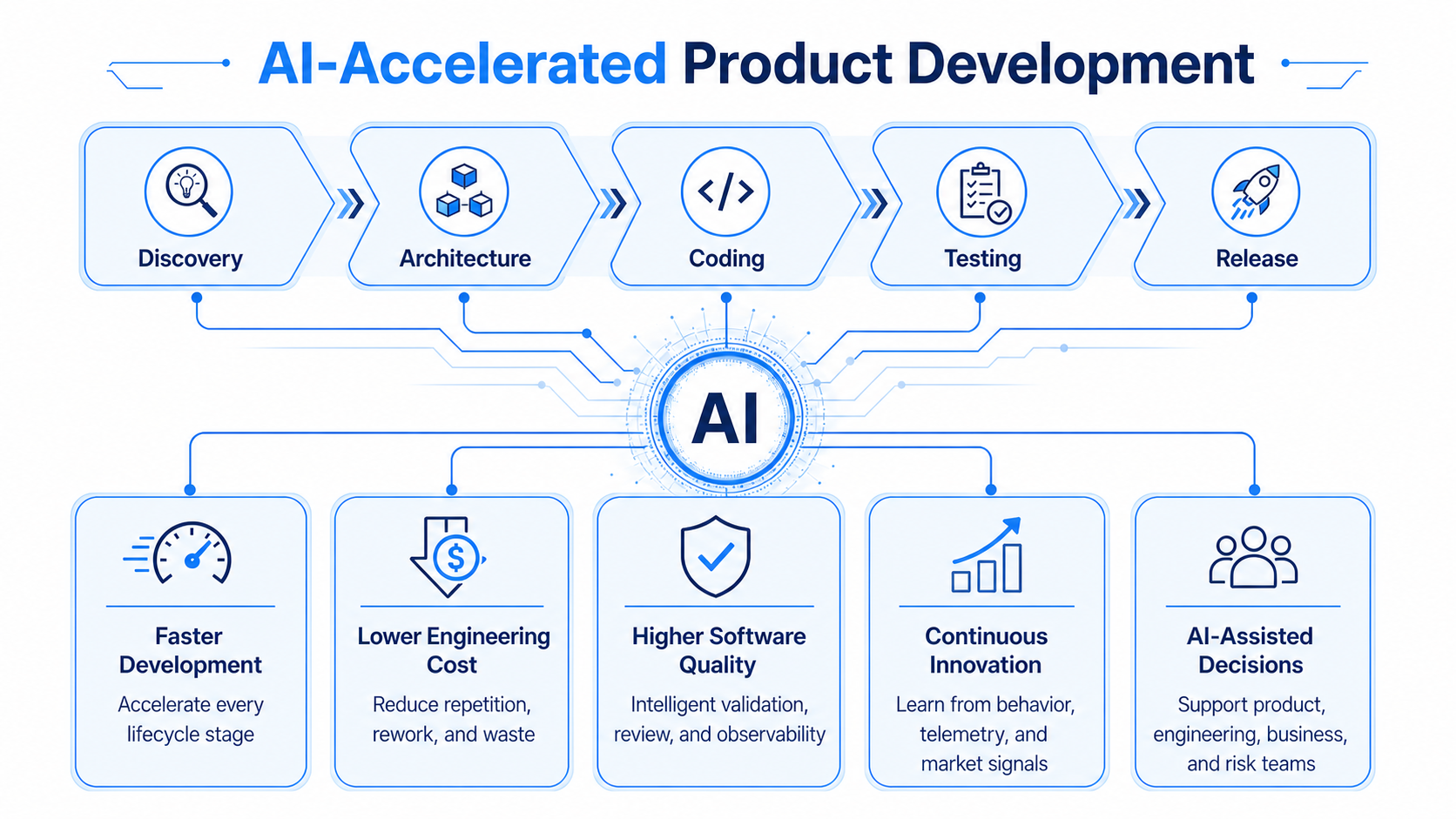
- Faster product development: Idea validation, prototyping, and code framework compress from weeks to days when generative AI handles the first draft of design and code, freeing engineers for judgment calls.
- Reduced engineering cost: Automated code generation, test creation, and documentation cut the manual effort per release, which shows up directly in cost-per-feature and total cost of ownership.
- Better software quality: AI-assisted static analysis, log-hook recommendations, and load-test generation catch defects earlier, before they become production incidents.
- Continuous innovation: When routine engineering work is AI-assisted, teams have bandwidth to keep experimenting instead of only maintaining what already shipped.
- AI-assisted decision-making: Leaders get real-time, data-grounded visibility into delivery risk, technical debt, and resourcing; decisions that used to wait for a quarterly steering review now happen inside the sprint.
From an AI Feature to AI Across the Product Lifecycle: How Calsoft engineers with AI
Most vendors talk about AI as a feature added to an existing delivery model. Calsoft's position is different: AI is embedded throughout the engineering process itself, across design, development, testing, delivery, and lifecycle management. That's the thinking behind our AI engineering services and software engineering services Calsoft unifies digital product engineering services, AI engineering services, and domain knowledge across concept validation, architecture, development, platform and cloud engineering, DevOps, software testing, security, product modernization, deployment, and sustenance.
Instead of treating business processes and software engineering as separate functions handed off at a requirements document, Calsoft runs them as one unified engineering process where both evolve together. Compliance, governance, and security are built into that process itself, not added later as a review gate or as “security by design” after the architecture is already fixed. That's also why Calsoft engineers complete end-to-end product solutions, spanning platform engineering on Kubernetes-based systems, cloud engineering, DevOps automation, and product modernization, instead of handing over isolated components. A unified engineering platform gives stakeholders shared visibility into both the business process and the engineering work, enabling faster governance and faster innovation at the same time. A unified engineering platform approach improves visibility. Product leaders can connect business outcomes to delivery progress. Engineering leaders can view architecture, quality, security, and operational risk together. Governance teams can trace controls and evidence. Users remain present through feedback and service data.
The old way vs. the Calsoft way
|
Dimension |
Traditional engineering model |
Calsoft's AI-driven model |
|
Business & engineering |
Separate functions, handed off at a requirements doc |
One unified process where both evolve together |
|
Compliance & security |
Added late as a review gate or audit |
Built into the engineering process |
|
AI's role |
A copilot bolted onto one stage (usually coding) |
Embedded across design, build, test, and lifecycle |
|
Delivery model |
Isolated components handed to the next team |
Complete, end-to-end product solutions |
|
Visibility |
Siloed dashboards per function |
Unified platform visibility across business and engineering |
What this looks like across industries
In storage and networking engineering, where Calsoft has operated for over two decades, generative AI now drafts test-impact analysis, generates software testing scenarios from historical defect data, and summarizes telemetry to predict where tech debt will surface next.
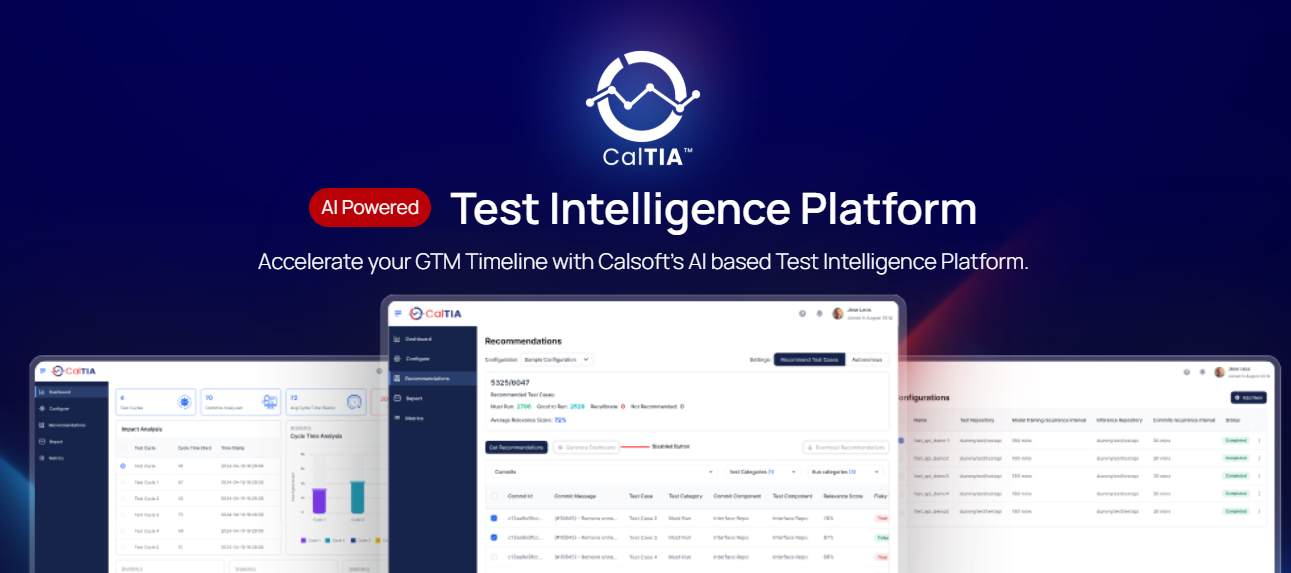
CalTIA (Calsoft’s AI-powered test intelligence platform), links code changes to risk-prioritized regression and CI/CD, accelerating releases without separating speed from quality.
A practical roadmap for enterprise leaders
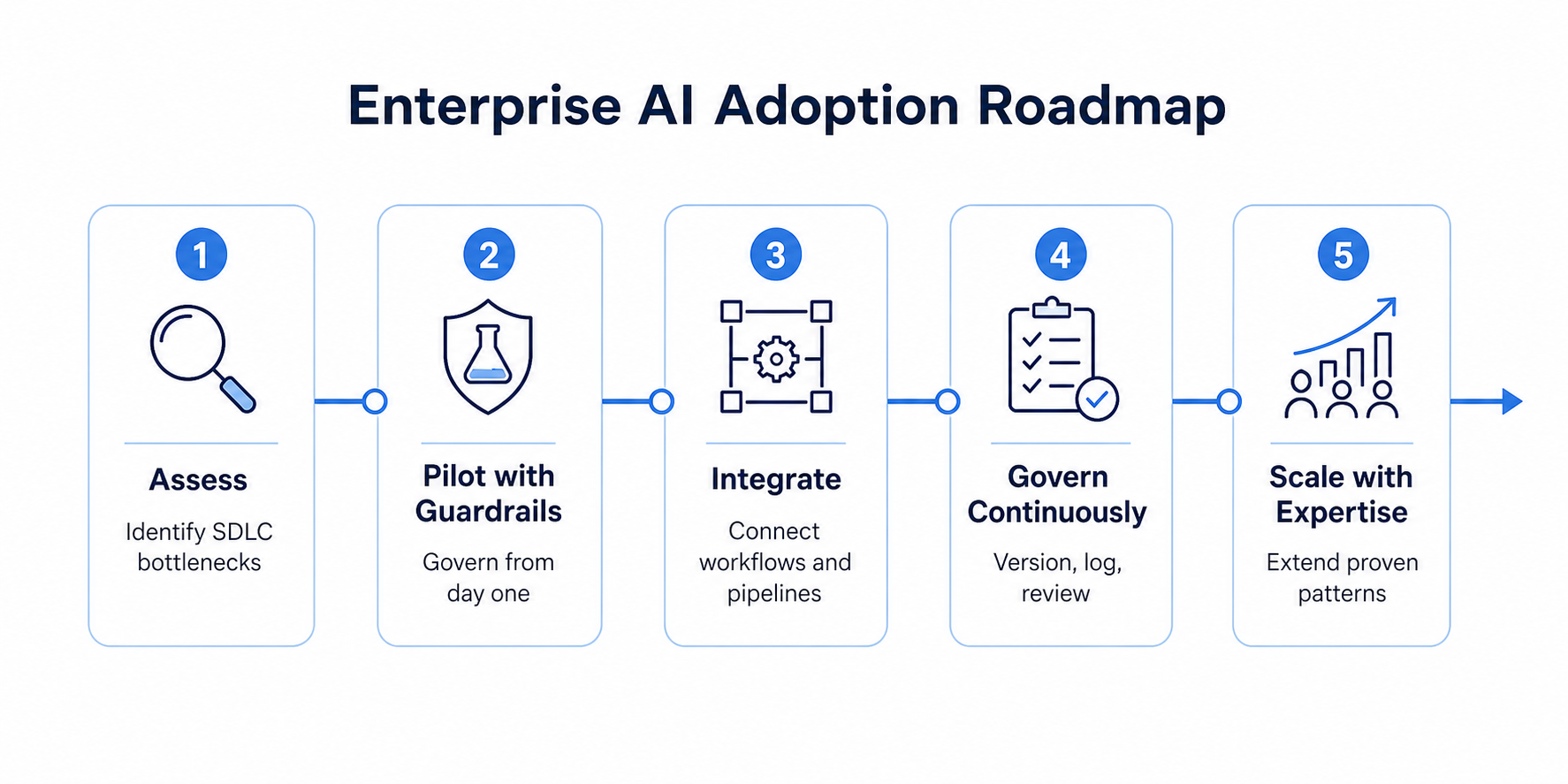
- Assess: Map where AI can act on existing SDLC bottlenecks, prototyping, testing, or telemetry analysis, rather than starting from the tool.
- Pilot with guardrails: Run a bounded pilot with governance and audit trails in place from day one.
- Integrate: Connect the AI-assisted workflow to existing business processes, compliance checks, and delivery pipelines so gains compound instead of staying siloed.
- Govern continuously: Treat AI governance as a living part of the architecture, version prompts, log decisions, and keep humans accountable for sign-off.
- Scale with domain expertise: Extend proven patterns across product lines with engineers who understand both the AI tooling and the domain it's operating in.
Conclusion
Generative AI is not a feature enterprises add to product engineering, it's a capability that must run through it. The organizations pulling ahead are the ones that stopped asking “where can we bolt on AI” and started asking “how does AI change the engineering process itself.” Calsoft has spent over two decades building enterprise-grade digital product engineering services across storage, networking, virtualization, and cloud, and we are now applying that same domain depth to AI-driven engineering, end to end. If you're evaluating what AI-driven digital product engineering services could look like for your roadmap, contact us.
Frequently asked questions
What is digital product engineering?
The end-to-end discipline of designing, building, testing, securing, and maintaining software products — from architecture and development to modernization and post-launch support — rather than any single stage in isolation.
How does Generative AI improve product engineering?
It accelerates prototyping, drafts code and test cases from natural-language requirements, catches defects earlier through AI-assisted analysis, and turns live telemetry into predictive maintenance signals.
What are the benefits of AI in the SDLC?
Faster development speed, lower engineering cost, higher software quality through earlier defect detection, and real-time, data-driven visibility into delivery risk and technical debt.
Can AI replace software engineers?
No. AI accelerates drafting, testing, and analysis, but architectural judgment and accountability for compliance and security decisions still require experienced engineers, AI changes what engineers spend time on, not whether they're needed.
How do enterprises implement Generative AI in product engineering?
Map AI to existing SDLC bottlenecks, run governed pilots with audit trails from day one, integrate AI into existing business and compliance workflows, and scale gradually with domain-experienced teams.
What challenges exist with AI adoption in enterprise engineering?
Governance built as an afterthought, AI output that isn't traceable or auditable, and treating AI as a single-stage tool instead of embedding it across design, build, test, and lifecycle management.
How does Calsoft ensure compliance and security in AI-driven engineering?
By building compliance, governance, and security into the engineering process itself, versioning AI-generated artifacts, applying DevSecOps and Zero Trust practices, and keeping every AI-assisted decision auditable.