

Your CI/CD pipeline deploys 50 times a day. Your Kubernetes clusters are humming. Your SRE team has dashboards for everything.
And yet, a silent memory leak surfaces at 2 AM, takes down a critical service, and costs your company $300,000 before anyone wakes up.
This is the paradox of modern enterprise DevOps: more automation, yet more fragility. The tools are faster. The deployments are frequent. But the complexity has outpaced the intelligence of the systems managing it.
According to the 2024 State of DevOps Report by DORA, elite DevOps performers deploy 127 times more frequently than low performers; however, the gap in reliability between high and low performers is widening, not closing. The bottleneck has shifted. It's no longer about how fast you ship; it's about how intelligently your systems self-heal, self-monitor, and self-improve.
This is precisely where enterprise DevOps transformation services have evolved, from automating pipelines to embedding AI-driven reliability into the operational fabric of the enterprise. At Calsoft, we've been at the forefront of this shift, helping engineering organizations across the globe move from reactive firefighting to predictive, AI-powered operations.
In this blog, I'll walk you through the forces reshaping enterprise DevOps, the key transformation levers available today, and a practical roadmap for 2026–2028.
Checkout: DevOps & SRE Services — Calsoft Inc
Why traditional DevOps is no longer enough
When DevOps emerged as a discipline, the promise was clear: break the wall between development and operations. Automate the build. Shorten the feedback loop. Ship faster.
For most of the 2010s, that worked.
But digital-first enterprises in 2026 look nothing like they did in 2015. Today's production environments involve microservice architectures with hundreds of interdependencies, multi-cloud deployments, AI/ML workloads running alongside transactional systems, and compliance mandates tightening by the quarter.
Also Read: 6 Key Steps and Best Practices in Data Quality Management | Calsoft Inc.
Legacy DevOps frameworks, even those with solid CI/CD pipelines, were designed for a simpler world. Here's where they break down:
-
Reactive monitoring: Traditional APM tools alert you after an incident. By then, SLAs are already breached.
-
Manual toil at scale: According to Google's SRE Book, toil should consume no more than 50% of an SRE's time, yet most enterprise teams report toil exceeding 60–70%, leaving little room for reliability engineering.
-
Pipeline fragility: As deployment frequency increases, a lack of intelligent gate-keeping leads to cascading failures. One misconfigured Helm chart can ripple across a dozen dependent services.
-
Security gaps: Traditional DevOps retrofits security as an afterthought. In an era of supply-chain attacks and zero-day exploits, this is no longer viable.
The enterprises winning in 2026 aren't just doing DevOps faster. They're doing smarter DevOps, powered by AI, built on SRE principles, and engineered for resilience from day one.
Also Read: DevOps + SRE: Scaling Software Delivery with Confidence
The two pillars of modern enterprise DevOps
Pillar 1: Intelligent CI/CD Automation
CI/CD automation remains the backbone of enterprise DevOps, but the definition of "automation" has expanded dramatically.
In 2026, leading organizations aren't just running automated tests. They're running AI-augmented quality gates that can:
-
Detect anomalous code patterns before they enter the main branch
-
Dynamically prioritize test suites based on code change impact radius
-
Automatically trigger rollbacks based on real-time SLO signals, not just hard failures
The business impact is tangible. Puppet's 2023 State of DevOps Report found that high-performing DevOps teams had 2x lower change failure rates and 24x faster recovery times than low performers.
At Calsoft, our CI/CD implementation engagements for enterprise clients have consistently reduced deployment cycle time by 35–45% while improving pipeline reliability scores by over 30% within the first six months. For one mid-sized ISV client, we re-architected their GitHub Actions pipeline with intelligent parallel execution and automated canary analysis, reducing their mean time to deploy (MTTD) from 4 hours to under 40 minutes.
The tools powering this evolution include Jenkins X, Tekton, ArgoCD, and GitHub Actions, but tools alone don't transform enterprises. The architecture, the quality strategy, and the AI layer on top are what make the difference.
Download full e-brief: Site Reliability Engineering (SRE): Top CXO considerations
Pillar 2: AI-driven reliability
This is where DevOps transformation moves from operational efficiency to business resilience.
AI-driven reliability, often called AIOps, brings machine learning and large language models into the heart of operational decision-making. Instead of waiting for dashboards to turn red, AI systems continuously learn the behavioral fingerprint of your environment and flag deviations before they become incidents.
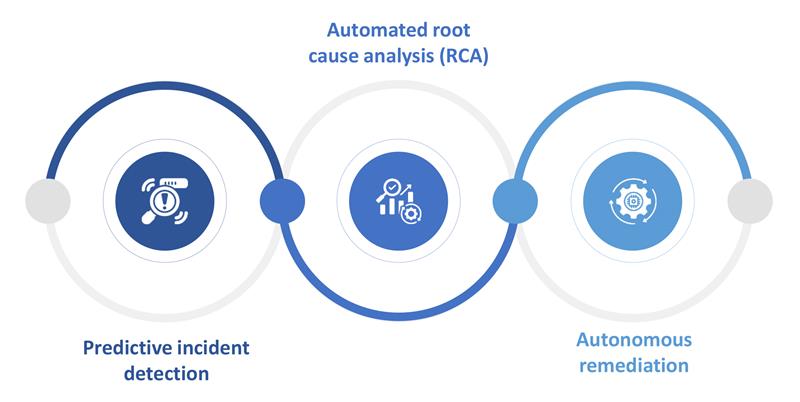
Concretely, this means:
-
Predictive incident detection: ML models trained on historical telemetry data identify failure precursors, unusual memory growth, latency spikes, pod restart patterns, and alert teams 15–30 minutes before user impact.
-
Automated root cause analysis (RCA): Instead of engineers sifting through 500 log lines at 3 AM, LLM-powered RCA tools correlate events across services, pinpoint the likely root cause, and even suggest remediation steps.
-
Autonomous remediation: For well-understood failure modes, AI-driven runbooks can execute fixes automatically, restarting degraded pods, scaling out overloaded services, and rerouting traffic without human intervention.
According to Gartner, by 2026, 40% of all IT operations tasks will be augmented by AI, up from less than 10% in 2020. Enterprises that adopt AIOps now are building a reliability advantage that will be very hard to replicate later.
At Calsoft, our AI-LLM evaluation services and AI-powered operations frameworks are purpose-built for enterprise environments. We help teams instrument their observability stack, using tools like Prometheus, Grafana, OpenTelemetry, and custom LLM pipelines, to build AI-driven reliability into production systems, not just proofs-of-concept.
How Calsoft drives enterprise DevOps transformation
Calsoft's DevOps and SRE practice is built around one core belief: transformation is not a tool purchase, it's an engineering discipline.
Our engagement model is structured around three layers of value:
1. Foundation: DevOps engineering & CI/CD modernization
We audit your existing pipelines, identify bottlenecks, and redesign your CI/CD architecture for scale. This includes build optimization, test intelligence, deployment strategy (blue-green, canary, feature flags), and GitOps implementation. Clients typically see:
-
35–45% reduction in deployment time
-
50%+ reduction in pipeline failures through intelligent gate-keeping
-
Compliance-ready pipelines aligned with SOC 2, ISO 27001, and DORA metrics
2. Intelligence: AI & LLM integration into DevOps workflows
Our AI engineering team integrates LLM-based tools for code review automation, intelligent alerting, and RCA acceleration. We also offer LLM fine-tuning services for organizations building proprietary AI models for internal DevOps tooling.
For a storage technology client, Calsoft deployed an AI-powered log analysis system that reduced mean time to detect (MTTD) incidents by 62%, freeing SRE engineers to focus on capacity planning and reliability architecture instead of manual log triage.
3. Resilience: SRE consulting & reliability engineering
We embed SRE best practices, SLOs, SLIs, error budgets, and toil reduction into your engineering culture. Our SRE consulting engagements don't just advise; they co-build. Calsoft engineers work alongside your team to implement reliability frameworks that are measurable, auditable, and scalable.
This holistic approach, CI/CD automation + AI integration + SRE rigor, is what differentiates Calsoft's enterprise DevOps transformation services from tool-specific implementations.
The future of enterprise DevOps is already here
The shift from CI/CD automation to AI-driven reliability is not a distant trend; it's the operating reality of high-performing engineering organizations today. The question for enterprise leaders in 2026 is not whether to transform, but how fast and how intelligently.
At Calsoft, we bring deep engineering expertise, AI-native tooling, and battle-tested SRE frameworks to help enterprises navigate this transformation with confidence, not chaos.
Whether you're starting your DevOps modernization journey or scaling an existing SRE practice, we're ready to partner with you.
FAQs
Q1: What is the role of AI in DevOps transformation?
AI enhances DevOps transformation by enabling predictive incident detection, automated root cause analysis, and intelligent remediation. Instead of reacting to failures, AI-powered systems analyze telemetry patterns in real time to prevent outages before they affect users — dramatically improving MTTR and overall system reliability.
Q2: How can enterprises implement CI/CD automation successfully?
Successful CI/CD automation starts with a pipeline audit to eliminate manual bottlenecks, followed by the adoption of tools like ArgoCD, Tekton, or GitHub Actions with intelligent quality gates. Enterprises should prioritize test intelligence, automated security scanning (DevSecOps), and canary deployment strategies, and measure success using DORA metrics: deployment frequency, lead time, change failure rate, and MTTR.
Q3: Why is AI-driven reliability crucial for enterprise DevOps?
As enterprise systems grow more complex — multi-cloud, microservices, AI workloads — traditional monitoring cannot scale. AI-driven reliability uses machine learning to detect anomalies, correlate cross-service signals, and trigger automated responses in milliseconds. For enterprises with SLAs tied to revenue, this translates directly to reduced downtime, lower operational costs, and higher customer trust.