

Why should businesses care about microservices? A short and crisp answer to this question can be powerfully summed up in four sentences.
Migrating from a monolithic architecture to microservices has the potential to affect several factors responsible for the growth and seamless operations of any organization. This includes improved efficiency, scalability, and agility. By adopting microservices, businesses gain a competitive edge — boosting team productivity, enabling faster deployments, enhancing fault tolerance, and achieving all this cost-efficiently.
Additionally, there are several other advantages of moving from a monolith to microservices. Teams often opt for this approach when they encounter one or more of the following challenges:
- The monolithic application becomes difficult to scale as the codebase grows in complexity.
- Businesses face reliability issues since a failure in one component can take down the entire system.
- The monolithic structure enforces a waterfall-style development process, slowing down developer velocity.
Microservices have rapidly gained popularity and adoption in recent years. According to an O’Reilly survey, 77% of businesses have adopted microservices, and around 92% of them reported success. Meanwhile, an IBM report highlighted benefits such as improved customer retention, enhanced data security, greater flexibility, and increased employee productivity.
In parallel, hybrid and multi-cloud strategies are becoming mainstream. Businesses are increasingly using multiple cloud platforms to avoid vendor lock-in, enhance flexibility, and optimize workloads across diverse environments. This trend is driving innovation and operational resilience.
Combining microservices with hybrid and multi-cloud environments can unlock immense scalability, flexibility, and efficiency — provided it’s done strategically. This blog explores key strategies to simplify microservices deployment in such environments and ensure optimal resource management.
Decoding Monolithic Architecture and Microservices: An In-Depth Overview
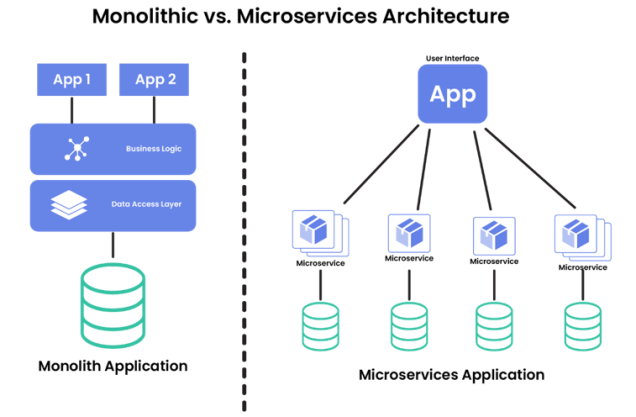
The image compares Monolithic and Microservices architectures. A monolithic application centralizes business logic and data access, while microservices distribute functionality across independent services — each with its own database — promoting flexibility and scalability.
What is Monolithic Architecture?
A monolithic architecture is a traditional software model built as a single, unified unit. It has one large codebase that combines all business logic and application layers. While it simplifies code management and deployment in early stages, making updates later requires rebuilding and redeploying the entire stack, which becomes cumbersome.
What are Microservices?
Microservices are a modern, cloud-native approach to application development, where independent services communicate via lightweight APIs. Each service handles a specific function and can be developed, deployed, and scaled independently. This architecture empowers development and operations teams to work in parallel without dependency bottlenecks.
Demystifying Microservices: Core Concepts
| Core Concept | Description |
|---|---|
| Decentralized Governance | Teams choose tools and technologies independently for each service. |
| Componentization via Services | Each microservice is an independent component that can be developed and deployed separately. |
| Smart Endpoints, Dumb Pipes | Services handle their logic; communication remains simple via APIs or messaging systems. |
| Decoupling of Services | Minimal interdependency allows easy scaling and maintenance. |
| Continuous Delivery | Supports frequent deployments and faster iterations. |
| Scalability | Each service can scale independently based on demand. |
| Resilience | Failure in one service doesn’t affect others, ensuring system stability. |
| Autonomous Teams | Teams work independently on their services without cross-dependencies. |
| Technology Diversity | Teams can use different tech stacks suited to each service. |
Navigating the Hybrid and Multi-Cloud Landscape
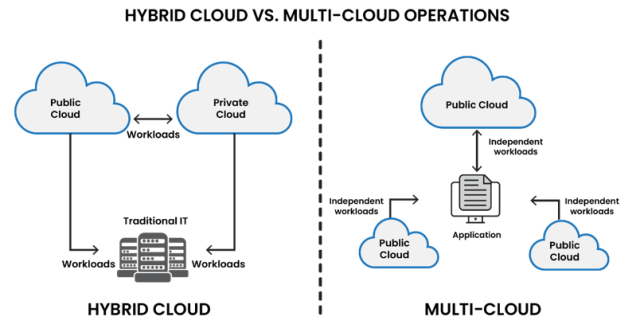
A hybrid cloud integrates public and private clouds, enabling workload movement between them and traditional IT environments. A multi-cloud setup, however, uses multiple public clouds independently for various workloads.
Hybrid Cloud
Hybrid cloud combines on-premises infrastructure with public and private clouds, enabling flexible workload management. It helps reduce costs, minimize risks, and facilitate digital transformation by integrating existing systems with cloud services.
Multi-Cloud
Multi-cloud involves deploying workloads across multiple cloud providers such as AWS, Azure, or Google Cloud. This strategy prevents vendor lock-in, improves reliability, and optimizes performance. Businesses can leverage the best services from different providers for cost efficiency and performance.
Understanding What Gets Microservices Ticking
Microservices differ from traditional application components because they’re designed to be shared across multiple applications. They rely on RESTful interfaces and lightweight communication mechanisms. To maximize their benefits, IT teams must ensure these characteristics are preserved — especially in hybrid or multi-cloud deployments.
Deployment Strategies for Microservices in Hybrid and Multi-Cloud Environments
- Design for Portability: Use Docker or Kubernetes for containerization to simplify deployment across environments.
- Leverage API Gateways: Centralize routing, monitoring, and security through gateways like Kong or Istio.
- Implement Centralized Monitoring: Tools like Prometheus and Grafana help track performance across environments.
- Adopt DevOps Practices: Automate deployment pipelines (CI/CD) to ensure consistency and faster delivery.
- Ensure Security & Compliance: Enforce unified identity, access, and encryption policies across clouds.
- Use Cloud-Native Tools: Kubernetes, Istio, and Terraform simplify orchestration and scalability.
- Optimize Workload Placement: Deploy services where they perform best, balancing cost and compliance.
- Enable Cross-Cloud Networking: Use VPNs or cloud interconnects for seamless communication between clouds.
Deploy Microservices Securely
When multiple applications share microservices, risks like compliance violations and security breaches increase. Secure each microservice individually and separate features with different compliance needs. Avoid mixing sensitive and open-access components within a single service.
Explore the Stateful vs. Stateless Issue
Applications supporting multi-step transactions face challenges maintaining state across distributed environments. For instance, if a service receives two sequential requests, other users could interrupt the sequence. Stateless architectures mitigate this risk by processing each request independently.
Technologies & Tools for Microservices Deployment
| Category | Tool | Description | Best Suited For |
|---|---|---|---|
| Containers | Docker | Containerization platform for packaging microservices. | Portable and scalable deployments. |
| Orchestration | Kubernetes | Automates deployment and scaling of containers. | Managing clusters across clouds. |
| API Management | Kong, Istio | API gateways and service meshes for microservice communication. | Cross-cloud service management. |
| CI/CD Pipelines | Jenkins, GitLab CI/CD | Automates integration and delivery of updates. | Continuous deployment workflows. |
| Monitoring | Prometheus, Grafana | Real-time monitoring and visualization. | Tracking performance and uptime. |
| Load Balancing | HAProxy, NGINX | Distributes network traffic efficiently. | Optimizing performance across clouds. |
Impact of Microservices in Hybrid and Multi-Cloud Environments
Microservices enhance scalability, flexibility, and resilience across hybrid and multi-cloud environments. Their modular nature enables independent scaling and deployment, ensuring business continuity even when one service fails. However, managing cross-cloud communication, latency, and network dependencies remains crucial for optimal performance.
Challenges of Hybrid and Multi-Cloud Architectures
Despite their advantages, hybrid and multi-cloud environments bring challenges:
- Increased Management Complexity: Multiple platforms and APIs complicate integration and monitoring.
- Data Security & Compliance: Varying standards across providers increase risk exposure.
- Latency & Performance: Distributed services can introduce network delays affecting performance.
Conclusion
Microservices enable agility, scalability, and fault isolation — key advantages for modern cloud applications. Whether deployed on hybrid or multi-cloud infrastructures, they empower faster innovation and cost efficiency.
Calsoft, a technology-first company, takes pride in being a trusted software product engineering partner for global ISVs and enterprises. Our cloud service offerings help organizations develop next-generation solutions across IaaS, PaaS, and SaaS ecosystems, accelerating innovation and business growth.