

Nobody creates a ‘DevOps team’ expecting it to become the new bottleneck.
But talk to engineers at any mid-size enterprise six months after the reorganization, and the story is usually the same. Deployments got faster. Incidents got more frequent. The post-mortems got longer. And somewhere in the middle of all that, an on-call engineer started muting alerts at 2 am — not out of laziness, but because nine of the last eleven had resolved themselves before anyone could respond. The tenth didn't.
That moment — the muted alert — is where the DevOps vs. SRE debate actually lives.
Speed without a floor is just controlled falling
Most enterprises have a CI/CD pipeline. CI/CD, Continuous Integration and Continuous Deployment, is the automated process of moving code from a developer's commit straight to production. It removes friction. That's exactly what it's supposed to do.
The problem is what got left behind.
Nobody built the floor. Nobody asked: what happens when the system on the other end can't absorb what the pipeline keeps throwing at it? Velocity became the metric. Stability became someone else's problem. And ‘someone else’ never showed up with the authority to actually own it.
SRE was designed to fill that gap. Site Reliability Engineering applies software engineering to operational problems — not as a philosophy, but as an engineering discipline with measurable targets. Error budgets, a pre-agreed threshold of acceptable unreliability before new feature deployment freezes, are the mechanism that forces velocity and stability to negotiate with each other. SLOs, Service Level Objectives, are the internal reliability targets that tell you when the system is degrading before a customer does.
DevOps without SRE is a faster pipeline into an unmanaged system. SRE without DevOps is a reliability practice with no authority over how fast code arrives. Both descriptions fit real teams in production right now.
According to DORA's 2023 State of DevOps Report, Google Cloud's survey of over 36,000 technology professionals, elite-performing teams are the ones that refuse to treat throughput and stability as a tradeoff. They achieve both. That finding has been consistent across ten years of DORA research. Which means if your organization is still framing this as a choice, the problem isn't technical. It's structural.
.png)
The reorganization that makes things worse
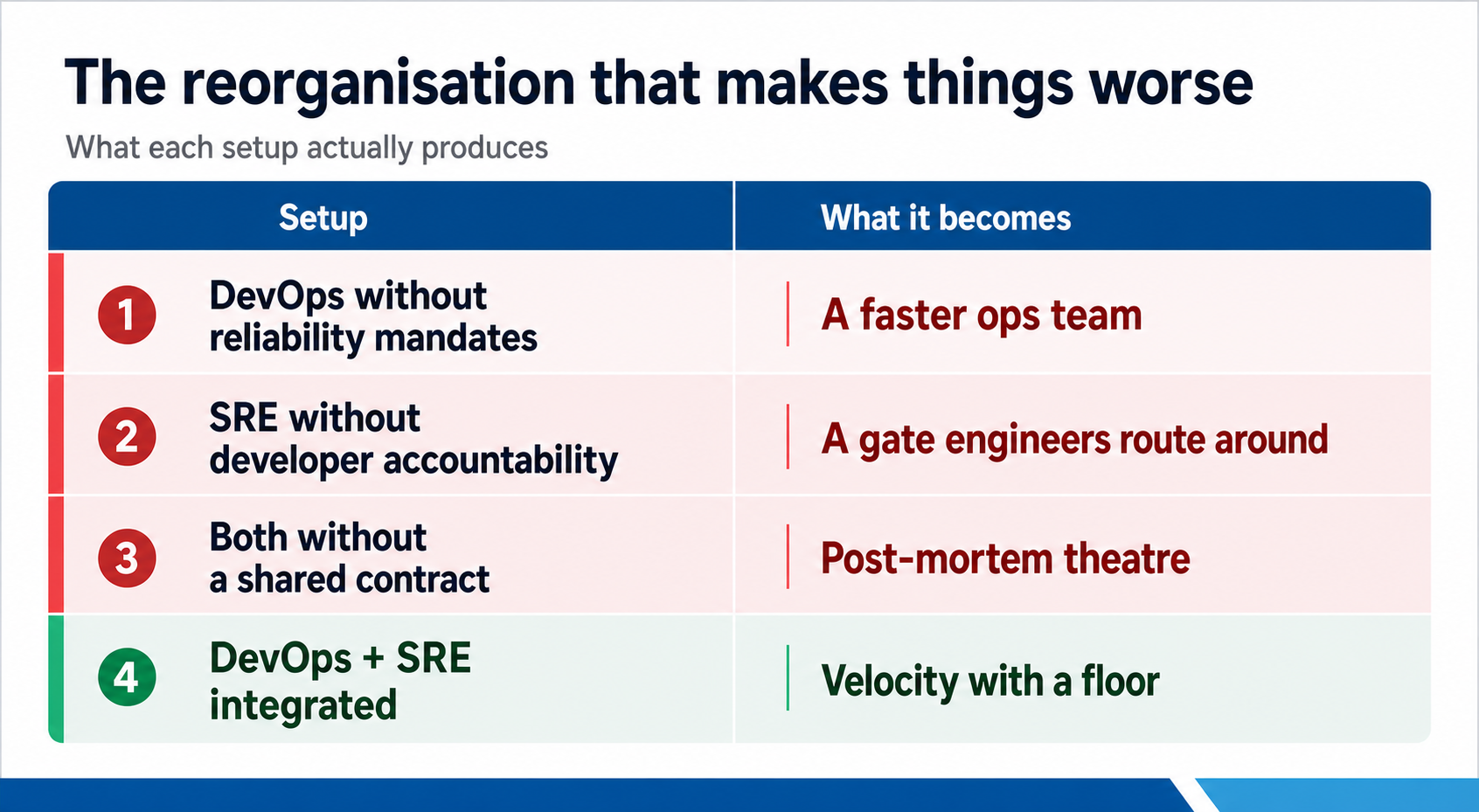
Here is what most CTOs do: they create a team.
A DevOps team. Or an SRE chapter. Or a platform engineering function, which is a third concept that is genuinely useful but often gets inserted between the two as a way of avoiding the harder conversation.
None of these moves are wrong. They are just premature. They name the solution before diagnosing what is actually broken.
A DevOps team without reliability mandates becomes a faster ops team. Faster tickets. Faster pipelines. Faster path to the same incidents. An SRE function without developer buy-in becomes a gate — something engineers learn to route around. And platform engineering teams without defined ownership boundaries inherit the tension between the other two functions without the authority to resolve it.
According to ITIC's 2024 Hourly Cost of Downtime Survey, an independent study of over 1,000 enterprises globally, the average cost of a single hour of downtime now exceeds $300,000 for over 90% of mid-size and large enterprises — not counting litigation or regulatory penalties. That number does not move by adding headcount. It moves when there is a shared contract between velocity and stability. A contract that says: here is how fast we can ship, here is how reliable the system must stay, and here is what happens when those two things come into conflict.
Most organizations do not have that contract. They have a post-mortem template.

What the integration gap actually costs
Calsoft's DevOps and SRE practice is built around a specific diagnosis: most enterprises don't fail at DevOps or SRE individually. They fail at the handoff.
The monitoring exists. The CI/CD pipeline runs. The dashboards are live. What is missing is the operating model that connects those components to decisions. Who owns a degraded SLO? What does an error budget freeze actually trigger in sprint planning? When does a reliability incident have the standing to push back on a release?
The work is in those questions. Not in adding more tooling.
That means building SLO governance that feeds back into engineering processes, not just reporting. It means designing observability — the practice of understanding system behavior through the signals it emits — to surface actionable alerts rather than noise. It means reducing toil, the manual operational work that scales with traffic but produces no lasting structural improvement, until engineers have the capacity to prevent incidents instead of just responding to them.
Google's SRE model sets a hard ceiling: no more than 50% of an SRE's time on toil. Above that, you no longer have a reliability practice. You have a rotating firefighting shift.
Most enterprises don't fail at DevOps or SRE in isolation — they fail at the handoff between the two. Calsoft's One-pager maps exactly where that handoff breaks down. Download the One-pager
What an in-house team cannot compress
Building this capability internally is possible. Most engineering organizations have the raw talent.
What they don't have is pattern density. An internal SRE team optimizes for one environment. The failure modes they encounter feel novel because they are new to that system. They are rarely new.
Runbooks that are perpetually out of date. Dashboards that display everything and signal nothing. Alert thresholds calibrated to the last incident rather than the next one. These patterns show up across industries, across infrastructure stacks, across team sizes. A partner who has already debugged the same failure in three other organizations does not eliminate the learning curve. It compresses it in ways that are difficult to quantify until you measure what it cost to learn without them.
The real question is not whether to build this in-house. It is what the gap between today and functional costs — measured in incidents, SLA penalties, and the quiet attrition of engineers who are tired of being on call for alerts they no longer trust.
FAQs
Should DevOps come before SRE, or can both run in parallel?
Parallel is possible but rarely efficient. Without stable deployment automation, SRE practices have nothing consistent to measure against — error budgets require velocity to be meaningful. The practical approach is establishing CI/CD foundations first, then layering SRE governance. The planning for both, however, should happen simultaneously. Teams that sequence the thinking sequentially end up rebuilding their reliability framework from scratch.
How do we measure whether our DevOps & SRE investment is actually working?
Three numbers matter: mean time to recovery after incidents, the percentage of engineering time absorbed by toil versus proactive work, and SLO compliance across rolling 30-day windows. If toil is above 40% of engineering capacity, the investment is running as overhead, not as discipline. That distinction is the difference between a team that responds to failures and one that reduces them.
What is the difference between platform engineering and SRE?
Platform engineering builds the internal infrastructure other teams deploy onto — its mandate is reducing cognitive load and standardizing tooling. SRE governs how reliably those systems run in production. They are complementary, not interchangeable. Conflating them produces teams with ambiguous mandates, metrics that don't connect to business outcomes, and accountability gaps that only become visible during incidents.