

Many enterprises have tested large language models over the past two years. Some teams built internal chat interfaces. Others automated isolated workflows. Initial results often looked promising. Over time, the outcomes varied.
In several organizations, usage slowed after early instability. Outputs required manual correction. Retrieval lacked consistency. Deployment practices were unclear. In other environments, AI capabilities expanded steadily across teams.
The difference was rarely the model itself. It was the structure around it.
Across seven real Custom LLM and RAG implementations, a consistent pattern emerged. Stable results appeared when domain clarity, retrieval discipline, workflow integration, and lifecycle governance were treated as core engineering responsibilities rather than add on features.
These case studies span engineering automation, infrastructure provisioning, healthcare operations, multilingual systems, support intelligence, and distributed edge environments. Despite industry differences, the sequence of progress was similar.
Download white paper: Top 7 real successful Custom LLM, RAG, and Gen AI case-studies
What the 7 Custom LLM, RAG, and Gen AI case studies reveal
-
The first step was always domain grounding. Teams defined vocabulary, entities, response boundaries, and workflow expectations. Proprietary datasets were curated carefully. Without this step, outputs remained generic and required oversight.
-
The second step was retrieval foundation. Enterprise documents and operational data were normalized and indexed. Semantic search was introduced. Metadata standards were defined. Context grounding improved response quality and reduced ambiguity.
-
The third step was model alignment. Fine tuning on domain specific datasets improved relevance. Evaluation benchmarks were introduced. Structured output schemas reduced integration friction with downstream systems.
-
The fourth step was workflow embedding. Language models were integrated with APIs and operational platforms. Inference became part of CI pipelines, ticket systems, provisioning workflows, and knowledge portals. AI shifted from interface to infrastructure.
-
The final step was lifecycle governance. Monitoring dashboards tracked usage and latency. Version control frameworks ensured stable rollout. Drift monitoring and retraining cycles preserved performance as data evolved.
Each case followed this progression in its own timeline. None skipped foundational steps without later correction.
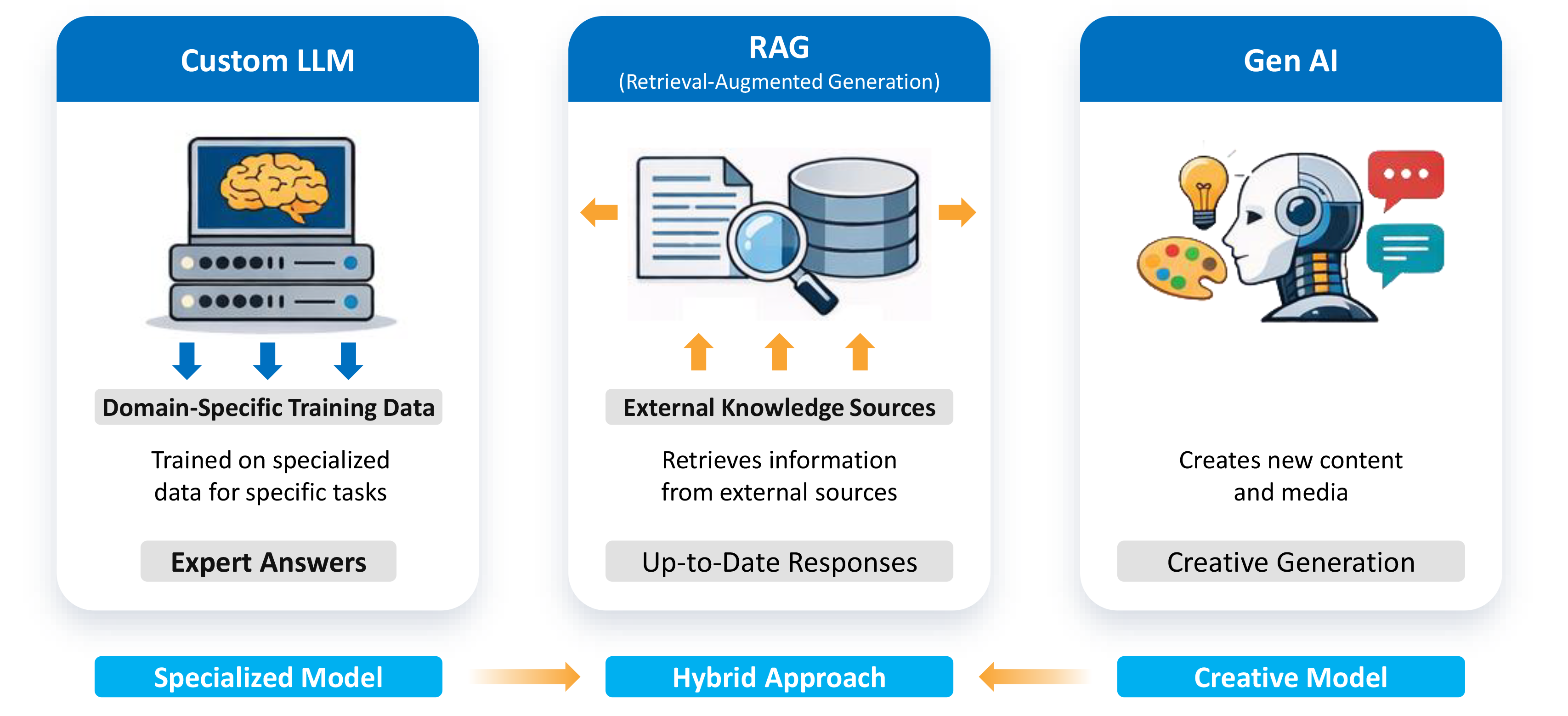 How Custom LLM, RAG, and Generative AI differ in enterprise deployments.
What measurable impact looked like
Across these implementations, impact was measurable and operational.
Knowledge retrieval time reduced significantly once retrieval architecture was structured. Support ticket classification improved when proprietary datasets were used for model alignment. Engineering teams generated deployment artifacts in seconds rather than hours. Documentation cycles shortened when structured outputs were enforced. Provisioning workflows stabilized when language models were integrated with validated execution logic.
Healthcare and regulated environments improved information accessibility without exposing sensitive data externally. Distributed edge deployments achieved version consistency and better visibility into model performance.
 Download white paper: Top 7 Custom LLM successful case studies
These gains did not appear immediately after deploying a model. They appeared after retrieval, integration, and monitoring controls were formalized.
Early stage deployments produced usable but inconsistent responses. Structured retrieval improved contextual grounding. Custom fine tuning aligned outputs to enterprise logic. Integration into workflows created efficiency gains. Monitoring and retraining preserved long term performance.
Custom LLM and RAG systems delivered value when engineered as production systems.
What this means for enterprise leaders
-
For board members and CXOs, the implication is practical. Custom LLM initiatives require clear business outcomes, phased investment, and cost visibility. Productivity gains accumulate when domain alignment and governance are prioritized early. AI should be evaluated against operational KPIs, not demonstration metrics.
-
For CIOs and enterprise architects, retrieval architecture is foundational. Enterprise knowledge must be structured before generation is scaled. API integration must be controlled. Observability must be integrated into existing monitoring frameworks. Deployment standards must align with platform practices.
-
For engineering leaders, reliability drives adoption. Inference services should integrate with CI pipelines. Rollback controls must exist for model updates. Latency and throughput should be monitored under production load. Structured outputs reduce downstream friction.
-
For data science and ML leaders, proprietary fine tuning and evaluation discipline are essential. Retrieval relevance must be tested alongside model accuracy. Drift monitoring and retraining triggers protect long term performance. Model metrics should connect directly to workflow impact.
FAQs
1. What makes Custom LLM and RAG implementations successful?
Successful implementations rely on domain alignment, structured retrieval, workflow integration, and continuous lifecycle governance rather than just model selection.
2. Why do many enterprise LLM projects fail after initial success?
Early deployments often lack retrieval consistency, domain grounding, and monitoring, leading to unstable outputs and reduced long-term adoption.
3. How does RAG improve enterprise AI performance?
RAG improves performance by grounding responses in enterprise data through structured retrieval, reducing hallucinations and increasing contextual accuracy.
Would this be what you’re company is looking for? Drop in for a chat and let’s talk about how Calsoft’s LLM Eval as a Service can help you.