

Enterprise AI has moved beyond experimentation. It now supports customer interactions, internal knowledge access, analytics, and decision support. That shift changes the risk profile. When AI output influences actions, a weak response is no longer a minor defect. It can affect customer communication, policy alignment, operating decisions, and business confidence. The paper makes this clear.
AI systems can appear useful while still producing errors tied to accuracy gaps, hallucinations, logical inconsistency, or weak retrieval quality.
This matters even more now because adoption is rising quickly. At the same time, McKinsey says inaccuracy is the AI related risk organizations most often report experiencing and working to mitigate. The issue is no longer access to models.
The issue is whether enterprises can trust AI systems as those systems keep changing in production.
The trust gap usually starts quietly. A team launches a copilot or assistant. Early results look promising. Then prompts change, retrieval logic shifts, or a model update alters response quality. Users start checking outputs manually. Teams hesitate to use AI in important workflows.
Leadership sees adoption, but does not see stable confidence. The solution report (given below) describes this pattern well. When performance cannot be measured clearly, organizations struggle to scale usage with control.
Download full solution report: Custom LLM Eval as a Service | Complete guide
What structured LLM evaluation actually solves
A structured evaluation layer solves a practical business problem. It gives the organization a repeatable way to measure, validate, and monitor how an AI system behaves. In most enterprise settings, AI systems do not stay still. Models are upgraded. Prompts are tuned. Retrieval behavior is adjusted. Knowledge sources evolve. Each change can alter output quality in ways that are hard to detect early. Without evaluation, issues often surface through user complaints, escalations, or inconsistent decisions.
Calsoft’s Custom LLM Evaluation as a Service addresses this by placing evaluation alongside the AI system as a continuous operating layer. It uses datasets that define expected behavior, evaluation pipelines that test each change, scoring systems that assess response quality at scale, monitoring that tracks live performance, and reporting that gives visibility to engineering and business teams.
The value here is simple. The enterprise gets evidence before release, visibility during production, and better control over how the system evolves. That is what turns AI trust into an operating discipline instead of a hope. This approach also fits a wider business trend.
PwC reports that nearly 60% of executives say responsible AI improves ROI and efficiency, and 55% say it improves customer experience and innovation.
That is relevant here because evaluation is one of the practical mechanisms that helps responsible AI move into daily operations. It gives leaders a clearer basis for release decisions, governance, and scale.
Custom LLM and RAG adoption requires domain alignment, accurate retrieval, disciplined deployment, and strong governance for consistent enterprise performance.
Download whitepaper: Top 7 Custom LLM Case Studies with Real Impact
How the evaluation layer works in real enterprise scenarios
Customer support assistant
Consider a customer support assistant that answers product questions, guides users through troubleshooting, or supports service teams. In a steady state, the assistant may appear reliable. Then a prompt change or a retrieval shift introduces incomplete answers, policy drift, or weak grounding. Support teams start reviewing responses manually. Escalations rise. Confidence drops.
In this situation, evaluation begins with strategy and metric design. The team defines what good performance means for the use case. It may include response accuracy, policy adherence, groundedness, latency, and cost. A golden dataset is then built using common support queries, edge cases, and policy sensitive scenarios.
Automated validation checks every material system change against this baseline before release. Production monitoring continues the work by sampling live interactions and checking for drift, hallucinations, and response inconsistency. Reporting closes the loop by showing trends, failure patterns, and version level changes to the support and product teams.
Internal knowledge assistant
Now consider an internal knowledge assistant used by employees for IT support, HR policies, operations guidance, or document lookup. These systems often win quick adoption because they save time. They also face a quiet risk. Documentation changes. New policies are added. Retrieval quality weakens. A model update changes tone or precision. Performance looks stable until employees start getting partial or unsupported answers.
This is where retrieval evaluation becomes especially important. The framework checks whether the retrieved content actually supports the final answer. It also helps teams identify cases where the system sounds correct but lacks grounding in approved sources.
Observability and reporting give engineering and business stakeholders a clear view of what changed, where performance is slipping, and how the current version compares with prior baselines. That matters because internal AI systems shape employee productivity, operating consistency, and trust in shared knowledge. If those systems become unreliable, users return to manual search and parallel workarounds.
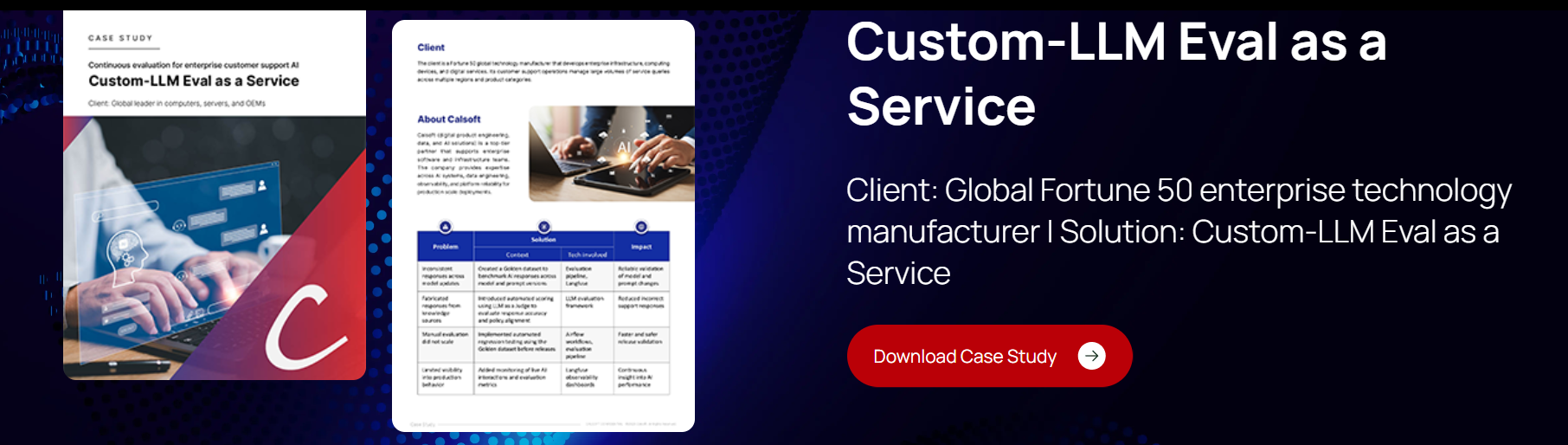
Download case study: Fortune 50 company deploys Calsoft’s LLM Eval as a Service
Decision support and document generation
A third scenario involves document generation, enterprise search, or decision support tools. These systems often influence market planning, sales guidance, contract analysis, analytics, or strategic review. The cost of inconsistency is higher here because the output can affect planning choices and customer commitments.
In this case, structured evaluation helps leadership ask sharper questions. Does the system stay aligned with policy after each update? Are outputs grounded in relevant source material? Has response quality shifted after retrieval tuning? Are latency and cost still within acceptable thresholds?
Offline evaluation pipelines compare current behavior with established baselines before release. Structured reporting then provides a measurable view of reliability, operating cost, and system behavior over time. This is valuable because leadership does not need more AI activity. It needs controlled AI activity that can support business decisions with confidence.
What this changes for the business
Structured evaluation improves enterprise AI because it adds control before defects reach users or influence decisions. It gives teams a consistent way to validate change, monitor live behavior, and manage release quality using measurable criteria. For heads of business and technology, this matters because AI value depends on stable operations, predictable quality, and confidence in scale. The paper presents a clear impact view across release stability, issue detection, cost efficiency, operational risk, and decision confidence.
- Up to 60% lower change failure rates
- 30 to 60% reduction in release related instability
- 75 to 90% faster issue detection
- Detection cycles reduced from weeks to days
- 15 to 25$ improvement in cost efficiency
- Lower risk of customer impact and escalation
- Greater confidence in deploying and scaling AI systems
These gains matter because they improve core operating competencies across the client organization. Engineering teams can validate changes with more confidence. Product teams can define clearer quality thresholds for AI features.
Support teams can reduce escalation risk in customer facing workflows. Leadership gains better visibility into reliability, cost, and operational exposure. Over time, that supports a wider AI footprint across the business. It allows organizations to move into more sensitive workflows with stronger governance and less uncertainty. It also supports longer term market coverage because the business is able to scale AI use without scaling unmanaged risk.
Enterprise AI becomes trustworthy when the organization can measure behavior, validate change, and maintain control as the system evolves. That is the practical case for a structured evaluation layer. It helps enterprises move ahead with stronger evidence, clearer governance, and better operating confidence.
For CXOs, that is what turns AI into an asset the business can rely on.
Would this be what you’re company is looking for? Drop in for a chat and let’s talk about how Calsoft’s LLM Eval as a Service can help you.