

Network Operations Center (NOC) support services evoke reliability, seamless operations, reduced downtime, and robust management of an organization’s IT infrastructure. When we think of NOC, it brings to mind elements like continuous real-time monitoring, proactive issue resolution, performance optimization, and strong security management — all critical for keeping a network safe, secure, and operational.
According to a report by the Ponemon Institute, an unplanned outage can be extremely costly. The most expensive ones can cost businesses over $17,000 per minute, with the average incident costing around $9,000.
Downtime is just one aspect covered under NOC support services. There’s much more that keeps business networks up and running, ensuring uninterrupted operations and productivity.
This blog explores everything you need to know about NOC support services — including an overview, key components, types, functions, choosing the right NOC services, best practices, and future outlook.
Decoding NOC Support Services
The network is the heart of every business. It enables communication, data storage, and critical business functions. On the technical front, Network Operations Centers (NOCs) — often pronounced as “knock” — are centralized hubs where IT professionals monitor, manage, and maintain an organization’s network.
NOCs handle network monitoring, patch management, incident response, backup, and recovery to ensure optimal performance. They also work closely with security teams to mitigate threats. By proactively managing network operations, NOCs help prevent downtime, improve efficiency, and ensure smooth, secure digital connectivity.
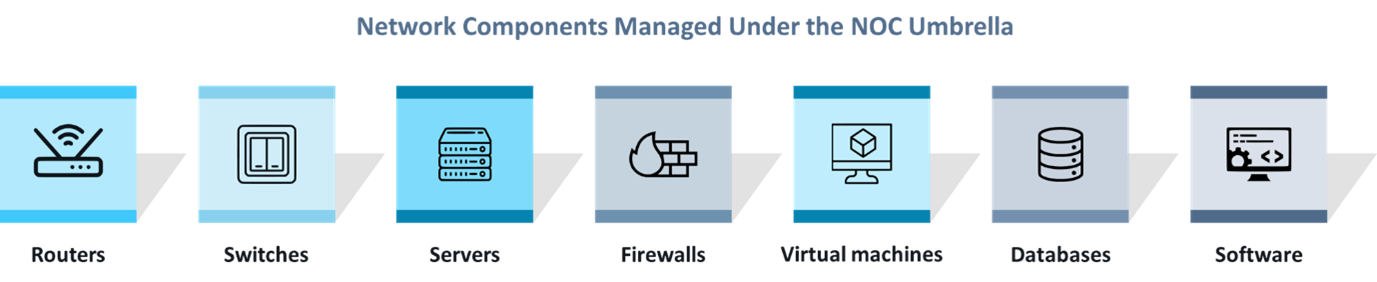
Large enterprises often seek NOC expertise to manage complex infrastructures, while small and mid-sized businesses benefit from these services when internal talent is limited. A typical NOC includes multiple monitoring tools, screens, and professionals ensuring uninterrupted business operations. Over time, NOCs have evolved to manage not just network devices but also cloud services, software distribution, and other digital infrastructure components.
Key Functions of a Network Operations Center (NOC)
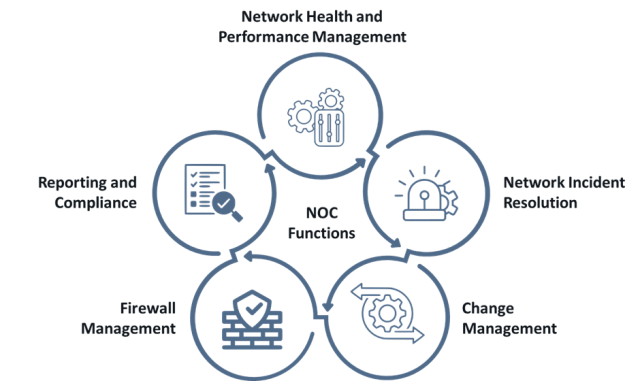
Networks can be managed in-house or outsourced to third-party providers. Here are the primary functions of NOC support services:
Network Health and Performance Management
Monitoring the network 24/7 helps detect unusual activities and unauthorized access. Regular performance checks allow businesses to identify issues early and prevent major disruptions. This ensures seamless operations and optimal performance of business applications.
Network Incident Resolution
NOC systems continuously monitor the network, detect problems, and resolve them before they escalate. This proactive approach minimizes downtime and maintains stability through fast incident response and troubleshooting.
Change Management
Change management involves overseeing hardware/software upgrades and configuration adjustments. NOC ensures seamless integration with minimal disruption and keeps detailed change logs for risk mitigation and operational stability.
Firewall Management
Firewalls are critical for network security. NOCs assist in monitoring and maintaining firewall performance to prevent unauthorized access and strengthen defense against cyberattacks.
Reporting and Compliance
Reporting and compliance are key components of NOC services. Teams generate detailed reports on network performance, incidents, and security breaches. Regular reports on firewall logs, traffic, and bandwidth usage help improve processes and maintain compliance standards.
Choosing the Right NOC Services
Selecting the right NOC model — in-house or outsourced — depends on your organization’s size, budget, and technical requirements.
An in-house model offers full control but comes with higher costs and resource demands. Outsourced NOC services are cost-efficient, scalable, and provide access to 24/7 expertise.
| Context | In-House NOC | Outsourced NOC |
|---|---|---|
| Cost | High initial investment | No setup cost; subscription or contract-based pricing |
| Expertise | Depends on internal talent | Access to a wide range of skilled professionals |
| Scalability | Limited scalability | Highly scalable; adjusts to business demand |
| Response Time | Depends on team availability | Quick response based on SLAs |
| Resource Availability | Available during business hours | 24/7 support from provider |
| Implementation Time | Faster setup | Longer setup due to onboarding |
| Security & Compliance | Managed with internal policies and tools | Provider follows strict compliance and global standards |
| Innovation & Upgrades | Frequent updates with internal control | Relies on vendor roadmap and upgrade cycle |
Best Practices in NOC Support
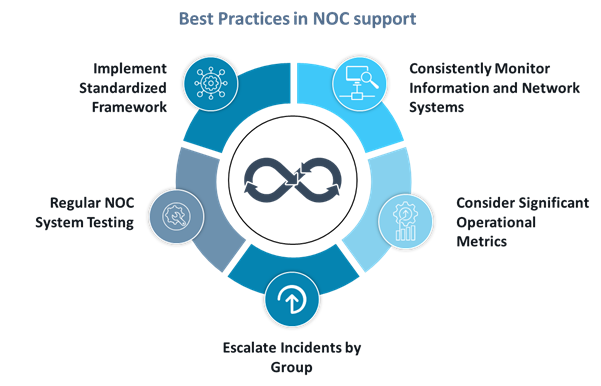
To maintain a resilient network and high system availability, NOC teams should follow these best practices:
1. Consistent Monitoring of Systems
Proactive monitoring prevents issues before they escalate. Regular tracking helps detect anomalies early, avoiding costly downtime and preserving business continuity.
2. Focus on Relevant Metrics
Monitor performance indicators that align with business goals. Key KPIs include FCR (First Call Resolution), MTBF (Mean Time Between Failures), MTTR (Mean Time to Restore), and CSAT (Customer Satisfaction).
3. Escalate Incidents by Group
Group-based incident escalation ensures quick issue assignment to the right personnel, improving resolution times and resource utilization. Incident management tools can automate this efficiently.
4. Regular System Testing
Frequent testing reveals vulnerabilities and ensures readiness for potential disruptions. Routine evaluations enhance recovery strategies and minimize downtime risk.
5. Implement a Standardized Framework
Standardized frameworks streamline workflows, reduce errors, and ensure consistent operations across teams. This leads to faster turnaround times and better service quality.
Future Trends in NOC Support Services
NOC services are evolving alongside technologies like AI, IoT, and cloud computing. As business infrastructures become more complex, NOCs must adopt smarter, more agile systems to deliver value.
- Artificial Intelligence (AI) and Machine Learning (ML): AI and ML automate repetitive tasks, detect anomalies, and assist in predictive maintenance, enabling teams to focus on strategic initiatives.
- Automation and Orchestration: Automating service provisioning and workflows boosts efficiency and allows human operators to focus on innovation.
- Cloud Computing: As hybrid and multi-cloud environments expand, NOCs are leveraging cloud-native tools for scalable monitoring and security.
- Internet of Things (IoT): Managing numerous connected devices demands enhanced visibility, interoperability, and threat protection capabilities from modern NOCs.
Conclusion
In today’s fast-paced IT landscape, businesses must ensure their networks are resilient and secure to deliver consistent service quality. NOC services act as the backbone of modern enterprises, enabling continuity, performance, and trust.
The future of NOC services lies in automation, AI, and adaptive frameworks that evolve with technology. Companies must have a well-defined strategy to leverage these advancements effectively.
Calsoft, being a technology-first organization, understands the significance of robust network operations. Our NOC support services provide 24/7 monitoring, proactive maintenance, and incident resolution to ensure uninterrupted business operations.