

The telecommunications industry stands on the edge of a fundamental transformation. While 5G deployment continues globally, research and early testbeds for 6G are already redefining what’s possible in wireless communication. One of the most significant shifts in this next-generation journey is the integration of Cognitive Radio (CR) into the core fabric of 6G architecture—making it a critical component of future 6G wireless networks.
CR introduces real-time intelligence, spectrum adaptability, and autonomous decision-making—making it essential for next-gen telecom infrastructure. As telcos face growing pressure from data-heavy applications, ultra-low latency demands, and spectrum scarcity, Cognitive Radio will play a pivotal role in staying competitive.
Read on to explore how Cognitive Radio is shaping the future of 6G networks—and what it means for telecom providers worldwide.
From Static Spectrum to Dynamic Intelligence
The traditional approach to spectrum allocation—fixed licenses and static frequency bands—is unsustainable in the era of exponential device growth and bandwidth-intensive applications like XR, holographic calls, and digital twins. Cognitive Radio (CR) disrupts this paradigm.
First introduced by Joseph Mitola in the late 1990s, Cognitive Radio is a self-aware radio system that senses its RF environment in real time and dynamically adjusts transmission parameters. This enables idle or underutilized spectrum to be temporarily accessed by secondary users without interfering with primary license holders—a concept known as Dynamic Spectrum Access (DSA).
This model offers clear business benefits. It helps Communication Service Providers (CSPs) leverage underutilized spectrum, onboard more users, and expand coverage—all without acquiring additional licensed bands. This leads to lower cost-to-serve and better market reach.
The rise of Software Defined Radios (SDRs) has already paved the way, providing the reconfigurability needed for CR functionality. Combined with Integrated Sensing and Communication (ISAC) and AI-native frameworks, spectrum management becomes autonomous, context-aware, and highly efficient.
Calsoft brings deep telecom expertise through its dedicated Networking & Telecom Center of Excellence. Our team supports end-to-end transformation—from legacy systems to modern, cloud-native architectures—spanning SDN, NFV, edge deployments, and network automation.
Read our eBrief to understand the growing significance of intelligent Radio Access Network (RAN).
Cognitive Radio in 6G: Why Now?
Why is Cognitive Radio becoming central to 6G—and why should telecom leaders take notice?
- Spectrum scarcity is real. As frequencies above 100 GHz are explored for 6G (e.g., terahertz bands), traditional spectrum management breaks down. CR enables fine-tuned, on-demand allocation based on user density, interference, and application priority. Terahertz bands (0.1–10 THz) unlock ultra-high-speed data and sub-millisecond latency, but managing their propagation challenges requires intelligent CR systems.
- AI-native architectures demand smarter infrastructure. Frameworks like O-RAN’s RIC and 3GPP’s AI initiatives are embedding intelligence deep within RAN. CR complements this by using ML models to optimize channel selection, power control, and modulation in real time—enhancing 5G’s core pillars: massive IoT, ultra-low latency, and enhanced mobile broadband.
- Cost-to-serve must drop. Telcos can no longer depend solely on adding infrastructure to fix performance gaps. CR-based systems improve utilization through adaptive beamforming, environment-aware routing, and interference mitigation—boosting performance without increasing capex.
Emerging Use Cases
Here are some of the most compelling Cognitive Radio applications in 6G already taking shape:
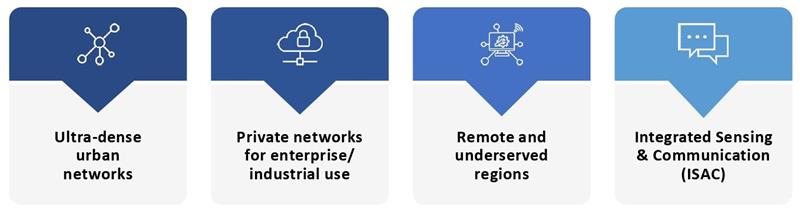
- Ultra-dense urban networks: In congested cities, CR dynamically offloads traffic across available frequencies, time slots, and spatial channels.
- Private networks for enterprise and industry: CR allows customized spectrum slices for mission-critical applications, especially in restricted-license environments.
- Remote and underserved regions: CR facilitates opportunistic spectrum sharing to deliver connectivity in economically or geographically challenging areas.
- Integrated Sensing & Communication (ISAC): CR pairs seamlessly with ISAC, enabling radios not just to transmit but to perceive—detecting motion, interference, and environmental factors, then adapting transmissions accordingly.
For instance, CR systems can forecast signal degradation caused by rain, fog, or snow and dynamically adjust power or frequency to reduce packet loss and maintain seamless connectivity.
Strategic Challenges Ahead
While the potential of Cognitive Radio is vast, several strategic and technical challenges remain:
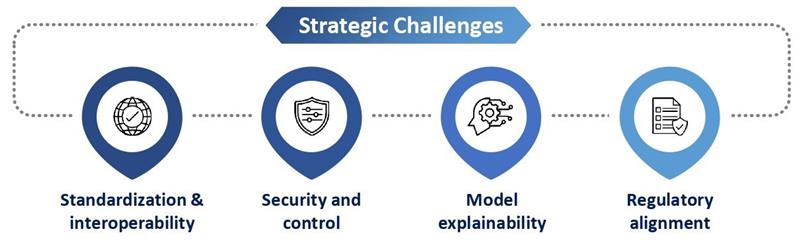
- Standardization & Interoperability: Lack of global CR standards, especially for AI-native RIC integration, could slow adoption.
- Security & Control: Autonomous decision-making introduces new security risks. Implementing strong authentication, access control, and fail-safes is vital.
- Model Explainability: As AI models make spectrum decisions, transparency and accountability will be essential for regulatory compliance.
- Regulatory Alignment: Dynamic access must respect licensed users. Close collaboration with regulatory bodies will shape CR deployment frameworks.
What Telcos Should Do Now
The move to cognitive, AI-driven 6G systems is inevitable. To prepare, forward-looking telecom providers should:
- Invest in SDR and AI/ML R&D within RAN and core network teams.
- Participate in global standardization efforts (3GPP, ITU, O-RAN).
- Collaborate with startups and research labs working on CR testbeds and ISAC integration.
- Strengthen AI readiness across OSS/BSS stacks to enable intelligent orchestration and automation.
The Road Ahead
Cognitive Radio isn’t just another checkbox in the evolution of wireless networks—it’s a shift from rigid, operator-controlled systems to adaptive, self-optimizing networks. It empowers telcos to support connected devices, smart cities, and immersive user experiences—without exhausting spectrum resources.
The future telco won’t just provide connectivity—it will run networks that think. That future begins with Cognitive Radio.
FAQs
Q1: What is Cognitive Radio in 6G?A: Cognitive Radio (CR) is an intelligent, self-aware radio system that dynamically adapts its transmission parameters based on real-time environmental sensing to optimize spectrum usage.
Q2: Why is Cognitive Radio important for telecom providers?A: CR helps telcos reduce operational costs, improve performance, and minimize dependence on fixed licensed spectrum—all while enhancing user experience.
Q3: Where is Cognitive Radio used in 6G?A: CR is applied in dense urban networks, private enterprise networks, remote rural areas, and sensing-based applications like ISAC.