
In today’s digital landscape, enterprises — whether large, small, medium, or startups — face a constant dilemma: how best to manage their data, applications, and technology stack.
Should everything remain grounded and on-premises, or should we move to the cloud and store everything online?
Choosing the right storage solution can feel overwhelming and complex. While flexibility, scalability, and cost-effectiveness are key considerations, an increasing number of organizations are turning to the cloud to optimize their operations and reduce infrastructure costs.
However, this decision isn’t simple. Businesses must evaluate multiple factors — from security, compliance, and legacy system compatibility to customization, accessibility, and cost control. There’s no one-size-fits-all answer, as every enterprise has unique priorities and challenges.
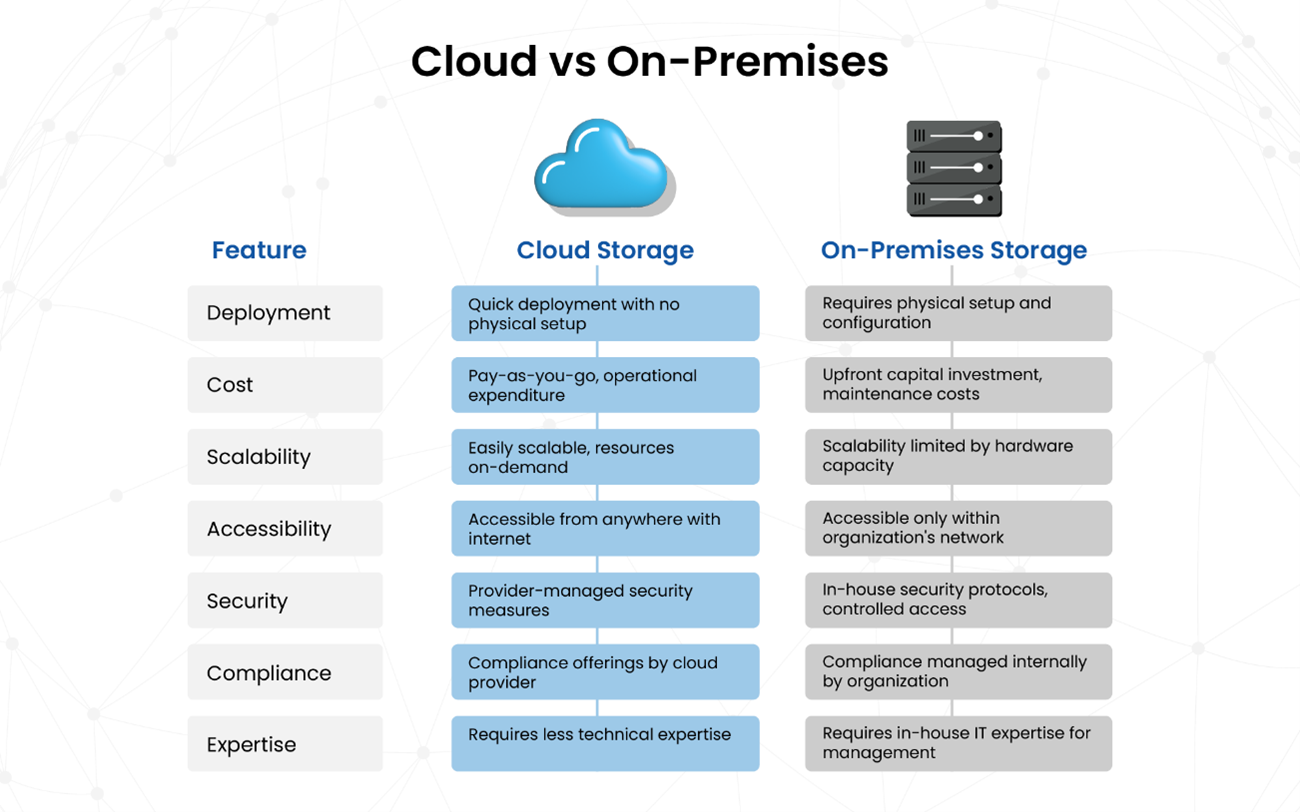
The image above compares on-premises and cloud storage across key parameters such as cost, deployment, scalability, security, compliance, and performance. Understanding these differences enables leaders to make more informed infrastructure decisions.
Ultimately, the choice between on-premises and cloud storage depends on the organization’s needs, data sensitivity, and workforce structure. For example, businesses with globally distributed teams often find cloud storage more efficient, while startups or small local firms may prefer on-premises setups for tighter cost control and localized operations.
The pandemic of 2020 further accelerated cloud adoption, as remote access and data sharing became essential for business continuity. Even so, cost and security remain decisive factors — and many organizations now opt for a hybrid storage model, combining the advantages of both on-premises and cloud solutions.
In this hybrid setup, highly sensitive data is retained on-premises for better control and compliance, while everyday workloads are moved to the cloud for agility and scalability.
Growth of the Cloud Environment
The rise of cloud computing has been a technological revolution. Since Amazon launched Amazon Web Services (AWS) in 2006, major players like Google, Microsoft, IBM, and Oracle — collectively known as the hyperscalers — have shaped the digital infrastructure landscape with massive cloud platforms.
Smaller providers still exist, but the industry has largely transitioned from traditional software licensing to Software-as-a-Service (SaaS) models. Gartner predicted that global end-user spending on public cloud services would grow by 20.7%, reaching $591.8 billion in 2023, up from $490.3 billion in 2022.
With the proliferation of Artificial Intelligence (AI), Blockchain, immersive web experiences, and Large Language Models (LLMs), cloud computing continues to evolve as a foundation for digital transformation. Understanding this evolution helps contextualize the rise of large enterprise data centers that support the growing demand for online commerce and digital applications.
AI and Sustainability: Their Disruptive Role in On-Premises vs Cloud Storage
Cloud computing is not without environmental impact. It contributes an estimated 2.5% to 3.7% of global greenhouse gas emissions.
Generative AI, while transformative, is power-intensive — training large AI models consumes significant energy. The more data and parameters involved, the higher the energy consumption required for processing and maintaining accuracy.
As AI adoption grows, businesses are re-evaluating cost, security, and sustainability — leading to renewed interest in on-premises AI data centers. According to Perry Sui, Area Vice President (ASEAN and Taiwan) at Juniper Networks, “Cloud regret is the new story as we hear countless anecdotes of companies repatriating workloads back to private, on-prem data centers.”
This evolving trend highlights the need for balance between cloud flexibility and on-premises control, especially in light of increasing sustainability demands and evolving Environmental, Social, and Governance (ESG) policies. Businesses must align their infrastructure choices with the United Nations’ Sustainable Development Goals (SDGs) to remain compliant and responsible.
Organizations can mitigate cloud-related emissions by optimizing workloads, leveraging energy-efficient infrastructure, and working with cloud providers committed to renewable energy. However, due diligence is essential — businesses must ensure that providers genuinely adhere to sustainability standards beyond marketing claims.
In Conclusion
While on-premises infrastructure offers control and data security, cloud storage delivers scalability, agility, and cost benefits. Each has its place in a balanced IT strategy. The hybrid model — combining on-premises reliability with cloud flexibility — is increasingly seen as the best approach for modern enterprises.
Emerging technologies such as quantum computing and edge computing are expected to further revolutionize storage strategies, improving speed, efficiency, and data security. Meanwhile, sustainability initiatives continue to push both cloud and on-premises providers toward greener, more energy-conscious operations.
Calsoft, as a technology-first organization and pioneer in software product engineering services, partners with enterprises to analyze, architect, and optimize infrastructure strategies. With expertise spanning AI, cloud, networking, and security, Calsoft enables businesses to build sustainable and future-ready IT ecosystems.