

A team spends fourteen months moving to cloud-native. Every deadline met. Every sign-off collected. Someone marks the project complete and moves on.
Three weeks later, the first real incident hits. A service goes down. Nobody knows which one. Nobody knows who owns it. Nobody can trace what happened, because the monitoring system was built for a world where servers stayed on, and this one wasn't.
The project was finished. The work had barely started.
This is not a rare story. It is the standard one. Enterprises invest heavily in moving to cloud-native and underinvest in learning how to run it. The gap between those two things is where the real cost lives.
So what is cloud-native, exactly? Think of it this way. A traditional application is like a single large machine; if one part breaks, the whole thing stops. Cloud-native breaks that machine down into many smaller, specialised tools, each doing one job. Those tools are called microservices. They run inside containers; self-contained packages that carry everything the software needs to work, and run the same way on any machine. A system called Kubernetes acts as the coordinator, deciding where each container runs, restarting it if it fails, and adding more copies when demand rises.
The promise is real. Faster updates. Fewer large failures. Infrastructure that scales with the business, not against it. But the promise depends entirely on how the transition is handled, and most enterprises handle the transition without adequately planning for what comes after.
Here is where the gaps appear, and what the teams that avoid them do differently. Calsoft's cloud-native enablement services are built around exactly this sequence, the decisions that determine whether cloud-native delivers, or quietly becomes a more expensive version of the problem it was meant to solve.
Where programmes break down
Migration treated as transformation
Moving an application to the cloud is not the same as making it cloud-native. Lift-and-shift means picking up existing software and dropping it onto cloud servers, without changing how it was built. The costs stay the same. The release speed stays the same. The team goes live and waits for the benefits that never arrive, because nothing about the application actually changed.
Cloud-native requires rethinking the application from the inside.
The skills gap that nobody planned for
Cloud-native engineering is specific. Container security, service mesh configuration, CI/CD pipelines, the automated systems that test and deploy code continuously, and Kubernetes cluster management are not extensions of traditional IT skills. They are distinct disciplines. According to IDC, by 2026, more than 90% of organisations worldwide will feel the impact of the IT skills crisis, with estimated losses reaching $5.5 trillion. Cloud-native sits at the centre of that gap.
A team that managed servers well for ten years is not automatically ready for container orchestration. That assumption alone has stalled more cloud-native programmes than any technical failure.
Governance left for later
Ten containers without a cost-tracking policy is manageable. Ten thousand is a crisis. No tag strategy. No namespace ownership. No cost attribution by team or service. The bill arrives, and nobody can answer for it. According to Flexera's 2025 State of the Cloud Report, organisations waste an estimated 27% of their cloud spend, a figure that has stayed near-constant for six consecutive years. Six years. That is not negligence. That is structure.
Governance is not housekeeping. Build it first or rebuild it under pressure.
Security added after the fact
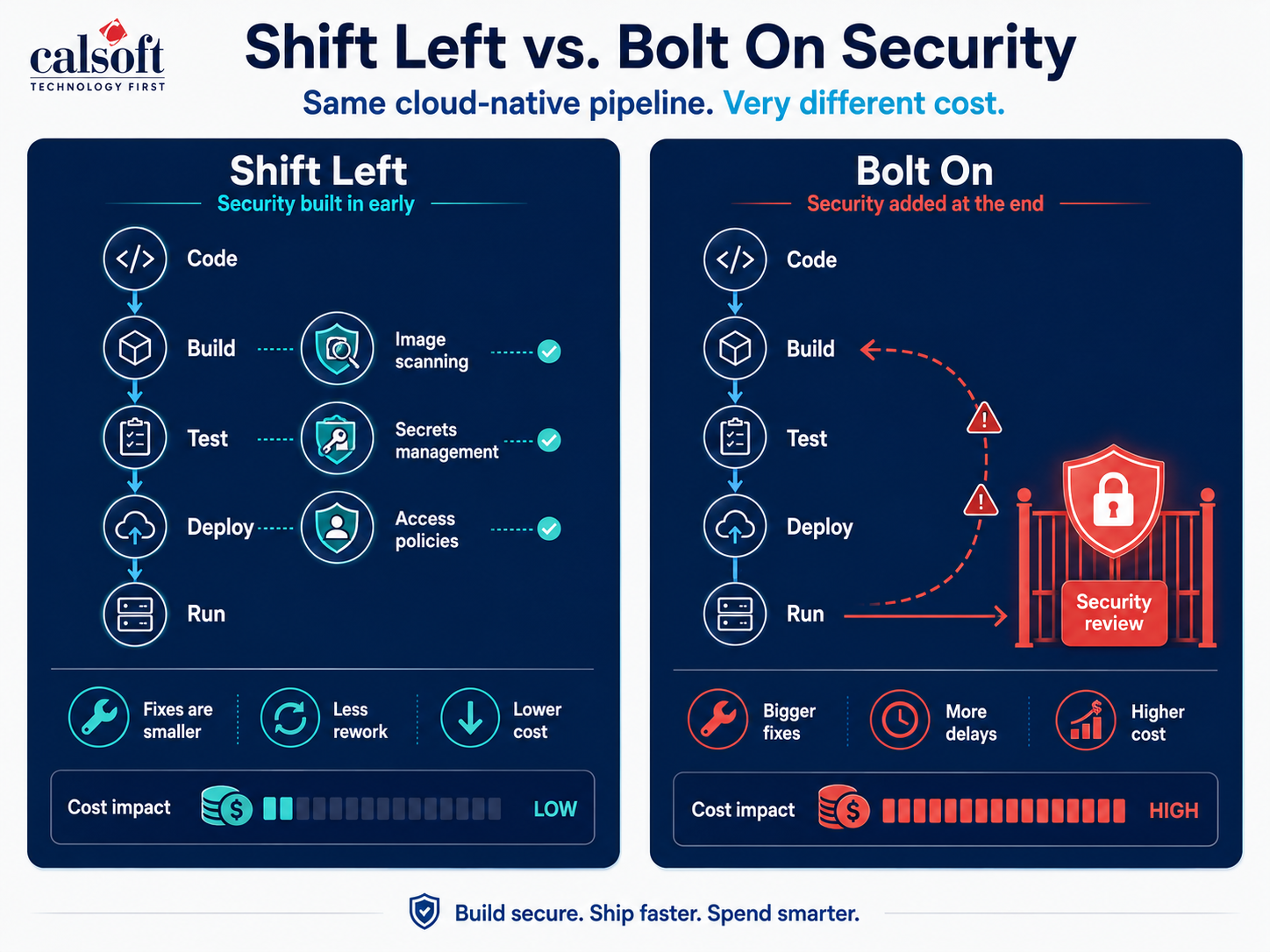
Each microservice has its own network exposure. Each container has its own image, its own secrets, its own runtime. Waiting until after deployment to think about image scanning, access controls, and threat detection means the attack surface was already open. Retroactively applying security to a live cloud-native environment is slow, expensive, and never quite complete.
The misconfiguration that slips through testing will show up in production. It always does.
Observability assumed, not built
Old monitoring watches servers. Servers stay up. Cloud-native containers spin up, do their job, and disappear, sometimes in seconds. A container that caused an incident at 2:14 a.m. may no longer exist by 2:16. Without distributed tracing, a method that follows a request across multiple services to find exactly where it broke, teams are left reading logs from systems that no longer match the state they're investigating.
Deploying without observability is not a temporary gap. It is a permanent liability.

Decomposition done too fast
Breaking a monolith- a single large application codebase- into microservices should increase agility. Done without domain analysis, it does the opposite. Teams end up with forty services where twelve were needed, owned by people who didn't sign up for the responsibility, connected in ways nobody fully documented. Deployments require coordination across teams that used to work independently. The architecture is distributed. The organisation is not.
Speed is not the point. Clarity is.
Proprietary lock-in built in quietly
Managed cloud services are convenient. They cut setup time and reduce operational load. They also create dependency that only becomes visible when the business needs to change direction, a new compliance requirement, a pricing change, a merger. Moving off a deeply embedded proprietary service is not a weekend task. Open standards and containerisation exist to keep options open. Under delivery pressure, they get deprioritised.
The lock-in is invisible until it is not.
What the CXOs who get this right actually do
They sequence before they sprint.
Governance before scale. Observability before complexity. Security at the pipeline, not the perimeter after deployment. Decomposition that follows domain boundaries, not project timelines. None of this is exotic. All of it gets skipped when the pressure is to show migration progress rather than operational readiness.

Before the roadmap gets signed off, read this
The decisions that determine whether a cloud-native programme delivers, or slowly becomes a cost problem with a modern architecture, are made in the first few months. Most teams make them without realising it.
The Cloud-Native Enablement One-Pager maps the choices that matter, the order they should be made in, and what happens downstream when they're made wrong.
Download the One-pager
The part nobody puts in the post-mortem
Cloud-native programmes fail quietly. Not with a dramatic outage. Costs climb without explanation. Incidents take too long to diagnose. Teams work harder and ship slower than they expected. Everyone suspects the problem is technical. Usually it isn't.
Ownership was never assigned. Containers belonged to one team, security to another, cost accountability to nobody. The architecture was sound. The operating model wasn't.
Seven pitfalls. One shared root: moving fast to cloud while underbuilding the systems that make cloud-native sustainable. The technical work is the shorter part. The governance, the observability, the team structure- these outlast the migration. They determine whether the investment pays off.
The architecture held. The coordination didn't. That sentence fits more post-mortems than anyone writes down.
FAQs
What does cloud-native enablement actually involve for an enterprise?
It is the full set of decisions required to run cloud-native in production — not just deploy to it. That includes containerisation strategy, Kubernetes setup and governance, CI/CD pipeline design, observability implementation, and security integration at the build stage. For enterprises with legacy systems, it also means deciding which applications to modernise first and in what order, so that moving one thing doesn't break another.
How is cloud-native different from just moving to the cloud?
Moving to cloud puts your existing software on someone else's servers. Cloud-native means rebuilding software to run as small, independent services that scale on demand and ship continuously. The difference matters because lift-and-shift carries all the old constraints into a new environment. Cloud-native removes them — but only when the rearchitecting is actually done, not just announced.
How long does cloud-native enablement take for a large enterprise?
For a well-scoped starting workload, foundational work — containers, pipelines, observability, governance — typically runs three to six months. Full adoption across a complex, legacy-heavy portfolio takes longer. The honest answer depends on one variable more than any other: how ready the organisation is to change how it works, not just where its software runs.