

Cloud computing is transforming the business landscape, addressing critical issues such as performance and data storage for over 70% of digital workspaces. With 94% of companies integrating cloud computing into their operations, cloud app development has become essential for creating productivity-enhancing applications that streamline workflows and elevate customer experiences.
Web applications running on cloud platforms differ significantly from traditional on-premises applications. A cloud-based infrastructure provides numerous services and tools to build scalable and highly available applications for a global audience. To maximize the benefits of cloud platforms, applications must be developed using cloud-native services and infrastructure capabilities.
However, running applications on a cloud platform comes with challenges. This blog outlines the common challenges of cloud application development and offers practical solutions to overcome them.
What is Cloud Application Development?
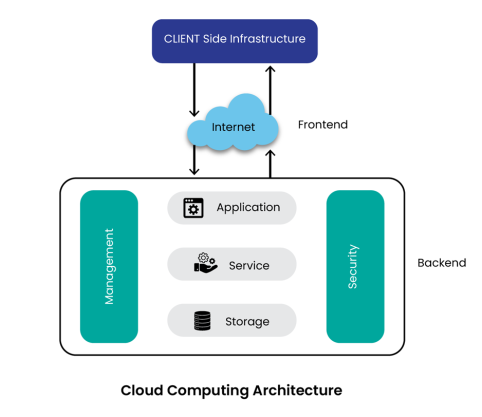
Note: The diagram above illustrates the basic architecture of cloud computing — showing how client-side components interact with backend services such as applications, storage, management, and security. Cloud computing provides the essential infrastructure that enables scalability and flexibility while keeping costs manageable.
Definition of Cloud Application Development
Cloud app development involves creating applications that run on cloud infrastructure, leveraging services for storage, processing, and networking. This approach enables businesses to build, test, and deploy applications rapidly without relying on physical hardware — ensuring scalability, security, and cost-efficiency.
Benefits of Cloud Applications
Cloud computing has evolved beyond cost reduction to provide businesses with a competitive edge, enhance user experiences, and transform operations. Regardless of size, organizations moving to the cloud gain agility, speed, and the ability to innovate continuously.
1. Faster Time to Market: Developers can spin up and retire instances quickly, accelerating application development and testing while minimizing hardware dependency.
2. Improved Collaboration: Cloud accessibility allows teams to collaborate globally in real-time, enhancing productivity and decision-making.
3. Prevention of Data Loss: Cloud computing solutions reduce data loss risks from hardware or software failures by maintaining data redundancy and backup mechanisms.
4. Better Monitoring: Cloud platforms provide integrated tools for continuous monitoring and proactive issue resolution, improving uptime and security management.
Challenges and Potential Solutions for Cloud Application Development
Cloud application development offers numerous benefits, but it also introduces several challenges. Below is an overview of common issues and practical solutions.
| Context | Challenges | Solutions |
|---|---|---|
| Interoperability and Portability | Ensuring applications run seamlessly across multiple cloud providers can be complex due to platform-specific differences. | Adopt open standards and consistent APIs to ensure compatibility and portability between different cloud environments. |
| Performance Challenges | Unawareness of data center locations and latency issues can affect application responsiveness. | Choose providers with optimal data center locations, perform end-to-end testing early, and monitor latency regularly. |
| Decoupled Service Architecture | Building loosely coupled systems is essential for scalability but can be complex to implement. | Train developers to design modular, service-oriented architectures for greater agility and maintainability. |
| Vendor Lock-In | Dependence on a single vendor’s proprietary services can make migration costly. | Opt for cloud-agnostic design and evaluate service compatibility before committing to a provider. |
| Query-Oriented vs API-Oriented Programming | Developers may lack experience in building complex query-based systems for federated datasets. | Invest in developer training to strengthen query-oriented data processing and optimization skills. |
Beyond these, additional challenges include availability, data management, messaging, monitoring, security, resiliency, scalability, and design consistency — all of which must be addressed strategically.
Options Provided by AWS and Azure
| Category | AWS | Azure |
|---|---|---|
| Availability | Autoscaling, Load Balancing | Azure Autoscale |
| Data Management | RDS, DynamoDB | StoreSimple, SQL Server, Cold Store |
| Messaging | SQS, SNS, SES | Azure Service Bus |
| Monitoring | CloudTrail, CloudWatch | Azure Monitor |
| Security – Data | KMS | Key Vault |
| Security – Network | VPC, Security Groups | Azure Virtual Network |
| Security – Identity | IAM, AWS Directory Service | Azure Active Directory |
| Resiliency | Availability Zones, Global Infrastructure | Azure Regions |
| Performance & Scalability | EC2, CloudFront, ElastiCache, Containers | VMs, Azure CDN, Managed Cache |
Note: This is a high-level comparison of AWS and Azure offerings. Other providers like IBM Cloud, Google Cloud, and Rackspace offer similar features.
Common Cloud Design Patterns
- Federated Identity: Use external identity providers to manage authentication securely.
- Gatekeeper: Add a broker layer between client and services to limit attack surfaces.
- Valet Key: Provide restricted, token-based access to specific resources.
- CQRS: Segregate read and write operations using distinct interfaces.
- Circuit Breaker: Handle failures gracefully and improve system resiliency.
- Integration Provider: Manage cross-platform messaging and data exchange efficiently.
Best Practices for Developers
- Make applications generic and cloud-agnostic.
- Design applications to be stateless.
- Store session data in persistent storage.
- Use centralized logging systems instead of file-based logs.
- Avoid coding with specific infrastructure dependencies.
- Implement an API gateway.
- Use DevOps tools for automated deployment and configuration.
Final Takeaway
Cloud application development is at the forefront of innovation but poses its challenges. The goal of the cloud is to simplify application deployment while removing infrastructure complexity. Despite the hurdles, the cloud remains a powerful enabler of agility and scalability.
Calsoft, with decades of experience, has successfully guided numerous organizations in their cloud transformation journeys through innovative solutions. We provide expertise in cloud architecture, DevOps, networking, and security — delivering scalable, secure, and high-performing applications that drive growth.