
IoT and cloud computing are key drivers of business innovation in today’s digital-first landscape. According to Gartner analysts, over 85% of organizations will adopt a cloud-first strategy by 2025, while those lacking cloud-native architectures may struggle to fully implement their digital initiatives. As cloud technology becomes the foundation for intelligent, connected devices, IoT cloud architecture enables businesses to optimize operations and scale efficiently across industries. In this context, cloud architecture functions as the nervous system of modern enterprises, empowering seamless communication, data flow, and process optimization to maintain a competitive advantage.
A well-structured IoT cloud architecture ensures scalability, efficient resource allocation, and secure data transmission. By choosing the right platforms and designing for flexibility, organizations can create an IoT infrastructure that adapts to changing business needs while ensuring smooth integration across devices.
This blog details how IoT and the cloud work together. You’ll learn strategies to build a robust, future-ready architecture for your business. Whether you run a large company or a startup, now’s the time to tap into the full power of IoT cloud architecture.
What is IoT Cloud Architecture?
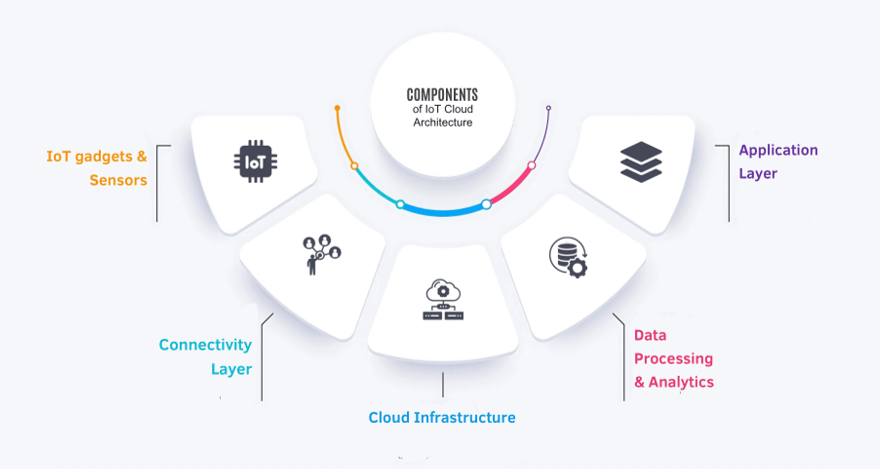
IoT cloud architecture is a structured system that connects IoT devices, sensors, networks, and cloud resources. This setup ensures smooth communication, data handling, and intelligent decision-making. It acts as a bridge between the physical world and digital platforms.
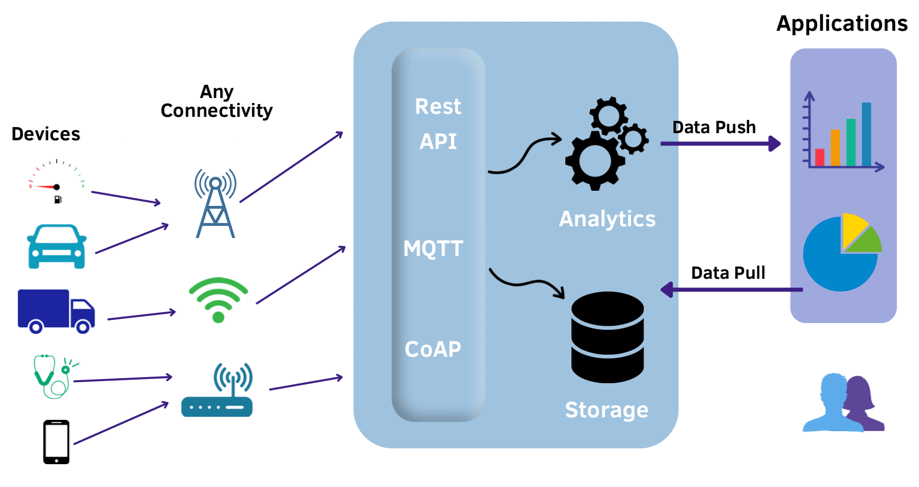
Critical Components of IoT Cloud Architecture
- IoT Devices and Sensors: Collect data from their surroundings.
- Connectivity Layer: Enables device-to-cloud communication via protocols like MQTT and CoAP, as well as gateways and networks.
- Cloud Infrastructure: Provided by platforms such as AWS, Azure, or Google Cloud.
- Data Processing and Analytics: Converts raw data into actionable insights for faster decision-making.
- Application Layer: Software and dashboards use IoT data to power use cases like smart cities, healthcare, and industrial automation.
Key Functionalities
- Scalability: Grows to handle more devices and data.
- Real-time Data Processing: Ensures quick responses for critical applications.
- Data Integration and Interoperability: Enables smooth communication between different devices and systems.
- Predictive Analytics: Identifies potential issues and maintenance needs.
- Reliability and Fault Tolerance: Maintains uptime through redundancy and backups.
IoT cloud architecture plays a significant role in developing modern technologies. It helps manage data efficiently and supports app creation that enhances user experience.
Key Layers of IoT Cloud Architecture
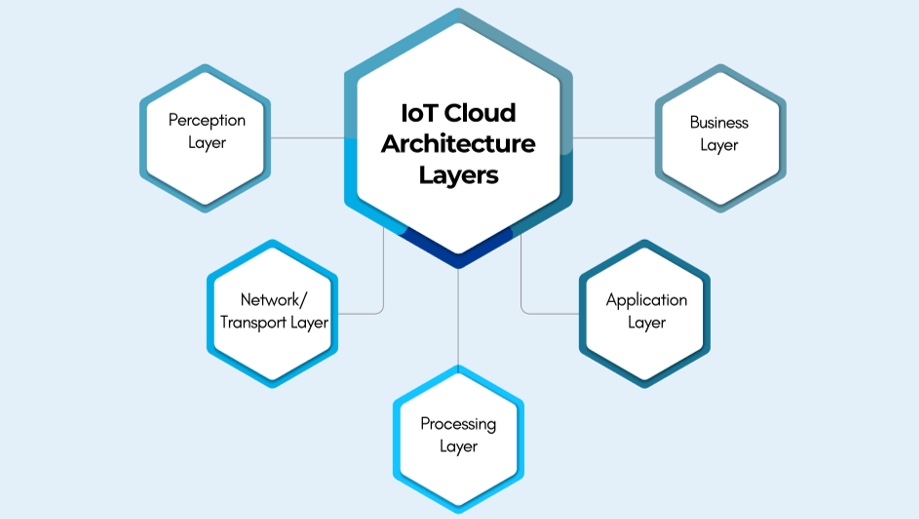
Perception Layer
The Perception Layer is where data collection occurs. It includes sensors and actuators that capture and respond to environmental data.
- Sensors: Detect and convert physical properties into digital data (e.g., temperature, humidity, motion).
- Actuators: Perform actions based on sensor data (e.g., motors, valves).
Network/Transport Layer
This layer handles data transmission between IoT devices and the cloud, ensuring security and efficiency.
- Communication Protocols: Wi-Fi, Cellular, LoRaWAN, Zigbee, Bluetooth.
- Data Transmission: Routers and gateways manage data traffic.
- Security: Network-level encryption and authentication safeguard data during transit.
Processing Layer
Responsible for data handling through edge computing and cloud-based processing.
- Edge Computing: Processes data near its source for immediate insights and bandwidth savings.
- Cloud-Based Processing: Handles large-scale analytics and pattern recognition.
- Data Integration: Combines data from multiple sources for unified reporting.
Application Layer
This layer visualizes and analyzes IoT data, providing a user interface for interaction.
- Dashboards: Real-time visualizations for monitoring system performance.
- Analytics Tools: Predictive analytics and machine learning enhance decision-making.
- User Interface (UI): Mobile, web, or desktop interfaces for accessibility.
Business Layer
Aligns IoT insights with organizational goals and decision-making processes.
- Focuses on strategic management and optimization of IoT initiatives.
- Uses BI tools to evaluate ROI, productivity, and customer satisfaction improvements.
Common IoT Cloud Architecture Models
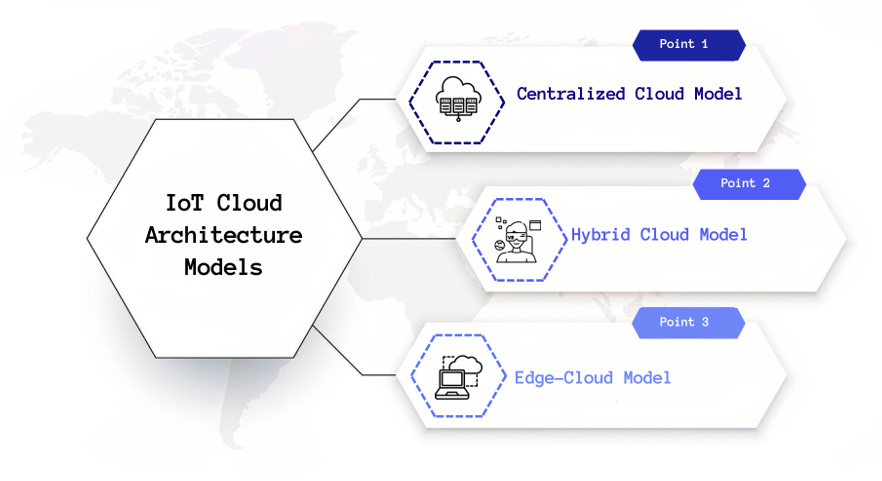
IoT Cloud Architecture Models define how data is processed, stored, and integrated. The three common types are:
Centralized Cloud Model
All IoT devices send data to a single cloud server for processing and storage. This simplifies management but can create latency and bandwidth challenges.
Hybrid Cloud Model
Combines cloud and edge processing. Immediate actions occur locally, while analytics and storage happen in the cloud—balancing cost, scalability, and speed.
Edge-Cloud Model
Processes data primarily at the edge, sending only summaries to the cloud. Offers ultra-low latency for real-time applications like autonomous systems.
Understanding IoT Connectivity Protocols
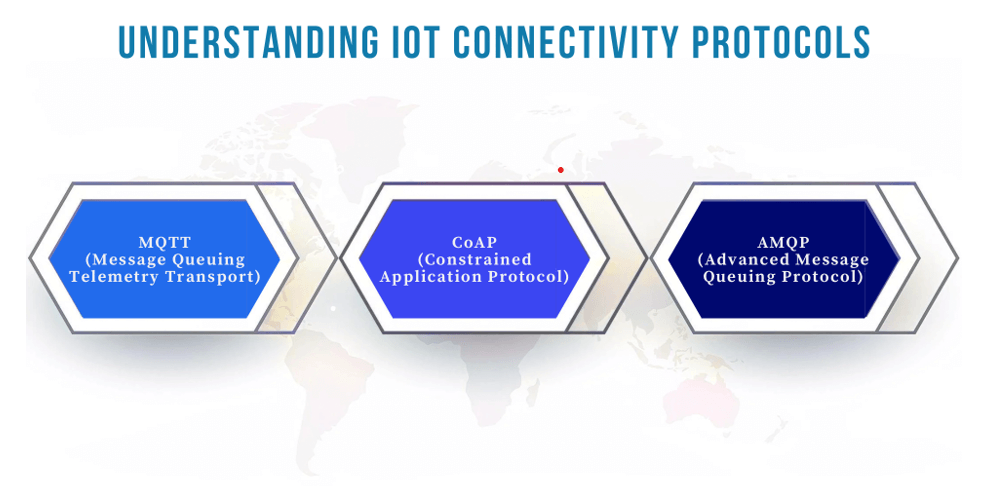
IoT connectivity protocols facilitate communication between devices and the cloud. Choosing the right one determines efficiency, reliability, and scalability.
| Protocols | Features | Pros | Cons |
|---|---|---|---|
| MQTT | Lightweight messaging; publish-subscribe model; low bandwidth usage. | Efficient for real-time messaging; low power consumption. | Limited features for complex messaging scenarios. |
| CoAP | Resource-oriented; supports multicast. | Great for low-power, low-bandwidth devices. | Less suitable for complex messaging; no guaranteed delivery. |
| AMQP | Advanced message queuing; flexible routing; guaranteed delivery. | Reliable for enterprise-scale and complex scenarios. | Higher overhead compared to MQTT and CoAP. |
Best Practices for Optimizing IoT Cloud Architecture
- Use Edge Computing: Process data near its source to minimize latency and bandwidth usage.
- Optimize Data Flow: Filter data to transmit only what’s necessary.
- Use Predictive Analytics: Anticipate issues and schedule maintenance proactively.
- Select the Right Cloud Provider:
- AWS IoT – for scalability and broad toolsets.
- Google Cloud IoT – for advanced data analytics.
- Azure IoT – for integration within Microsoft environments.
- Ensure Security and Scalability: Implement robust authentication and encryption.
- Minimize Costs: Use pay-as-you-go pricing to optimize expenses.
Conclusion
Optimizing IoT cloud infrastructure unlocks vast potential for scalability, efficiency, and connectivity. Adopting best practices like edge computing and streamlined data flow enables organizations to enhance performance and prepare for future growth. IoT-driven enterprises that prioritize cloud efficiency gain a competitive edge in digital transformation.
Calsoft’s IoT services portfolio provides end-to-end solutions, including edge-to-cloud integration, IoT application development, and data analytics to empower connected enterprises.