

Enterprises worldwide are harnessing cloud capabilities to achieve elasticity, flexibility, scalability, innovation, and automation. While the cloud brings new opportunities to modernize and innovate, security risks remain one of the most critical challenges in cloud adoption. The complexity of multi-cloud and hybrid environments often makes cloud transitions even more challenging.
Security is often viewed as an obstacle to cloud adoption, but in reality, it can become a major accelerator when combined with automation. Automating cloud security enables organizations to efficiently gather critical data to safeguard cloud workloads. It involves using automated tools and processes to enhance and manage cloud security effectively. According to Gartner, over 85% of companies will adopt a cloud-first strategy by 2025.
Let’s dive into cloud security automation — its advantages, best practices, strategies, and actionable tips enterprises can embrace to maximize business value.
What is Cloud Security Automation?
Cloud security automation refers to the use of automated tools and processes such as continuous monitoring, automated compliance checks, vulnerability scanning, and Identity and Access Management (IAM) to manage and strengthen cloud security.
As organizations adopt cloud-first strategies, their environments become more complex, demanding scalable and consistent security mechanisms — which automation provides efficiently.
According to Business Wire, the cloud computing market is projected to reach $1,251.09 billion by 2028, growing at a CAGR of 19.1%.
Cloud security automation applies across multiple industries:
- SMEs: Simplify operations without deep in-house expertise.
- Large Enterprises: Manage vast multi-cloud setups efficiently.
- E-commerce: Protect customer data and transactions.
- Financial Institutions: Ensure compliance and safeguard financial data.
- Healthcare: Protect patient information under HIPAA.
- Tech Startups: Embed security early while focusing on innovation.
- Retail: Secure customer and transaction data.
- Government Agencies: Protect confidential data and ensure compliance.
- Education: Safeguard student and faculty data.
- Non-profits: Maintain data privacy and donor trust.
Benefits of Cloud Security Automation
Think of cloud security automation as your co-pilot — handling complex and repetitive tasks so your IT teams can focus on innovation and growth. Just as autopilot simplifies flying, security automation reduces manual workload and improves precision.
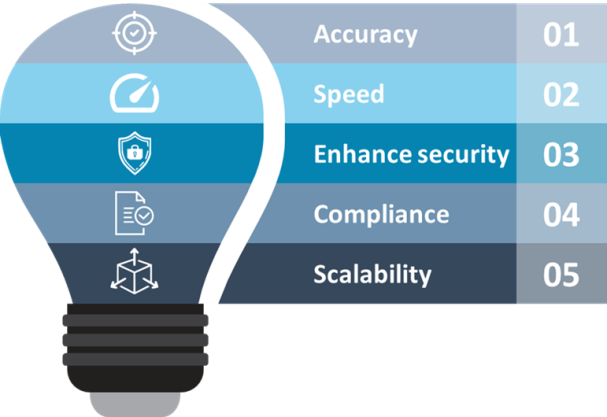
- Reduced Time on Security Operations: Automates routine tasks, freeing teams for strategic initiatives.
- Consistent Security Enforcement: Ensures standardized security measures across environments.
- Minimized Human Errors: Reduces the risks caused by manual configuration mistakes.
- Enhanced Security Posture: Deploys complex security protocols automatically.
- Improved Compliance: Continuously monitors and enforces regulatory standards.
- Rapid Threat Detection: Identifies and responds to threats faster.
Now that you understand the benefits, let’s explore the five steps to implement cloud security automation effectively.
5 Steps for Successful Implementation of Cloud Security Automation
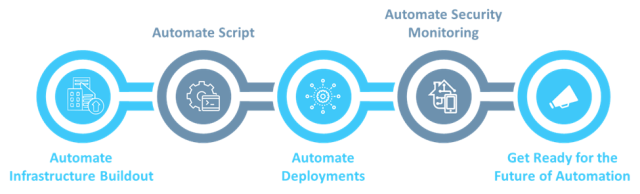
1. Automate Infrastructure Buildout
Automation eliminates the need for manually configuring security groups, access controls, firewalls, and DNS settings. Engineers can use predefined scripts to ensure consistent setups and reduce human errors.
2. Automate Scripts
Automation scripts streamline updates, configurations, and patch deployments across instances. One change in a setup file can apply globally, ensuring uniformity and efficiency.
3. Automate Deployments
Integrating automation into CI/CD pipelines ensures quick patch rollouts and immediate deployment of security updates to counter zero-day vulnerabilities.
4. Automate Security Monitoring
Unified dashboards and automated alerts provide real-time visibility across hybrid or multi-cloud setups, allowing proactive threat detection and incident response.
5. Prepare for Automation’s Future
As hybrid setups grow, manual security becomes unsustainable. Investing in in-house automation expertise today builds a foundation for scalable, future-ready cloud security.
Is Cloud Security Automation Important for Your Business?
Just like a café that uses a system to manage orders and payments efficiently, automation helps your cloud infrastructure run securely and smoothly. Here’s why it’s essential:
- Faster detection and response to threats.
- Standardized security configurations across environments.
- Scalability for growing cloud operations.
- Better compliance management.
- Reduced operational costs and manual efforts.
- Proactive identification of vulnerabilities.
- Improved access control and IAM management.
Stages of Cloud Security Automation Framework
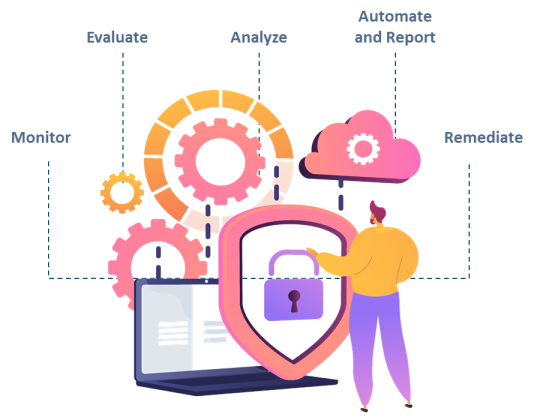
Monitor
Continuously track workflows and cloud resources to detect security incidents early and ensure full visibility.
Evaluate
Identify repetitive or manual tasks suitable for automation (e.g., resource provisioning, policy enforcement).
Analyze
Assess the severity and frequency of risks, automating low-risk processes first for controlled rollouts.
Automate and Report
Deploy automation workflows and generate detailed reports for audit and compliance tracking.
Remediate
Implement auto-remediation processes using tools like AWS Config and Lambda to patch vulnerabilities instantly.
Cloud Security Automation Challenges
Despite its benefits, organizations face several hurdles when implementing cloud security automation:
| Challenge | Description |
|---|---|
| Integration Complexity | Difficulty integrating diverse tools like SIEM and IAM systems. |
| Managing False Positives | Filtering false alarms without missing genuine threats. |
| Ensuring Compliance | Adhering to regulations like GDPR and HIPAA. |
| Scalability | Expanding automated security to match infrastructure growth. |
| Skill Gaps | Shortage of trained security automation experts. |
| Cost Management | High setup and maintenance expenses. |
| Human Oversight | Maintaining human checks alongside automation. |
| Dynamic Threats | Adapting to evolving attack vectors and zero-day exploits. |
Cloud Security Automation Strategies
| Strategy | Description |
|---|---|
| Use Infrastructure as Code (IaC) |
|
| Security Automation in CI/CD |
|
| Policy-as-Code |
|
| Auto Remediation |
|
| Security Orchestration |
|
The Future of Cloud Security Automation
With AI and machine learning becoming integral to cybersecurity, the future of cloud security automation looks promising:
- AI-Driven Threat Detection: Intelligent systems will predict and mitigate attacks proactively.
- Real-Time Threat Intelligence: Automated data analytics for faster response.
- Seamless Compliance: Continuous integration of compliance validation in pipelines.
- Scalability: Automated frameworks that adapt dynamically to cloud expansion.
- Proactive Incident Response: Faster remediation powered by ML algorithms.
Conclusion
Cloud security automation provides significant operational and security advantages. However, implementing it requires proper planning, skilled resources, and investment in automation technologies. Despite the upfront effort, the long-term benefits—such as improved security, reduced risk, and compliance efficiency—are substantial.
Calsoft’s Cloud Security services help enterprises address compliance challenges and modernize cloud processes through automation and AI-driven analytics.