

On July 27, Bank of Baroda confirmed what cybersecurity researchers had been circling for days: an employee's email account had been compromised, and the unauthorized access that followed touched “certain data.”
This cyber incident has highlighted a reality every enterprise should acknowledge: many breaches begin with compromised identities rather than sophisticated malware.
Separate media reports and dark-web analysis suggested that a significant volume of data may have been exposed. However, the exact scale of the exposure and the number of affected customers had not been publicly confirmed at the time of reporting. The bank stated that its core banking systems were not breached and opened a forensic investigation with the relevant authorities. Regardless of the final investigation findings, the incident underscores why identity security is now central to enterprise cyber resilience and why organizations should adopt identity security best practices.
When identity documents, loan files, internal audit material, or operational information are exposed, attackers can reuse that data long after the initial intrusion. It can support phishing attacks, account takeover, social engineering, identity fraud, and convincing follow-on campaigns.
The Bank of Baroda incident should encourage every technology leader to ask important questions:
Are privileged accounts adequately protected? Is access continuously validated? Are employees equipped to recognize phishing attempts? Are audit trails and monitoring sufficient to detect unusual behaviour early?
These are among the most important questions when considering how to prevent employee email compromise in modern enterprises. The organizations that succeed in the coming years will be those that treat cybersecurity as a strategic business capability rather than a compliance exercise.
Calsoft helps enterprises strengthen this security foundation through Enterprise Security Services spanning Identity and Access Management (IAM), cloud security and infrastructure security, Zero Trust enablement, security assessments, governance, and consulting. The objective is to build resilient digital platforms that enable innovation without compromising trust.
Why is an Employee Email Compromise an Enterprise Security Risk?
Digital transformation has expanded the attack surface across cloud platforms, remote work, APIs, AI applications, and connected devices, making employee email compromise one of the fastest-growing credential-based attacks affecting modern enterprises. A single compromised account can quickly become the gateway to sensitive information if organizations lack strong identity controls, monitoring, and governance.
A single compromised identity can quickly become an enterprise-wide security incident.
How Identity-Based Attacks Spread Across Organizations
Every enterprise runs on people, applications, and data, but the common thread connecting them is identity. When an employee email account is compromised, attackers don't just gain access to a mailbox. They inherit the digital identity associated with it, often unlocking access to business applications, cloud services, sensitive data, and trusted communication channels.
Five Identity Security Challenges Every Enterprise Faces
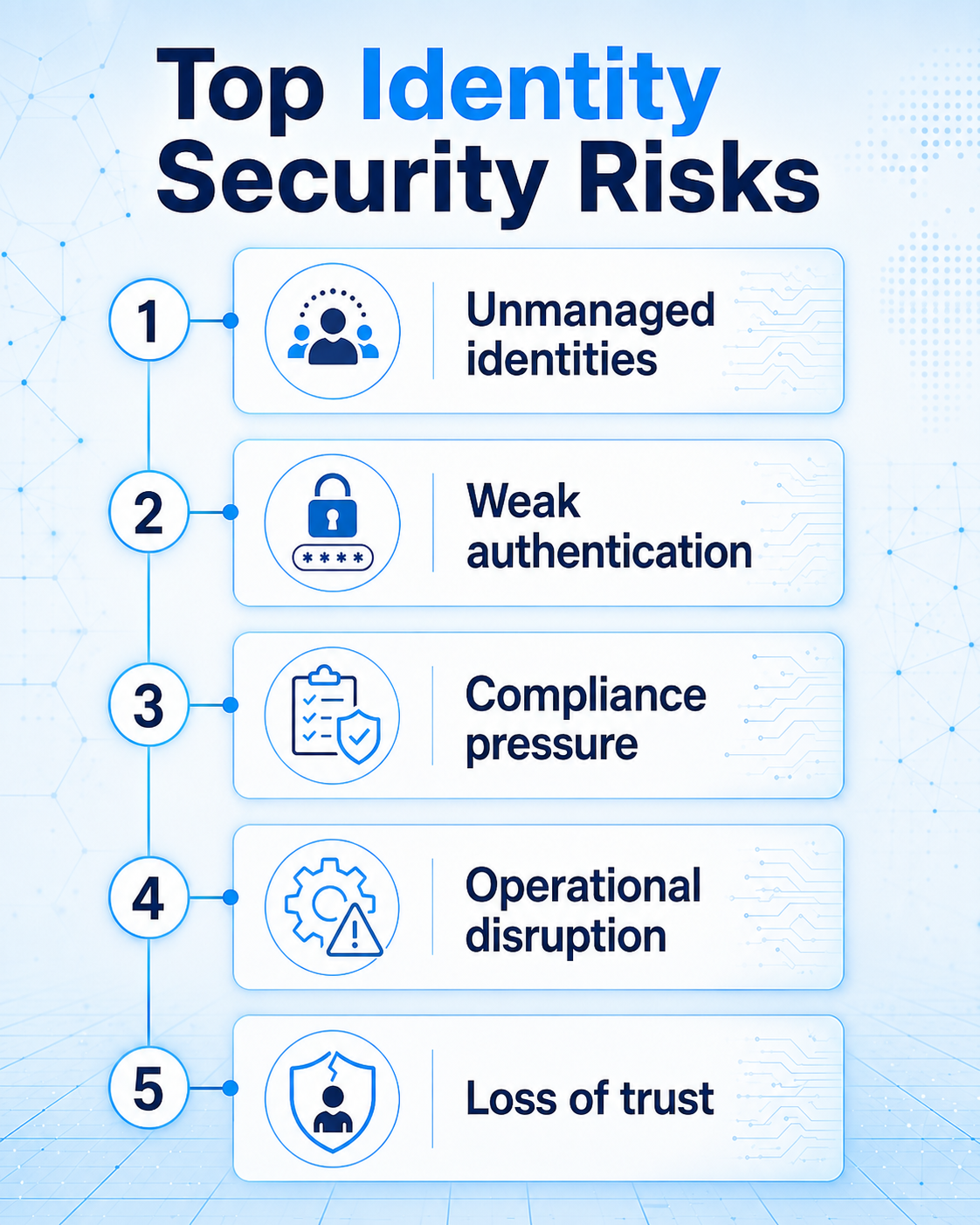
Unmanaged identities
Employees change roles, contractors leave, and service accounts continue running long after they're needed. Without a strong identity governance framework and identity lifecycle, outdated privileges accumulate, giving attackers multiple paths to move across cloud and on-premises environments once an account is compromised.
Weak authentication
Passwords alone are no longer sufficient. Inconsistent Multi-Factor Authentication (MFA) and Privileged Access Management (PAM), fragmented Single Sign-On (SSO), and approval bypasses create opportunities for Credential-Based Attacks.
Compliance and regulatory risks
Modern regulations such as SOX, PCI DSS, GDPR, and HIPAA require organizations to demonstrate who accessed what, when, and why. Poor Identity Governance makes it difficult to provide audit evidence, increases Security Risk Management challenges, including the risk of compliance failures, financial penalties, and regulatory scrutiny.
Operational Disruptions
Manual access requests and delayed provisioning slow business operations while increasing the likelihood of excessive or unauthorized access. During a security incident, these gaps make it harder to contain compromised accounts and restore normal operations.
Loss of Customer Trust
Identity-based attacks rarely stop at technical damage. A compromised employee account can expose confidential information, enable phishing against customers and partners, and damage an organization's reputation. Rebuilding trust often takes far longer than recovering systems.
How Identity and Access Management (IAM) Strengthens Enterprise Security
Identity and Access Management (IAM) has therefore become a business necessity rather than an IT function. It is a foundational component of Identity and Access Management for Enterprises and strengthens overall Enterprise Cybersecurity. Effective IAM ensures that the right people have the right level of access for the right duration. Combined with Multi-Factor Authentication (MFA), Privileged Access Management (PAM), role-based access control, and continuous monitoring, it significantly reduces the likelihood and impact of credential-based attacks.
Another key lesson is that cybersecurity cannot be reactive. Regular security assessments, vulnerability management, identity governance, privileged access reviews, and incident response preparedness should become part of an organization's ongoing operational strategy.
Cybersecurity and business continuity go hand in hand. A strong cyber risk strategy keeps critical operations running through an incident, protecting trust, availability, and resilience.
As enterprises increasingly adopt Generative AI, AI security must extend to AI workloads as well. Protecting prompts, models, enterprise knowledge, and user identities requires consistent governance, strong authentication, encryption, and auditability.
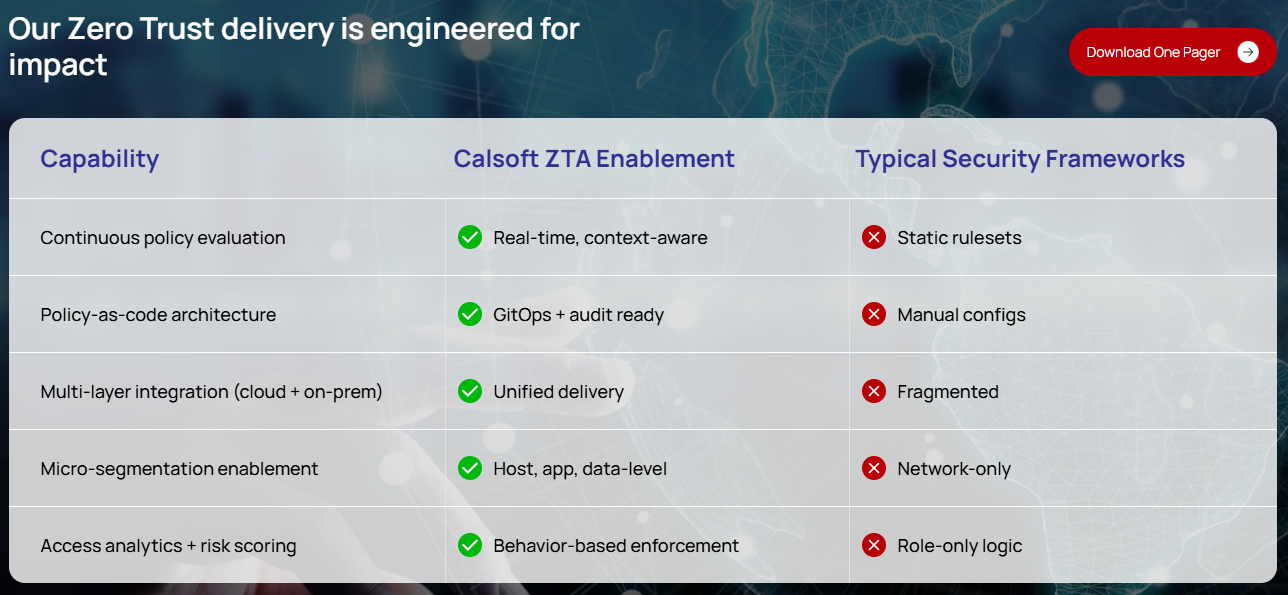
Zero Trust Architecture Implementation strengthens this further by continuously verifying every user, device, and application instead of assuming trust based on network location. This limits lateral movement and helps contain attacks before they spread.
How Calsoft Helps Enterprises Build Cyber Resilience
Key Takeaways
The Bank of Baroda incident is a timely reminder that cybersecurity is not just about protecting networks or endpoints; it is about protecting identities. As enterprises embrace cloud computing, AI, and increasingly interconnected digital ecosystems, identity has become the new security perimeter. Every employee, contractor, application, and machine identity must be continuously verified and governed to reduce the risk of unauthorized access.
By adopting IAM, Zero Trust principles, continuous monitoring, and strong governance, organizations can significantly reduce credential-based attacks, improve Identity Threat Detection, and build long-term Enterprise Cyber Resilience, while securing cloud, AI, and hybrid environments. Ultimately, cybersecurity is a strategic business enabler that builds resilience, strengthens customer trust, and empowers organizations to innovate securely.
FAQs
1. What caused the Bank of Baroda cyber incident?
The incident involved the compromise of an employee email account, leading to unauthorized access to certain data. The bank stated that its core banking systems were not breached.
2. What is identity security?
Identity security protects digital identities by ensuring that only authorized users can access enterprise systems, applications, and data.
3. What is Identity and Access Management (IAM)?
IAM manages user identities, authentication, authorization, and access permissions to reduce unauthorized access.
4. Why is Zero Trust important?
Zero Trust continuously verifies every user, device, and application instead of assuming trust, helping prevent lateral movement during attacks.