

Picture this: a mid-sized financial services firm spends eight months building an AI-powered assistant to handle customer queries - account questions, product eligibility, basic advisory inputs. It performs beautifully in the demo. The CTO signs off. It goes live on a Monday morning.
By Wednesday, the support team is flooded. The assistant is confidently giving customers wrong eligibility information. Not always - just enough times to matter. The AI never threw an error. It just gave plausible-sounding, wrong answers. And nobody had designed a test to catch it before it met real users.
This isn't a hypothetical. Variations of this story play out regularly across enterprises adopting AI - in healthcare, legal tech, retail, and banking. The model wasn't broken. The evaluation process was.
That's what AI LLM Evaluation as a Service is built to prevent.
The gap nobody talks about
Most enterprise AI projects have a well-defined build phase and a defined launch date. What they often don't have is a structured evaluation phase that sits between the two.
Evaluation gets squeezed. Teams run a few test queries, things look reasonable, and the pressure to ship takes over. What gets skipped is the disciplined work of testing the model across its full range of expected inputs - including the ones that are ambiguous, edge-case, adversarial, or simply outside the neat examples used in development.
The result is a confidence gap. Teams believe the model works because it worked on the inputs they tested. They have no visibility into how it performs on the inputs they didn't test, which is exactly where production failures come from.
AI LLM Evaluation as a Service exists to close this gap before it becomes a business problem.
What AI LLM evaluation looks like
LLM evaluation is the systematic process of testing an AI model’s accuracy, safety, consistency, and domain fit — before and after deployment — to ensure it performs reliably in real-world conditions.
LLM evaluation is not running a model against a standard benchmark and calling it ready. Benchmarks measure general model capability, not how your model performs in your context, for your users.
Rigorous AI LLM evaluation covers:
-
Accuracy and hallucination rate: Is the model giving correct answers? How often does it make things up?
-
Consistency: Does the model give the same answer to the same question phrased differently?
-
Domain fit: Does the model understand your industry's language, terminology, and reasoning patterns?
-
Safety and compliance: Are outputs appropriate for the regulatory context in which they operate?
-
Edge case and adversarial performance: What happens on unusual, ambiguous, or deliberately tricky inputs?
Each of these requires deliberately designed test sets, not pulled from a public dataset, but built from real production conditions, real user input patterns, and the specific failure modes that matter for your deployment.
Why 'off-the-shelf' doesn't cut it for enterprise
Standard evaluation frameworks are useful starting points. They are not sufficient for enterprise-grade deployment.
A legal AI assistant needs to be evaluated on legal document types, legal reasoning patterns, and the edge cases specific to the practice areas it supports. A customer service AI needs to be tested against the actual queries your customers send, including the badly worded ones, the emotionally charged ones, and the ones that fall outside the scope the model was trained to handle.
This is where custom LLM evaluation becomes non-negotiable. And it's where most internal evaluation efforts fall short, not from lack of intent, but from lack of the specific expertise to design evaluation frameworks that actually surface the failure modes that matter.
Beyond the technical gaps, there is another dimension that rarely gets enough attention: trust. LLM evaluation is not just about catching errors — it is about giving your business, your stakeholders, and your users the evidence they need to trust the AI you are deploying. That is what makes custom evaluation non-negotiable, not just useful.
What LLM evaluation covers & why each dimension matters
|
What LLM evaluation covers |
Why it matters for enterprise |
|
Model Performance Assessment |
Validates output quality against real production benchmarks, not just lab results |
|
Ethical Considerations |
Surfaces bias, harmful outputs, and compliance risks before they reach users or regulators |
|
Comparative Benchmarking |
Helps you choose the right model for your use case with objective, side-by-side data |
|
New Model Development |
Provides feedback loops that guide fine-tuning and improve model iterations faster |
|
User & Stakeholder Trust |
Beyond technical validation — gives your business the evidence to deploy AI with confidence |
Each dimension above requires a custom-designed evaluation framework — not generic benchmarks.
What Calsoft's AI-LLM evaluation as a service actually delivers
Calsoft's AI-LLM Evaluation as a Service is built for exactly this problem. It goes well beyond running your model through public benchmarks.
Here's what the service actually delivers:
-
Custom evaluation framework design: tailored to your use case, not generic.
-
Test dataset construction: built from real production data, edge cases, and adversarial inputs specific to your domain.
-
Multi-dimensional assessment: accuracy, consistency, safety, hallucination rate, latency, and domain fit evaluated systematically.
-
Independent assessment: separate from the team that built the model, which matters for objectivity.
-
Actionable interpretation: evaluation that drives decisions, not just produces a report.
-
Continuous monitoring support: so evaluation doesn't stop at launch.
The last point matters more than it sounds. Models don't stay static in production. User behavior shifts. System prompts change. A model that passed evaluation in Q1 may be producing lower-quality outputs by Q3, not because the model changed, but because usage patterns did. Without continuous monitoring, that drift is invisible until users notice.
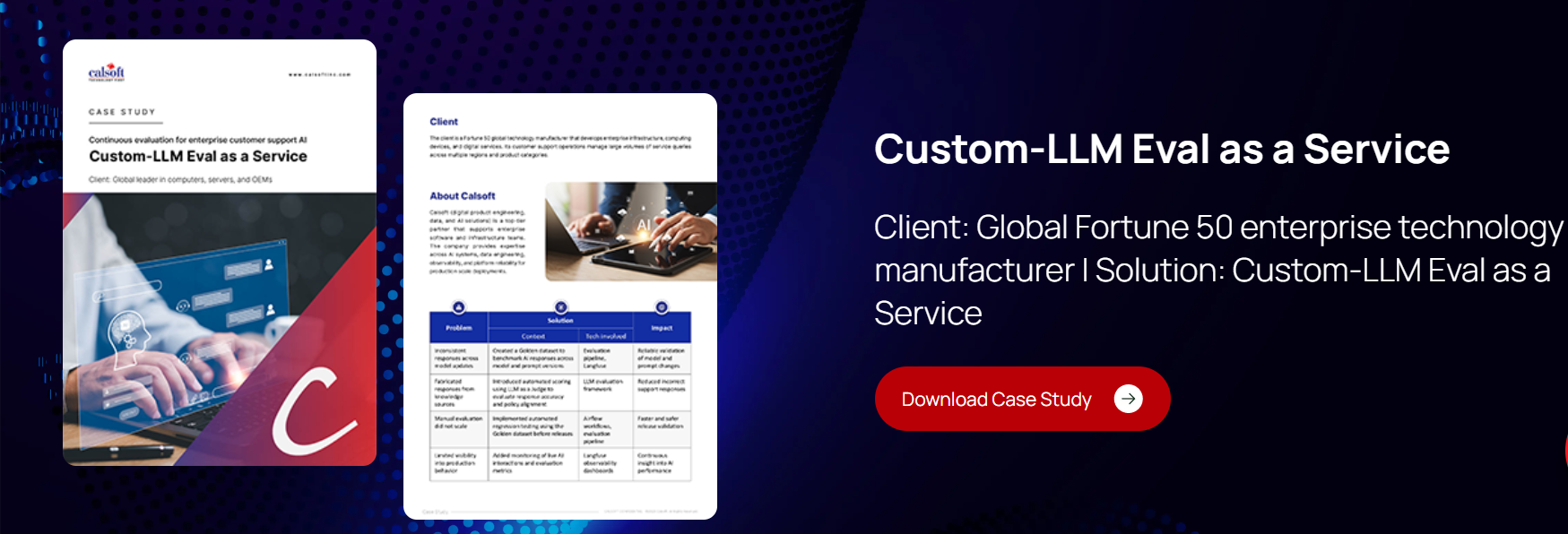
Real Results: See How Custom LLM Evaluation Works in Practice
Wondering what a structured LLM evaluation engagement looks like - the inputs, the process, the outcomes? Calsoft's Custom-LLM Eval as a Service case study walks through exactly that: how a real enterprise deployment was evaluated, where the gaps were found, and what decisions the results drove. Download it and see for yourself.
Evaluation is not a launch gate. It's an ongoing practice.
One of the most common and costly mistakes in enterprise AI is treating LLM evaluation as a one-time pre-launch check. Build, evaluate once, ship, done.
That's not how reliable AI deployments work.
Every model update, every system prompt change, every shift in how users interact with the system is a potential source of quality drift. Evaluation needs to be tied to the model lifecycle, triggered by changes and run periodically even without explicit changes, because the real-world input distribution shifts whether the model does or not.
The organizations that build evaluation into their ongoing AI operations, not just their launch checklist, are the ones that end up with AI they can actually trust over time.
The bottom line for enterprise technology leaders
If your organization is deploying AI into anything that touches customer experience, internal operations, or compliance-sensitive workflows, you need a systematic evaluation process. Not as a checkbox. As a fundamental discipline.
The question isn't whether to evaluate your LLMs rigorously. The question is whether you have the expertise and the framework to do it in a way that actually surfaces the failures that matter before users do.
Calsoft's AI-LLM Evaluation as a Service is designed to answer that question for enterprise teams that are serious about deploying AI reliably, not just quickly.
Ready to talk about what a structured LLM evaluation looks like for your deployment? Let's start the conversation.
FAQs
Q1: What is the difference between LLM evaluation and standard AI testing?
Unlike standard software testing which checks for deterministic pass/fail outcomes, LLM evaluation assesses probabilistic outputs across accuracy, consistency, safety, and domain fit. It requires custom test sets, human judgment, and continuous monitoring - not a one-time QA check.
Q2: When should an enterprise use an external AI LLM evaluation service vs. doing it internally?
Use external AI-LLM evaluation as a service when you need domain-specific test design, independent assessment, or scale your internal team can't match. For high-stakes or regulated deployments, external evaluation adds objectivity that in-house teams structurally cannot.
Q3: How often should enterprises evaluate their LLM after deployment?
Trigger evaluation on every model or system prompt change. Run periodic re-evaluations even without changes, since user input patterns shift over time and degrade quality silently. For regulated industries, continuous monitoring is the baseline, not the exception.