

Most enterprises today operate through layers of digital systems that have grown over time. Monitoring platforms collect telemetry across infrastructure and applications. Automation scripts handle routine tasks in operations and security. Predictive models estimate failure probability, customer behavior, and capacity demand. Each capability is introduced to solve a defined problem. Each team improves its own scope.
As these capabilities expand, they begin to interact in more complex ways. Signal volumes increase. Thresholds are refined. New models are deployed into production. Automation triggers multiply across environments. The organization becomes more data aware and more automated, yet coordination across signals, models, and workflows does not always mature at the same pace.
In many environments, predictive outputs remain in dashboards while execution logic resides elsewhere. Alerts are interpreted manually. Scripts execute without full dependency awareness. Decision pathways are distributed across tools. Over time, visibility into how automated decisions are made becomes harder to maintain.
AI-driven predictive orchestration addresses this coordination challenge by aligning signal ingestion, contextual evaluation, predictive modeling, workflow sequencing, and policy enforcement within a structured operating model. Predictive insight is embedded directly into execution pathways. Automated actions follow defined sequencing. Decision logs remain traceable. Oversight becomes systematic rather than reactive.
Download full paper for in-depth case study details | AI-driven predictive orchestration
What the 10 AI-driven predictive orchestration case studies reveal
Organizations implement predictive orchestration through staged capability development. They progress through these stages at different speeds. Sustained improvement follows when signal control and execution governance are established early.
Calsoft helps enterprises move from fragmented, reactive operations to intelligent, self-governing systems through AI-driven predictive orchestration. Predict trends and infer actionable insights at enterprise speed.
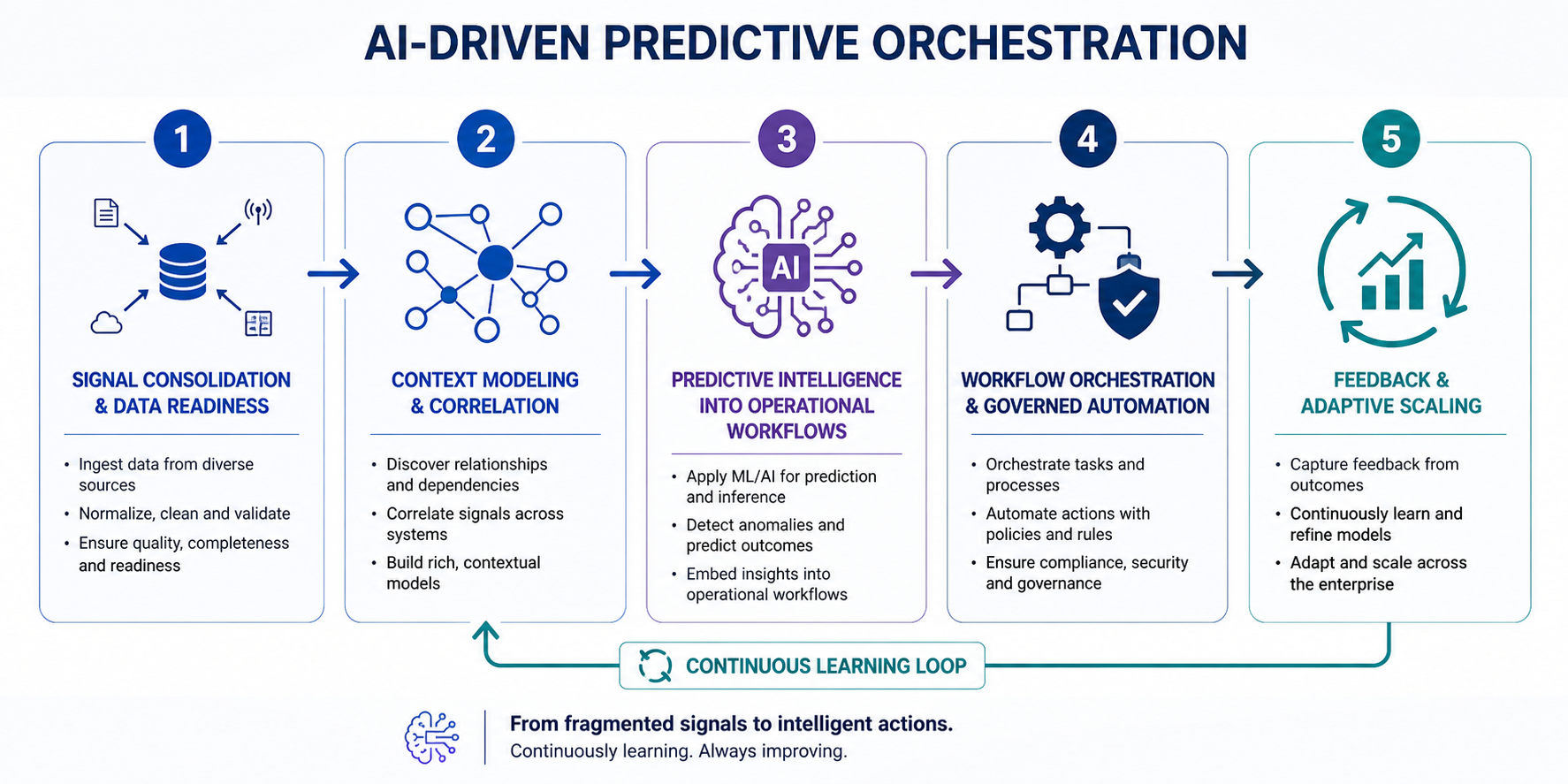
- The first stage focuses on signal consolidation and data readiness. Telemetry from infrastructure, applications, and business events is unified into structured pipelines. Validation rules are embedded at ingestion. Ownership of signal quality is defined. This reduces ambiguity before models are deployed.
- The second stage addresses context modeling and correlation. Infrastructure dependencies are mapped. Entity relationships are documented. Correlation engines reduce alert duplication. Prioritization logic reflects system context. Operational noise declines as signals become clearer.
- The third stage introduces predictive intelligence into operational workflows. Forecast models and anomaly detection engines are deployed within structured pipelines. Inference services integrate into execution paths. Model performance is monitored in production. Response becomes anticipatory rather than reactive.
- The fourth stage formalizes workflow orchestration and governed automation. Execution paths are sequenced. Dependency awareness is embedded in triggers. Escalation controls are documented. Decision logging captures model outputs and actions. Automation becomes controlled and repeatable.
- The final stage institutionalizes feedback and adaptive scaling. Outcome signals route back into training pipelines. Drift monitoring is enabled. Performance scorecards are reviewed at defined intervals. Regional routing and policy enforcement align with compliance requirements.
What measurable impact looked like
Industry benchmarks referenced in the paper show that predictive orchestration maturity can reduce service operations cost by up to 20% when AI is embedded into execution workflows. Productivity gains of 20 to 30% are documented where intelligent automation is structured and sequenced.
Unplanned downtime reductions of up to 30% are observed in predictive maintenance environments. Mean time to resolution improves by up to 40% when observability and signal prioritization are strengthened. By 2026, 30% of enterprises are expected to automate more than half of network activities under governed orchestration models.
In practice, these improvements translate into shorter investigation cycles, clearer prioritization, more reliable deployment workflows, and stronger audit readiness. Incident handling shifts toward model-informed action. Commercial platforms see improved conversion behavior when probability models integrate directly into workflows.
These gains appear when predictive insight, orchestration sequencing, and governance controls operate within a coordinated structure.
What this means for enterprise leaders
For board members and CXOs, predictive orchestration influences cost discipline, operational continuity, and compliance clarity. Automated decisions affect customer experience and regulatory posture. Executive oversight should include measurable impact reviews, decision traceability visibility, and lifecycle governance alignment.
- Confirm that predictive outputs are embedded in execution workflows
- Require trace logging for automated decisions
- Review cost, productivity, and performance metrics regularly
- Align automation investments with governance standards
For CIOs and enterprise architects, predictive orchestration must be reflected in platform design. Signal ingestion, model integration, orchestration logic, and policy enforcement should operate within a unified architectural framework.
- Unify telemetry ingestion across systems
- Document dependency mappings before embedding automation
- Integrate inference services into orchestration engines
- Embed lifecycle controls for models within platform standards
For platform and engineering leaders, execution reliability depends on structured sequencing. Predictive triggers should align with documented runbooks. Override controls should be auditable. Performance baselines should be monitored across releases.
- Codify orchestration logic within version-controlled workflows
- Define escalation paths for automated actions
- Record baseline performance before and after model deployment
- Monitor telemetry coverage for blind spots
For data science and ML leaders, model development must align with operational constraints. Feature pipelines should reflect real execution signals. Drift detection and retraining cycles should follow defined schedules. Outcome signals should feed back into training environments.
- Align feature engineering with actionable signals
- Monitor production performance and drift indicators
- Schedule retraining based on observed variance
- Maintain version traceability for deployed models
Concluding Thoughts
AI-driven predictive orchestration is an operational imperative. As the use cases in this blog demonstrate, enterprises that align signal intelligence, automated workflows, and governance controls within a unified framework consistently see measurable gains in efficiency, uptime, and decision quality. The path forward is staged, deliberate, and grounded in execution discipline. Organizations that invest in this foundation today will be better positioned to scale intelligent operations tomorrow.
FAQs
Q1: What is AI-driven predictive orchestration?
AI-driven predictive orchestration is the use of machine learning models to anticipate system demands and automatically coordinate workflows, resources, or processes before issues.
Q2: How does AI-driven predictive orchestration differ from traditional automation?
Traditional automation follows fixed, rule-based triggers, while AI-driven predictive orchestration learns from historical patterns to make proactive, dynamic decisions without human intervention.
Q3: What are the key benefits of AI-driven predictive orchestration for enterprises?
It reduces downtime, optimizes resource allocation, and improves operational efficiency by enabling systems to self-adjust in real time based on predicted workload or demand shifts.