

Your CEO wants AI results. Competitors are launching AI-powered features. Yet behind the scenes, your data infrastructure is crumbling under AI’s demands.
You’re not alone. Only 6% of enterprise AI leaders say their data infrastructure is fully AI-ready, according to CData Software’s 2026 research. Worse, 71% of AI teams spend over 25% of their time on data plumbing instead of innovation.
The culprit isn’t your AI models—it’s the data foundation beneath them.
The hidden crisis: Infrastructure over algorithms
While enterprises invest billions in sophisticated models, a stark reality emerges: 44% cite IT infrastructure constraints as the top barrier to expanding AI initiatives. The research reveals a critical divide: 60% of high-maturity AI organizations have invested in advanced data infrastructure, while 53% of struggling organizations are hampered by immature data systems.
Consider this productivity drain: for a team of 100 data scientists earning $150,000 annually, 25% time lost to data preparation represents $3.75M in annual waste. Meanwhile, 46% of organizations need real-time access to six or more data sources for a single AI use case—yet most struggle to connect their 900+ enterprise applications.
The symptoms are predictable: models work in development but fail in production. Training accuracy hits 95%, but real-world performance barely reaches 70%. Edge cases cause complete breakdowns.
These aren’t model problems—they’re infrastructure problems.
Why traditional data infrastructure fails AI
Your BI and analytics infrastructure won’t cut it for AI. Here’s why:
Traditional analytics processes sample datasets in batch mode, handle structured data, and accept ‘good enough’ quality. AI workloads demand massive training datasets with real-time streaming, can process unstructured data, and require excellent quality for accurate predictions. Most critically, AI needs continuous data flow—not periodic updates—plus complete lineage tracking for reproducibility.
All high-AI-maturity organizations have built centralized data layers, while 80% of low-maturity providers haven’t even started. This single capability predicts AI success more than model sophistication or cloud spending.
The four pillars of AI-ready infrastructure
Based on Calsoft’s 27+ years of implementing data and AI solutions for enterprises, four pillars separate successful AI deployments from failed pilots:
Pillar 1: Unified data access
The Problem: Point-to-point integrations create exponential complexity. With 10 data sources, you need 45 unique integrations. At enterprise scale (50+ sources), this becomes unmanageable.
The Solution: A centralized, semantically consistent integration layer that provides standardized access to all data sources. Calsoft’s data engineering services build unified architectures that eliminate data silos.
Real Client Impact: A US regional banking institution formed through decades of acquisitions faced fragmented customer, product, and account definitions across legacy systems. Each region maintained its own interpretation of core entities, creating friction during analytics and compliance reporting.
Calsoft structured unified information architecture foundations that harmonized domain models across all systems. The results: reduced definition inconsistencies across regional systems, improved reporting reliability with minimized manual adjustments, created predictable change management for system updates, and supported smoother long-term modernization planning.
Download Case Study: Enterprise Information Architecture
Pillar 2: Data quality & observability
The Problem: 42% of organizations cannot customize AI models due to poor data quality, costing underperforming programs up to 6% of annual revenue.
The Solution: Automated quality monitoring across six dimensions: accuracy, completeness, consistency, timeliness, validity, and uniqueness. Calsoft’s data quality management framework implements continuous profiling, anomaly detection, and automated remediation.
Real Client Impact: A UK-based luxury fashion marketplace struggled with partner feed inconsistencies, pricing conflicts, and manual reconciliation loops consuming significant analyst time. Product, pricing, and inventory data varied across systems, affecting reporting reliability.
Calsoft deployed unified data quality controls with standardized validation rules, lineage mapping for critical data journeys, and telemetry-driven monitoring. The impact: improved stability of product and inventory attributes across all systems, reduced operational interruptions from inconsistent data, provided cleaner inputs that increased analytical confidence, and strengthened cross-team coordination through shared standards.
Download Case Study: Enterprise Data Quality Management
Pillar 3: Governance, security & compliance
The Problem: AI amplifies governance risks beyond traditional analytics. 62% of AI Masters increased security budgets, compared to just 16% of less mature organizations.
The Solution: Three essential layers—access control (RBAC/ABAC with encryption and masking), lineage and traceability (source-to-model tracking), and compliance automation (policy-as-code with continuous monitoring).
Real Client Impact: A global healthcare supply chain organization faced inconsistent entity definitions across regions, limited lineage traceability, and compliance uncertainty. Regional systems, clinical partners, and distribution platforms handled data differently, creating operational trust issues.
Calsoft designed governance structures that unified definitions, clarified lineage, and created sustainable workflows. The results: reduced ambiguity around clinical and supply-chain data sources, improved domain accountability through structured stewardship, enabled clearer audit readiness with complete traceability, and exposed dependencies that helped teams plan updates with less operational risk.
Calsoft’s data governance practice ensures AI initiatives meet regulatory requirements from day one, leveraging 25+ years of security expertise.
Download Case Study: Enterprise Data Governance Program
Pillar 4: Scalable, cost-optimized infrastructure
The Problem: 42% of IT leaders say AI compute costs are too high in 2025, up from just 8% in 2024. Infrastructure spending reached $246 billion as enterprises race to support AI workloads.
The Solution: Hybrid architectures that optimize for performance and cost. Research shows 98% of enterprises favor hybrid approaches—using cloud for experimentation and on-premise for production workloads delivers 27% aggregate savings.
Real Client Impact: A global enterprise software and managed services provider operated a fragmented SQL environment across physical and virtual instances, creating uneven performance and growing maintenance effort. Limited dependency assessment and manual migration attempts increased operational overhead.
Calsoft implemented a structured SQL Server migration to Azure SQL Database with comprehensive assessment, DTU workload planning, and standardized processes. The impact: consolidated database footprint and simplified daily operations, streamlined access patterns that improved troubleshooting, achieved right-sized workloads for smoother application behavior, and created repeatable patterns for additional migrations with reduced uncertainty.
Calsoft’s cloud infrastructure services deliver hybrid architectures that optimize costs while maintaining AI performance.
Download Case Study: SQL Server Migration to Azure
The synthetic data advantage
When real data isn’t enough—due to privacy constraints, rare events, or cold start problems—synthetic data generation becomes critical. AI is consuming data faster than organizations can generate it, creating unprecedented scarcity.
Calsoft’s LLM-powered Synthetic Data Curation service addresses this challenge. A personal injury law firm needed to classify and rate new cases but faced human errors and service availability issues. Calsoft’s GenAI legal co-pilot model enabled case classification and rating with 24/7 availability, faster real-time decision making, cost-effective operations, and seamless integration with existing workflows—all while eliminating dependency on manual legal expert review.
Modern synthetic data delivers 90-95% of real data performance when properly implemented, while solving privacy, scale, and cost challenges simultaneously.
Your 90-day quick start
Weeks 1-2: Assessment
-
Inventory data sources and integration architecture
-
Measure baseline quality across six dimensions
-
Calculate current productivity drain
-
Schedule an AI readiness assessment with Calsoft’s experts
Weeks 3-8: Quick wins
-
Implement automated quality monitoring
-
Create data catalog for priority datasets
-
Establish access standards and governance policies
-
Deploy unified API layer for top 10 data sources
Weeks 9-12: Foundation building
-
Build semantic layer and feature store
-
Implement lineage tracking and RBAC
-
Optimize infrastructure costs through hybrid architecture
-
Establish continuous improvement processes
Organizations following this approach typically achieve initial ROI within 90 days, with full infrastructure maturity in 6-12 months versus 18-24 months for DIY approaches.
The bottom line
The gap between AI ambition and AI achievement comes down to data infrastructure. While 94% of enterprises struggle with inadequate foundations, the 6% with mature infrastructure capture compounding competitive advantages daily.
Your immediate next steps:
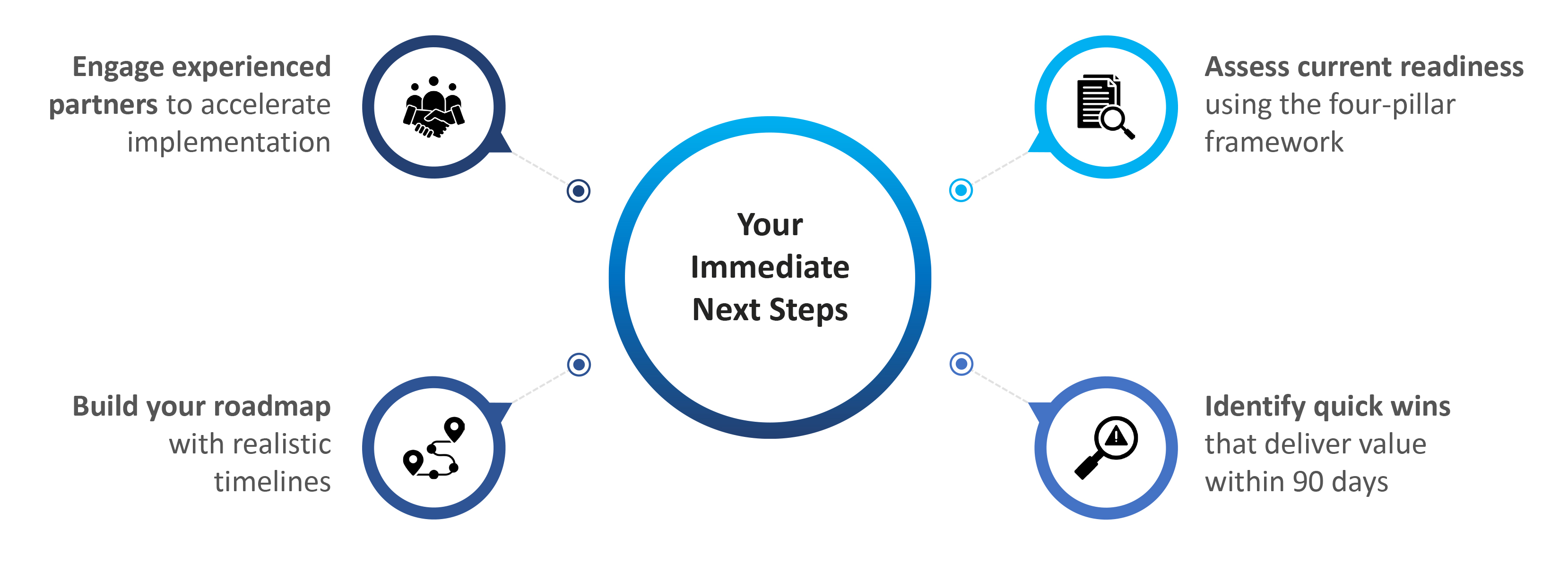
- Assess current readiness using the four-pillar framework
- Identify quick wins that deliver value within 90 days
- Build your roadmap with realistic timelines
- Engage experienced partners to accelerate implementation
The enterprises winning with AI aren’t building better models—they’re building better data foundations.
FAQs
1. How long does it take to build AI-ready data infrastructure?
6-12 months for full maturity, with initial ROI visible within 90 days. Timeline breakdown: Weeks 1-2 for assessment, Weeks 3-8 for quick wins (automated monitoring, data catalog), Weeks 9-12 for foundation (unified access layer, quality controls), and Months 4-12 for enterprise-wide scaling.
2. What does AI data infrastructure cost?
$200K-$800K for foundation building over 6-12 months, depending on current maturity. Enterprise-wide deployment ranges $500K-$2M. However, poor data quality costs up to 6% of annual revenue—making investment essential. Typical ROI: 10-15x within 18 months through eliminated productivity waste and 30-40% infrastructure cost reduction.
3. Can synthetic data replace real data for AI training?
No, but it's a powerful complement. Modern synthetic data delivers 90-95% of real data performance. Best practice: 30% real data + 70% synthetic data for optimal results. Ideal for privacy-constrained scenarios (healthcare, finance), rare event simulation, and cold start problems.