

Are your IT operations still reacting to incidents instead of preventing them?
As multi-cloud environments expand and microservices architectures scale, operational complexity is increasing. Additionally, the pressure of always-on systems and traditional monitoring approaches is starting to reveal clear limitations.
Traditional AIOps platforms, relying on rules and dashboard support, often fall short in prediction, decision-making, and automated remediation.
This is where agentic AI in AIOps planning begins to shift the approach, introducing autonomous systems that can observe, reason, and act with minimal human input.
Gartner predicts agentic AI will autonomously resolve 80% of common customer service issues without human intervention by 2029.
Calsoft enables enterprises to design and deploy autonomous, goal-driven AI agents and multi-agent systems that streamline workflows and improve decision-making at scale. Integrates agentic AI into IT operations to enable predictive insights, automated workflows, and proactive issue resolution.
Enterprises now look for AI that moves from recommendations to responsible execution.
Execution Gaps in Enterprise SDLC and Operations
Customers demand high-speed, reliable, and personalized experiences across touchpoints, while enterprise leaders must deliver this within strict cost and compliance constraints. Enterprises aim to scale team capacity, simplify workflows, and drive operational efficiency in the following areas:
- Development Cycles: Enterprises need AI to automate structured code reviews so developers can focus on design and innovation.
- Testing & Validation: Enterprises need AI that can analyze changes, prioritize critical tests, and optimize regression cycles.
- Operations & Oversight: Large systems generate constant alerts, logs, and troubleshooting demands. AI can act as a first responder, handling repetitive tasks while keeping human control intact.
- Customer Engagement: AI can manage routine interactions, resolve common issues, and escalate complex cases.
Enterprise Bottlenecks in SDLC and AIOps Workflows
|
Role |
When It Appears |
Core Challenge |
Business Impact |
|
Developer |
Early build stage |
Code changes require repeated reviews and validations |
Slower releases, longer cycle time, and underutilized talent |
|
Quality Assurance |
Test planning & regression |
Growing test suites and inefficient test selection |
Delayed releases, higher costs, inconsistent quality |
|
Operations & Reliability |
Scale and sustain stages |
Alert overload and increasing log complexity |
Longer incidents, reduced reliability, and team fatigue |
|
Business Leadership |
When AI fails to scale |
Low ROI, poor adoption, lack of governance clarity |
Delayed strategy, reduced competitiveness, weak AI confidence |
Lack of oversight increases compliance risk. Action-driven AI enables scalable operations, streamlined workflows, and higher efficiency.
What Is Agentic AI in AIOps?
Agentic AI refers to AI systems designed as autonomous agents that can observe environments, reason about system state, act upon insights, and adapt over time without manual intervention.
Adopters move faster. Reviewers validate readiness. Laggards fall behind. Agentic AI is becoming the enterprise norm.
Download our Agentic AI Enterprise Readiness Report to learn how to safely deploy agentic systems across workflows.
Agentic AI moves beyond 'detect and alert' to 'diagnose, decide, and act.'
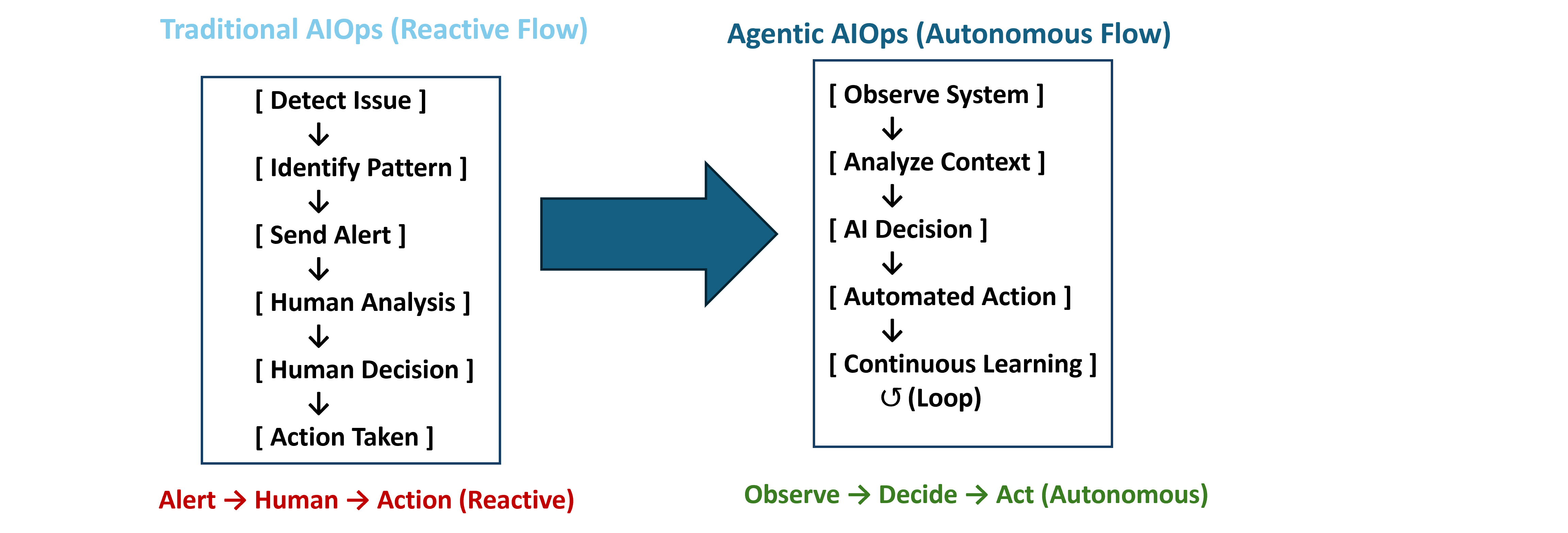
Agentic AIOps integrate generative AI and agentic AI with unified observability to autonomously detect issues, identify root causes, and resolve infrastructure issues.
Agentic AI is not a plug-and-play feature. Enterprises must align their people, processes, and technology to support it.
Enterprises scale on a platform and not on isolated tools. Without this foundation, AI remains limited to pilots and cannot scale across workflows.
Standalone agents may complete tasks, but at scale they introduce overlap, risk, and complexity. Platforms provide the structure—governance, coordination, and visibility needed for controlled execution.
- Orchestration & Coordination: Agents operate across complex workflows with multiple systems and stakeholders. Orchestration ensures defined roles, seamless handoffs, and coordinated execution. Calsoft optimized Kubernetes telemetry by enabling real-time data processing and automated orchestration across clusters using machine learning.
- Oversight & Intervention: This provides visibility, alerts, and the ability to pause or override actions.
- Governance & Traceability: Enterprises need full visibility in agent decisions and actions. Traceability records every step, linking actions to data and policies.
Learn more about Calsoft's AI-powered accelerators: CalTIA for quality assurance and CalPSR for reliability
CalTIA enables AI-driven test prioritization and orchestration at scale. With CI integration, it delivers real-time, traceable, and governed test execution. CalPSR uses predictive analytics to identify reliability risks and recommend actions. With built-in oversight, it enables proactive intervention with human control.
Real-World Use Cases of Agentic AIOps in Enterprises
Agentic AI operates within workflow, executing tasks, adapting to context, and delivering outcomes at scale. Each industry applies it differently. The following examples show how agentic AI creates value at scale:
- Manufacturing Industry Use Case: Predictive Maintenance & Quality Assurance
Context: Production environments depend on continuous quality checks, equipment monitoring, and scheduled maintenance. Manual processes delay response times and increase downtime risk.
Agentic Intervention: AI agents analyse real-time sensor data to predict equipment failures and trigger maintenance actions. They also ensure quality compliance at each stage of production.
Outcome: Reduced downtime, improved throughput, consistent quality, and better utilization of skilled resources.
- Software Development Use Case: Agentic AIOps for Faster Releases
Context: Technology companies face pressure to release products faster while ensuring security, compliance, and quality. Developers and testers spend significant time on repetitive validations.
Agentic Intervention: Agents can handle code reviews, generate deployment scripts, and prioritize test execution.
They can also flag security or compliance risks early in the cycle.
Outcome: Shorter release cycles, fewer errors, lower costs, and more time for innovation.
- Telecom Industry Use Case: Network Operations & Incident Management
Context: Telecom providers manage large-scale networks with high event volumes and disruptions. Manual monitoring strains operations teams.
Agentic Intervention: Agents monitor network events, predict outages, auto-resolve routine issues, and assist customer support.
Outcome: Faster resolution, improved reliability, consistent customer experience, and reduced operational overhead.
Final Takeaway
Agentic AI doesn’t replace engineers; it augments them. Teams that adopt autonomous intelligence for operations see measurable improvements in system reliability, productivity, and operational resilience. The future of enterprise work will not be built by humansalone or by AI alone. It will be shaped by systems where people and agents act together. Agentic AI provides the foundation for that future.
FAQs
1. What is agentic AI in AIOps?
Agentic AI refers to AI systems that act autonomously to detect issues, analyze root causes, and initiate corrective actions without human prompts.
2. How does Agentic AI improve operational efficiency?
It reduces manual intervention, accelerates incident resolution, and enables predictive detection by learning from historical data.
3. Are agentic AIOps suitable for cloud-native environments?
Yes. It is especially beneficial in microservices and distributed deployments where complexity is high and traditional tools struggle.
4. What are common use cases for agentic AI in AIOps?
Autonomous RCA, predictive outage detection, automated remediation, self-healing workflows, and continuous optimization.
5. How can businesses get started with agentic AIOps?
Start by unifying your observability data, defining SLOs, and integrating agentic analytics on low-risk workflows before scaling.