

Somewhere in the Slack channel #prod-alerts, there are 211 unread messages. Nobody will read them today. Not because nobody cares, but reading 211 alerts and doing something useful with each one isn't a job a person can finish before lunch, let alone before the next two hundred arrive. This is the actual state of enterprise IT operations in 2026: not a lack of visibility, a flood of it. Agentic AIOps exists because that gap between seeing a problem and fixing it has become the real cost center, not the infrastructure itself.
Most enterprises don't have a monitoring problem anymore. They have a bottleneck at the exact point where a decision needs to become an action. Telemetry pours in from Kubernetes clusters, cloud regions, and edge nodes. Someone still has to read it, decide, and click. According to Gartner (August 2025), 40% of enterprise applications will carry task-specific AI agents by the end of 2026, up from less than 5% today. The agents are arriving fast. The approval queue in front of them hasn't moved.
Here's the part most vendor pitches skip. A smarter dashboard doesn't fix a bottleneck made of people. Traditional AIOps got good at correlation: telling you which of four hundred alerts actually matters. It got nowhere near as good at execution, because execution means letting software touch production, and nobody wants to be the one who signed off on that without a safety net. So the backlog of ‘known, unresolved’ issues doesn't shrink. It just gets quieter. This is the exact gap Calsoft's agentic AI development services target: agents scoped to specific operational roles, wired into existing ITSM workflows, supervised in real time so a human watches the audit trail instead of the queue.
What Is Agentic AIOps?
The term gets stretched to cover almost anything with a dashboard. Worth being precise. Traditional IT operations needed a human to notice a problem and act on it. AIOps added machine detection and correlation, but a person still owned the decision and the action. Agentic AIOps closes that last gap, moving AI for IT operations from advisor to operator. Some vendors have started calling this AgenticOps instead. The label matters less than the shift it names.
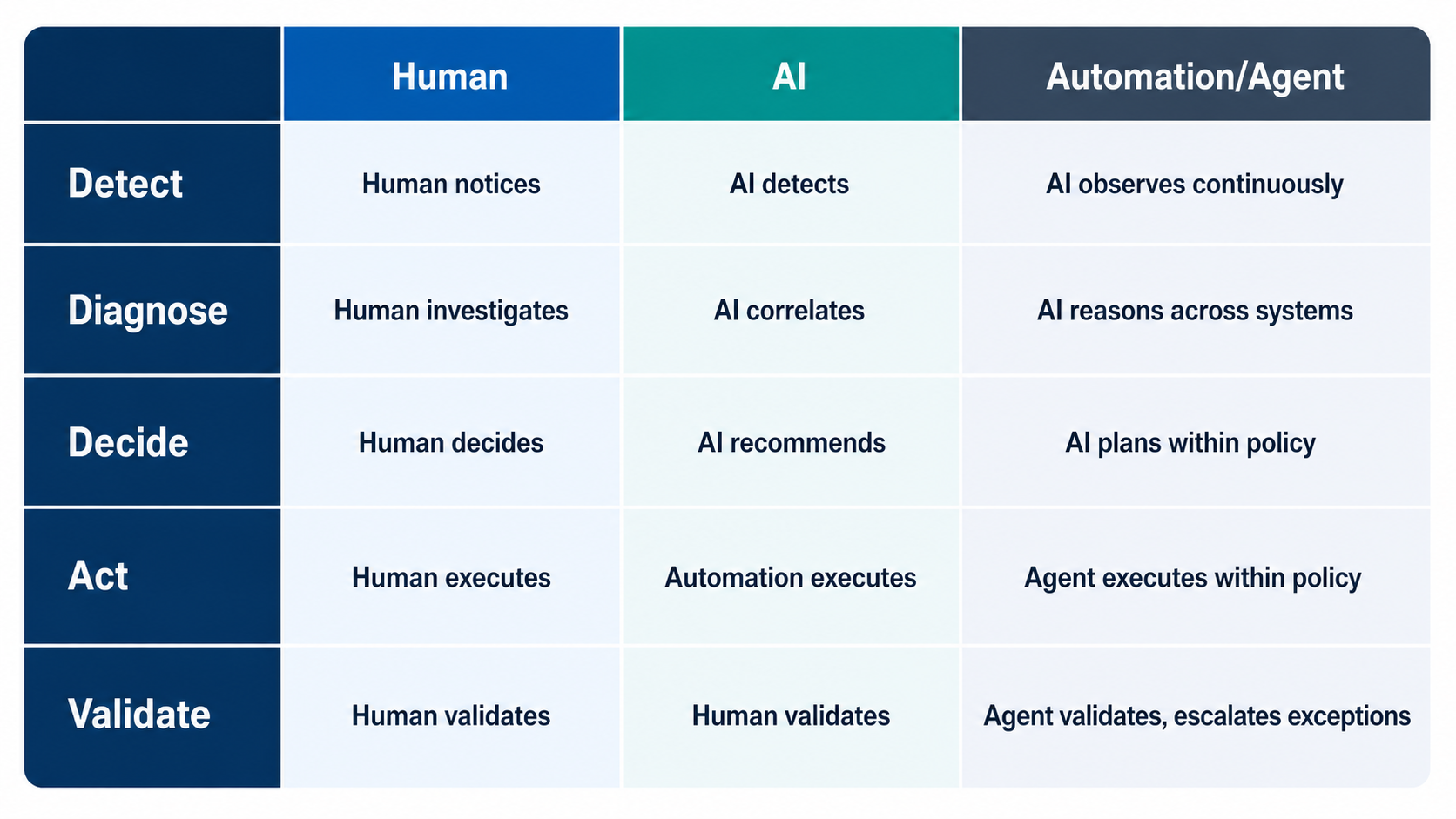
That last column is the whole shift. Not smarter alerts. Fewer clicks between ‘we know’ and ‘it's fixed.’
5 Agentic AIOps Trends Shaping 2027
These are the AIOps trends 2027 infrastructure leaders keep circling back to, whether the conversation starts with budget, headcount, or a bad night on call.
AIOps stops being a dashboard. It starts being an operator. Gartner (June 2025) projects more than 40% of agentic AI projects will be canceled by 2027. Most fail because teams skipped defining what ‘done’ looks like. The projects that survive will be scoped narrow, not scoped ambitious.
Observability becomes the surface agents act on, not just the surface humans read. Inconsistent telemetry across a hybrid stack means an agent reasoning over it inherits that inconsistency, and acts on bad information faster than a person would.
Inference efficiency becomes a matter of AI infrastructure management, not just model quality. Every agent reasoning continuously over live infrastructure burns compute doing it. The trend isn't a bigger model. It's cheaper reasoning, run constantly, close to where the data lives.
Hybrid and edge operations get their own agents, not one shared brain. A single orchestrator reasoning across a data center, three clouds, and a factory floor hits its ceiling fast. Autonomous infrastructure in 2027 looks like specialized agents per domain, coordinated, not one generalist doing everything badly.
Governance stops being a policy document. It becomes a runtime requirement. Greg Freeman, VP of Network and Customer Transformation at Lumen, put it plainly: “AI is non-deterministic, and we need to make it deterministic.” That's the governance conversation in one sentence. The agent's reasoning can be probabilistic. Its permission to act cannot.
Discover how Calsoft integrates AIOps planning to deliver scalable, customizable solutions, including how observability and orchestration got tied together for one enterprise's Kubernetes environment without adding headcount.
None of these five trends land the same way twice. A bank's guardrails and a manufacturer's edge footprint share almost nothing except the shape of the problem: telemetry outpacing the humans meant to read it. What they'll share by 2027 isn't a tool. It's a decision. How much of the loop, from detection to action, are you willing to hand to AI-driven IT operations that don't sleep and don't wait for a click? That question is what agentic AIOps forces onto every 2027 roadmap.
FAQs
What is Agentic AIOps?
Agentic AIOps extends traditional AIOps by letting AI agents act on their own reasoning within defined policy boundaries, instead of only detecting issues and waiting for a human to approve the fix.
How is Agentic AIOps different from traditional AIOps?
Traditional AIOps stops at recommendation. Agentic AIOps executes the action, validates the result, and escalates only what falls outside its defined boundary.
Is autonomous IT infrastructure safe for enterprises?
Only with guardrails: scoped permissions, audit logs, and human escalation paths built in from day one. Without those, autonomy is just faster risk.