

Picture this: a support system authenticates a user, identifies their issue, processes a refund, updates the CRM, and sends a confirmation, all without a human having to click anything. That’s agentic AI in action. It’s not “faster macros.” It’s a move from executing tasks to pursuing outcomes, where systems perceive context, plan, act through APIs, and verify results inside clear guardrails.
What agentic AI actually is
Agentic AI systems can understand intent, plan multi-step actions, call enterprise tools (CRM, ERP, ITSM, HRMS), check their own work, and escalate when needed. That’s a step beyond scripted RPA and Q&A chatbots. Gartner projects that by 2028, 33% of enterprise applications will include agentic capabilities (up from <1% in 2024) and 15% of day-to-day decisions will be made autonomously, evidence that workflows are being redesigned, not just accelerated.
Why is this happening now?
Three forces are converging:
-
Adoption crossed the chasm. McKinsey’s global survey shows organizations using generative AI jumped from 33% (2023) to 71% (2024), and the 2025 cut continues that momentum.
-
Platforms are ready. Modern SaaS now exposes tool-calling and granular APIs, allowing agents to act across apps rather than being confined to chat windows.
-
The productivity squeeze is real. Teams in cloud, networking, security, and IoT need cycle-time wins and fewer hand-offs; precisely where autonomous workflows shine.
Where agentic AI is reshaping workflows
Customer operations and service
In many service organizations, representatives spend a surprising amount of time on low-value administrative tasks. Salesforce reports service reps spend 66% of their time on non-customer-facing tasks like manual logging and data entry. That’s the surface area agents can absorb by triaging requests, searching knowledge bases, initiating standard refunds, updating CRM, and closing routine cases, so people handle the tricky, human moments. According to Salesforce AI Agents stats 2025 user survey, 85% of teams using AI say it saves time, and 92% say it reduces costs, both outcomes you’d expect when routine steps stop waiting on humans.
Software delivery and IT workflows
Engineering and IT are seeing material (but nuanced) gains. Bain notes organizations are already saving 15–40% on code generation and documentation, and 30–50%+ on refactoring, select testing, and debugging when they integrate AI into their delivery toolchain. The pattern with agentic systems is similar: spec-to-PR, test authoring, incident runbooks (diagnose → rollback → notify) become orchestrated loops with humans in approval steps. The lesson from Bain’s work: productivity rises when the process changes alongside the tool, drop agents into a broken flow and people may slow down; redesign the workflow, and you unlock throughput.
Finance, procurement, and back-office
Back-office teams wrestle with reconciliations, three-way matches, accruals, vendor checks, and exception queues; exactly the repetitive, rule-bound work agents can patrol continuously. Bain’s automation research found that “automation leaders” (those investing ≥20% of IT budgets in automation) achieved an average 22% reduction in process costs, a gap that widens as they industrialize the operating model. For CFOs, that’s not just speed; it’s predictability and control.
HR and knowledge management
From onboarding to policy Q&A, agentic systems can sequence tasks across IT, Facilities, and HRMS, keep stakeholders in the loop, and document the trail. McKinsey’s 2025 analysis highlights that 21% of organizations have already redesigned workflows to capture AI value, an important signal that outcomes come from changing the work, not just adding a tool.
How the agent actually works (and stays safe)
Most enterprise agents follow a simple loop: Perceive → Plan → Act → Verify → Learn. They ingest context (tickets, CRM entries, logs), create a plan, call tools via APIs, check outcomes against rules, and either close, retry, or escalate. The enterprise wrap is what makes it trustworthy: role-based access, audit logging, approval thresholds, rollback paths, and observability for “why it did that.” It’s also why Gartner warns that over 40% of agentic AI projects could be canceled by 2027, not for lack of potential, but for unclear value, governance gaps, or runaway complexity.
A practical roadmap
-
Start where the proof is easy. Pick 1–2 workflows with measurable outcomes (handle time, first-contact resolution, exception backlog).
-
Draw the boundary. Define which actions the agent can perform vs. what needs approval.
-
Instrument the loop. Log every action and decision; require citations or evidence where possible.
-
Pilot smart. Run in shadow/assisted mode before granting partial autonomy.
-
Govern from day one. Assign policy owners, set escalation paths, and test failure modes.
-
Scale what works. Replicate only the flows with proven ROI and stable governance.
Risks and controls (the short list)
Expect failure modes like wrong-tool calls, stale context, and policy conflicts. The answer isn’t to slow down; it’s to add layers: constrained retrieval, least-privilege access, rate limits, human-in-the-loop for sensitive steps, and red-teaming of agents. McKinsey found that among 25 attributes tested, workflow redesign had the strongest correlation with bottom-line impact from Gen AI.
What “good” looks like
-
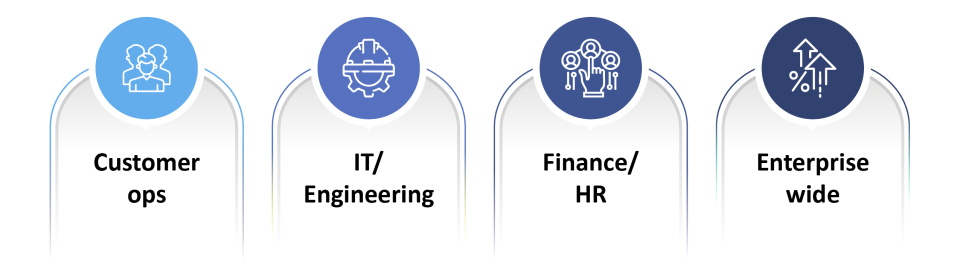
Customer ops: rising first-contact resolution, falling average handle time, fewer manual touches per case.
-
IT/Engineering: shorter lead time for changes, fewer failed changes, faster incident recovery.
-
Finance/HR: higher auto-reconciliation rates, smaller exception backlogs, faster close.
-
Enterprise-wide: lower cost per resolved task, higher percentage of tasks handled autonomously, clean audit trails.
Bottom line
Agentic AI isn’t a gimmick; it’s a new operating model where systems pursue goals under supervision. The winners won’t be those who install more tools; they’ll be the ones who redesign work so agents can deliver measurable outcomes, safely.
Ready to explore agentic AI for your enterprise?
Calsoft helps enterprises design, govern, and scale agentic systems that move the needle, faster resolutions, leaner operations, and real ROI across cloud, storage, networking, and telecom.
FAQ’s
1. How is Agentic AI different from traditional automation or RPA?
Traditional automation or RPA executes predefined rules and scripts; it can’t adapt when conditions change. Agentic AI, on the other hand, understands intent, plans multi-step actions, calls enterprise tools (like CRM, ERP, or ITSM), verifies outcomes, and learns from results. It shifts automation from rule-following to goal-driven execution while maintaining human oversight and governance.
2. What are the best starting points for deploying Agentic AI in an enterprise?
Begin with measurable, repeatable workflows, such as ticket triage in customer service, test automation in IT, or reconciliation in finance. Start in shadow mode (AI suggests, humans approve), then scale gradually with clear success metrics like handle time reduction, accuracy, and cost per transaction. This controlled rollout helps demonstrate ROI while maintaining compliance.
3. What challenges should enterprises anticipate with Agentic AI adoption?
Key risks include unreliable outputs, lack of workflow redesign, governance gaps, and over-trusting AI autonomy. Gartner predicts that over 40% of agentic AI projects could fail by 2027 due to unclear value or oversight. The fix is proactive governance, audit trails, human-in-loop reviews, policy constraints, and continuous performance monitoring to ensure safe, value-driven autonomy.