

Enterprise AI has delivered insights at scale, but insight alone no longer creates advantage.
Most organizations today face the same problem:
Data-driven recommendations exist, yet execution remains slow, manual, and fragmented. Decisions still depend on human handoffs, static workflows, and delayed approvals. As markets, systems, and customer behavior accelerate, this gap between insight and action becomes a competitive liability.
This is where Agentic AI is changing the equation.
Agentic AI enables enterprises to move from AI that informs to AI that acts—autonomously, responsibly, and at scale.
Why Agentic AI matters now
According to McKinsey, fewer than 30% of enterprise AI initiatives consistently deliver measurable business value, largely due to challenges in operationalization and integration
(Source: McKinsey Global Institute – The State of AI)
https://www.mckinsey.com/capabilities/quantumblack/our-insights/the-state-of-ai
The issue isn’t model quality.
It’s decision latency.
Agentic AI addresses this by embedding intelligence directly into enterprise workflows; allowing systems to monitor conditions, evaluate options, and execute actions within defined guardrails.
For data and AI leaders, this represents a shift from decision support to decision execution.
What makes Agentic AI different (without the hype)
Agentic AI systems are designed to:
-
Continuously sense enterprise data and system signals
-
Reason across goals, constraints, and policies
-
Take actions across applications without constant human prompting
This is not:
-
Rule-based automation (which breaks under complexity)
-
GenAI copilots (which wait for human instructions)
The key difference is closed-loop autonomy—agents learn from outcomes and adapt over time.
That structural capability—not model novelty—is what enables competitive advantage.
How Agentic AI creates competitive advantage
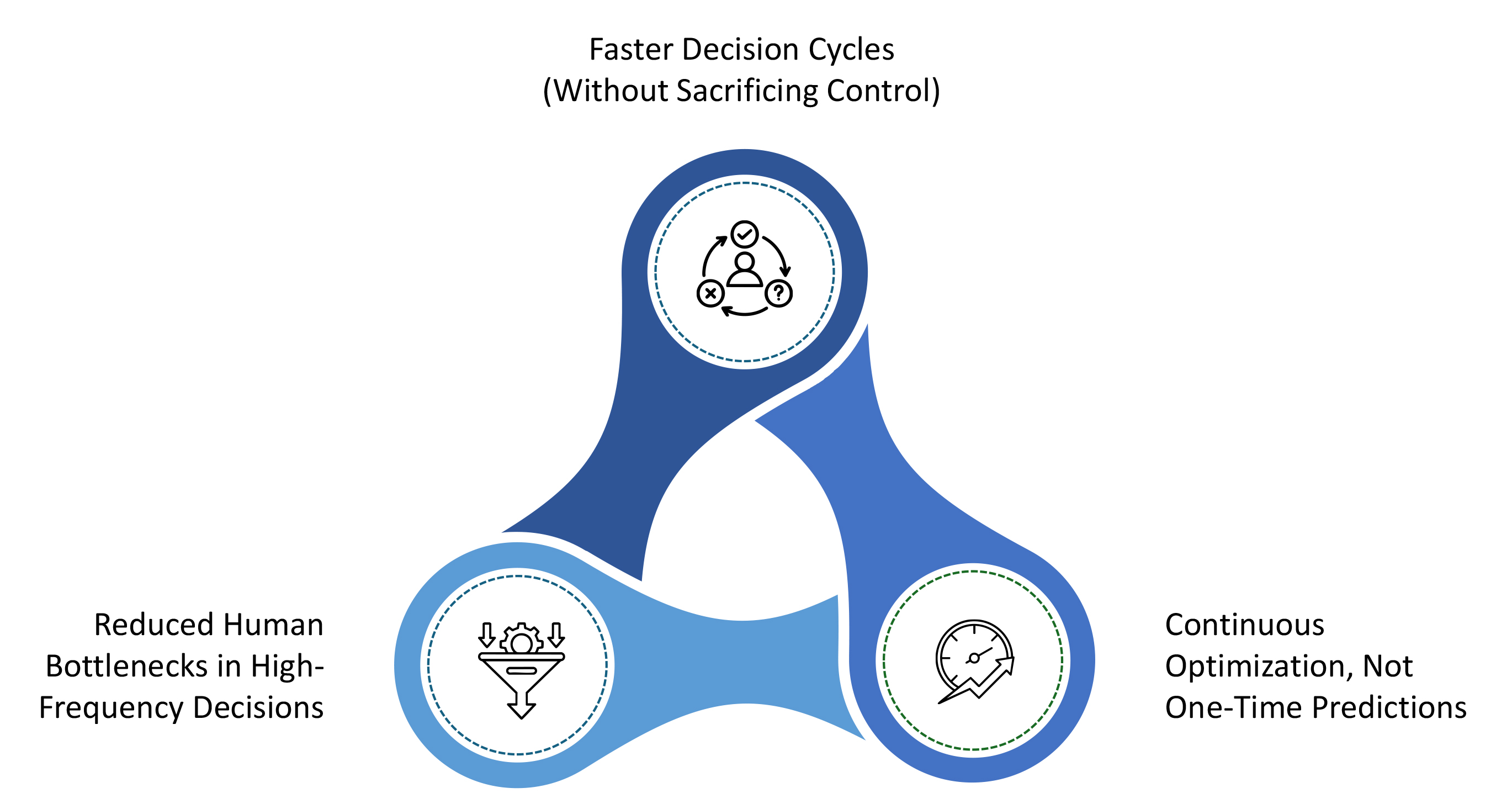
1. Faster decision cycles (without sacrificing control)
In traditional setups, insights wait for approvals. With Agentic AI, low- and medium-risk decisions can execute automatically, while high-impact actions escalate to humans.
Result:
Reduced latency without losing governance.
2. Continuous optimization, not one-time predictions
Agentic systems don’t stop at recommendations. They monitor outcomes, adjust strategies, and refine actions continuously.
This enables:
-
Dynamic pricing adjustments
-
Real-time operational rebalancing
-
Adaptive customer engagement
Advantage compounds over time.
3. Reduced human bottlenecks in high-frequency decisions
Enterprises face thousands of operational decisions daily. Agentic AI absorbs the repetitive load, allowing teams to focus on exceptions, strategy, and oversight.
Competitive advantage comes from organizational leverage, not workforce reduction.
Where enterprises are applying Agentic AI today
Agentic AI delivers the most value where decisions are frequent, data-rich, and time-sensitive.
Customer experience orchestration
Agents adapt journeys across channels, triggering proactive interventions based on behavior and context.
Intelligent operations & supply chain
Agents rebalance inventory, adjust procurement plans, and respond to disruptions in near real time.
Revenue & sales intelligence
Systems evaluate pipeline signals, forecast risk, and recommend next-best actions automatically.
IT operations & incident response
AI agents correlate alerts, diagnose root causes, and initiate remediation workflows.
Risk, compliance & governance
Agents continuously monitor transactions and enforce policy controls with auditability.
The enterprise architecture that makes Agentic AI work
Agentic AI fails without strong engineering foundations.
1. Data & context layer
Agents require trusted, governed access to structured and unstructured enterprise data.
2. Agent orchestration layer
This manages task delegation, conflict resolution, and policy enforcement across agents.
3. System integration layer
Autonomy only delivers value when agents can act across ERP, CRM, cloud, and operational systems.
4. Observability & human oversight
Enterprises must track decisions, outcomes, and agent behavior—enabling intervention when needed.
Common failure mode: agents optimizing locally but harming system-wide outcomes.
Successful implementations design shared objectives and escalation paths upfront.
Governing Agentic AI without slowing it down
Autonomy demands discipline.
Enterprises must clearly define:
-
Which decisions agents can execute independently
-
Risk thresholds requiring human approval
-
Accountability and audit mechanisms
Gartner notes that lack of governance is one of the top reasons AI initiatives stall in production
Effective governance enables scale—it doesn’t restrict it.
Measuring ROI: What actually matters
Model accuracy is not a business metric.
Enterprises measure Agentic AI success through:
-
Reduction in decision latency
-
Operational cost savings
-
Error and exception rate reduction
-
Revenue protection or uplift
These metrics reflect execution quality, not prediction quality.
From pilot to production: A practical path
Enterprises that scale Agentic AI successfully follow a consistent approach:
-
Identify high-friction, high-volume decisions
-
Strengthen data and integration foundations
-
Design agent workflows with clear guardrails
-
Deploy with observability and escalation paths
-
Optimize continuously based on outcomes
This is an engineering-led transformation—not a tooling exercise.
Why this is a Data & AI engineering problem
Operationalizing Agentic AI requires:
-
Deep data engineering
-
Scalable AI platforms
-
Secure system integration
-
Production-grade governance
This is where enterprise-focused Data & AI service providers add value—by connecting intelligence to execution across complex environments.
Final thought
Agentic AI is not about replacing people or chasing novelty.
It’s about closing the gap between intelligence and execution.
Enterprises that master this shift will move faster, operate smarter, and compete more effectively in increasingly complex environments.
FAQs
What is Agentic AI in simple terms?
AI systems that can make and execute decisions autonomously within defined business rules.
Is Agentic AI risky for enterprises?
Only without governance. With proper controls, it reduces risk by standardizing and monitoring decisions.
How is this different from automation?
Automation follows fixed rules. Agentic AI adapts decisions based on context and outcomes.
How long does it take to see value?
Initial use cases can deliver measurable impact within months when applied to high-frequency decisions.