

Do you feel flooded with security alerts daily? Do you struggle to keep up with data overload? One critical alert might be overlooked in such cases, leading to a severe security breach.
Why is this happening? The digital world is expanding—there are more devices, more data, and more sophisticated threats. The old ways of dealing with security are no longer enough. This is where security automation steps in.
Security automation uses technology to perform repetitive security tasks automatically. It enables the immediate detection and resolution of security alerts without constant manual intervention. In a modern Security Operations Center (SOC), automation handles most of the routine tasks assigned to security analysts—enhancing speed and efficiency while freeing up human operators to focus on strategic initiatives.
In this blog, we will explore what security automation is and how AI is redefining threat detection and response.
Understanding Security Automation
Before automation, security analysts manually investigated every alert—verifying, correlating, and remediating threats. With today’s volume of alerts, such manual processes are impractical. Many alerts turn out to be false positives, leading to alert fatigue and wasted time.
Security automation leverages software tools to detect, investigate, and remediate cyber threats—often without human intervention. It identifies potential risks, prioritizes them, and takes action to protect systems. This drastically reduces analyst workloads and response times.
How It Streamlines Processes
- Faster Incident Response: Automated systems detect and neutralize threats in real time, reducing risk exposure.
- Reduced Manual Workload: Routine processes like log analysis, vulnerability scanning, and alert triage can be automated.
- Improved Accuracy: Automation reduces human error, ensuring precise and consistent threat detection.
- Consistency: Automated tools ensure uniform enforcement of policies and compliance across all systems.
Enterprises must adopt a holistic security approach—implementing protection at every layer: network, endpoint, application, data, and cloud.
Importance of Security Automation in Cybersecurity
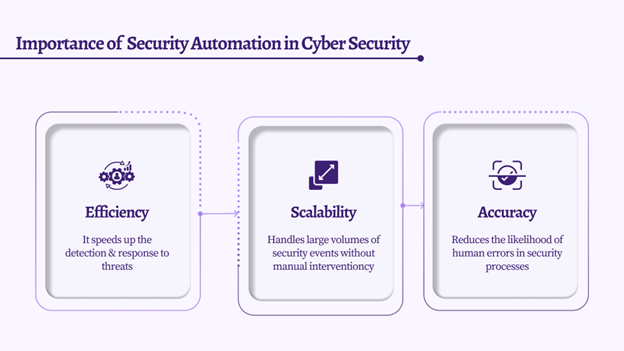
Security automation is vital for managing modern cyber threats and protecting systems efficiently.
- Efficiency: Detects and responds to threats faster.
- Scalability: Handles massive volumes of alerts automatically.
- Accuracy: Reduces human error and increases reliability.
Key Components of Security Automation
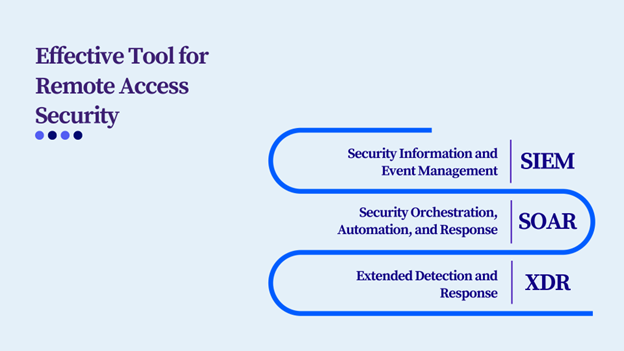
Security automation relies on interconnected systems and tools that handle detection, response, and orchestration without manual effort. The key components include:
Security Information and Event Management (SIEM)
SIEM systems collect, analyze, and correlate data across networks for real-time monitoring and threat detection. They aggregate logs from devices, applications, and servers to identify anomalies and trigger alerts.
Security Orchestration, Automation, and Response (SOAR)
SOAR platforms integrate multiple tools to automate incident response workflows. They isolate compromised systems, block malicious IPs, and notify teams—reducing response times and manual effort.
Extended Detection and Response (XDR)
XDR consolidates telemetry across endpoints, servers, and cloud environments for unified visibility and cross-domain threat detection.
Difference Between SIEM, SOAR, and XDR
| Component | Primary Function | Automation Level | Ideal Use Cases |
|---|---|---|---|
| SIEM | Aggregates and analyzes security data | Moderate | Real-time monitoring and threat detection |
| SOAR | Automates incident response workflows | High | Incident response and threat intelligence management |
| XDR | Integrates data across the entire security stack | Very High | Comprehensive detection and response across domains |
Implementing Security Automation: Best Practices
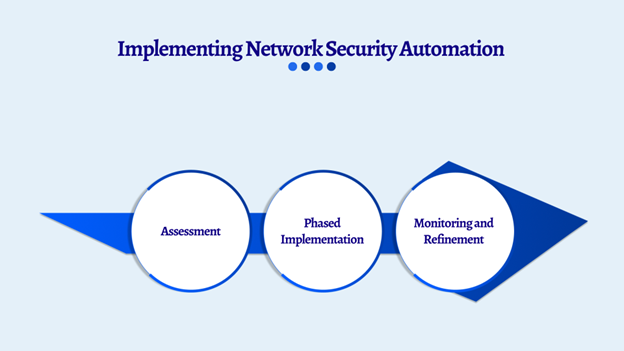
- Comprehensive Security Assessment: Identify repetitive, time-consuming tasks that can be automated. Evaluate gaps and prioritize areas for improvement.
- Phased Implementation: Start with low-risk automation (e.g., log analysis), test thoroughly, and gradually expand to mission-critical processes.
- Continuous Monitoring and Refinement: Regularly audit automation tools, update workflows, and refine based on evolving threats and lessons learned.
Challenges and Considerations
Despite its benefits, implementing security automation comes with challenges such as integration issues, high setup costs, and the need for skilled teams.
- Integration Challenges: Legacy systems may not easily connect with modern automation tools.
- Initial Setup Costs: Licensing, configuration, and training require upfront investment.
- Skill Gaps: Teams must be trained to manage and optimize automated systems.
The Role of AI in Security Automation
Artificial Intelligence (AI) and Machine Learning (ML) play a pivotal role in enhancing security automation by analyzing large datasets and identifying patterns impossible to detect manually.
- Predictive Analytics: Uses historical data to forecast potential security issues and prepare proactive defenses.
- Anomaly Detection: ML models learn normal behavior and flag deviations that could indicate emerging threats.
- Automated Decision-Making: AI systems can autonomously isolate infected systems or block suspicious traffic.
Use Cases of Security Automation
1. Automating Compliance Management
Automation ensures compliance with regulatory requirements by streamlining reporting and enforcement of security policies.
2. Enhancing Threat Detection and Incident Response
Automated systems continuously monitor network traffic and take swift action—isolating infected devices, blocking malicious IPs, and alerting teams instantly.
3. Streamlining Security Operations
Automation reduces manual workloads, prioritizes alerts by severity, and allows analysts to focus on strategic initiatives instead of repetitive tasks.
Future Trends in Security Automation
Technological Advancements
AI and ML will continue to strengthen automation by enabling adaptive systems that anticipate and neutralize threats in real time.
- Improved predictive analytics to detect risks early.
- Adaptive systems that evolve with new threat patterns.
Integration of Advanced Tools
Comprehensive solutions such as XDR and SOAR will merge into unified platforms, providing full-stack visibility and automated incident response capabilities.
- Consolidated security platforms with shared intelligence.
- Reduced manual intervention through intelligent automation.
Concluding Thoughts
Security automation is no longer optional—it’s essential. As cyber threats evolve, manual responses cannot keep up. Automation enables faster detection, response, and compliance management, helping organizations maintain a strong security posture. Investing in automation empowers teams to focus on innovation and resilience rather than repetitive firefighting.
Calsoft, as a technology-first partner, offers advanced AI/ML-based cybersecurity solutions that enhance detection and response capabilities across people, processes, and technologies.