

Ethical hacking is the word!
Penetration testing, also known as ethical hacking, is rapidly becoming a crucial element of modern cybersecurity strategies. As organizations embrace digital infrastructure, the risk of cyberattacks grows significantly. This makes it essential for businesses to identify and fix vulnerabilities before they lead to severe consequences.
Penetration testing services are designed to simulate real-world cyberattacks, uncovering weaknesses in systems, applications, and networks. This proactive approach empowers organizations to stay ahead of potential threats and strengthen their security protocols. In this blog, we’ll explore the fundamentals of penetration testing — its phases, types, benefits, and the latest trends shaping the industry.
So, stay tuned!
What is Penetration Testing?
Penetration testing (or pen testing) is a cybersecurity procedure where experts conduct simulated attacks to identify and fix vulnerabilities in systems. The main goal is to mimic real-world hacker behavior to uncover weak points in a system’s defense before malicious actors exploit them.
Pen testers use the same tools and techniques as cybercriminals to reveal potential weaknesses. These tests replicate a variety of attack scenarios to determine how well a system can withstand internal and external threats.
Why Do Companies Perform Pen Tests?
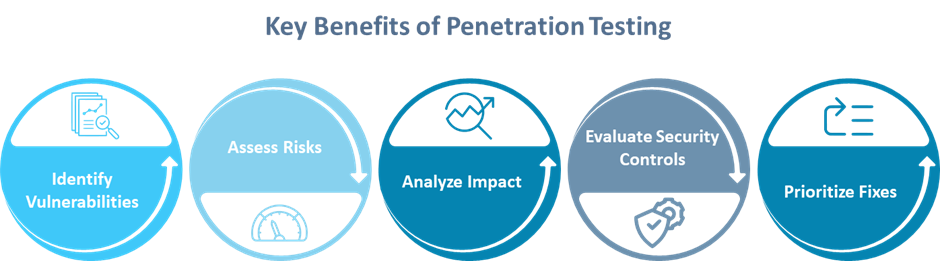
Penetration testing offers businesses numerous benefits. According to Kaspersky Lab, over 40% of companies lack sufficient cybersecurity, and 73% of successful breaches target vulnerable web applications. These alarming figures emphasize the importance of regular pen tests.
Here are the top three reasons why companies conduct penetration tests:
Reason #1: More Comprehensive than Vulnerability Assessments
While vulnerability assessments detect known flaws, penetration testing takes it further by simulating real-world attacks. This helps security teams understand how vulnerabilities could be exploited and allows them to build stronger defenses.
Reason #2: Recommended by Cybersecurity Experts
Cybersecurity professionals recommend pen testing as a proactive measure. Simulated attacks provide insight into how advanced threats can exploit weaknesses that automated tools may miss. Regular pen testing showcases an organization’s commitment to data protection and customer trust.
Reason #3: Compliance with Regulations
Data protection laws such as HIPAA and GDPR mandate robust security controls. Pen testing verifies that these measures are effective, helping organizations maintain compliance and avoid penalties.
Types of Penetration Testing
Penetration testing applies various approaches based on objectives and target systems. Understanding these types is essential for developing an effective security strategy.
Black Box Penetration Testing
In this type, the tester has no prior knowledge of the target system. It simulates an external attack, evaluating how far an outsider could penetrate without any insider information.
White Box Penetration Testing
Here, the tester has complete access to system architecture and source code. This approach identifies internal vulnerabilities caused by poor coding practices, weak configurations, or insufficient defenses.
Grey Box Penetration Testing
This hybrid approach gives testers partial knowledge of the system — such as limited credentials or network details. It strikes a balance between black box and white box testing, saving time while providing deep insights.
Five Phases of Penetration Testing
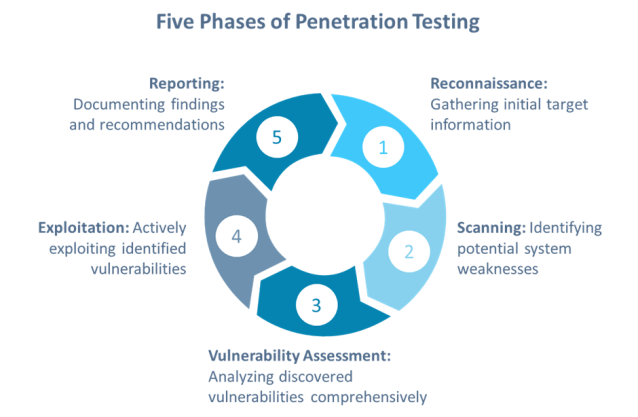
Penetration testing typically includes five key phases. Each phase builds on the previous one, forming a structured and effective assessment process.
Phase 1: Reconnaissance
The tester gathers as much information as possible about the target — including network details, OS, applications, and user data. This helps in strategizing effective attacks. Reconnaissance can be active (direct interaction) or passive (public data gathering).
Phase 2: Scanning
This phase involves analyzing the target system using tools like network mappers and vulnerability scanners to detect weak points and potential access routes.
Phase 3: Vulnerability Assessment
Testers evaluate the vulnerabilities identified during the first two phases and prioritize them based on severity. Databases such as the National Vulnerability Database (NVD) and Common Vulnerability Scoring System (CVSS) are often used for this assessment.
Phase 4: Exploitation
Here, testers attempt to exploit vulnerabilities using real-world attack methods to validate risks and test defenses. Although rare, testers must take precautions to avoid system crashes or data loss during this step.
Phase 5: Reporting
Finally, testers document findings, vulnerabilities, and exploited weaknesses in a detailed report. This includes actionable recommendations such as configuration changes, patches, and security policy enhancements.
Latest Trends and Technologies in Penetration Testing
To stay ahead of evolving threats, it’s crucial to understand the latest trends and technologies influencing penetration testing.
1. Cloud Security
With businesses migrating to the cloud, many service providers still lack strong encryption or authentication controls. Cloud-focused pen tests help secure endpoints and uncover vulnerabilities unique to virtual environments.
2. Artificial Intelligence (AI)
AI is transforming penetration testing by automating repetitive tasks, improving accuracy, and detecting threats faster. The integration of AI-based automation enhances efficiency and scalability in testing processes.
3. Integrations with GRC, SIEM, and Helpdesk Systems
Integrating pen testing with Governance, Risk Management, and Compliance (GRC), Security Information and Event Management (SIEM), and helpdesk systems helps automate workflows, alert teams in real time, and ensure coordinated responses to vulnerabilities.
Conclusion
Cyberattacks pose serious risks to any business, potentially leading to financial loss, reputational damage, and loss of customer trust. Conducting regular penetration tests is one of the best ways to mitigate these risks.
Experts recommend performing pen tests at least once a year or after significant system changes. A tailored and consistent testing plan helps maintain strong defenses and aligns with organizational security needs.
Penetration testing is no longer optional—it’s an essential practice for securing IT ecosystems against ever-evolving cyber threats.
At Calsoft, we offer comprehensive Managed Testing Services using advanced techniques such as beta testing and behavior-driven testing. Our focus is to accelerate customers’ digital transformation journeys with reliable, “just-in-time” quality validation for products and solutions.