

Keen on optimizing IT service management? Wondering how ServiceNow integrations can revolutionize your company’s workflows, efficiency, and customer support? It’s time to explore the transformative power of ServiceNow!
ServiceNow is a cloud-based platform that provides enterprise-level IT service management, automates business processes, and enhances overall efficiency. ServiceNow integration connects the platform with various systems and applications to streamline workflows and improve interoperability, allowing businesses to develop custom plug-ins for their unique requirements. Calsoft leverages its deep understanding of the ServiceNow ecosystem to deliver tailored plug-in solutions for enterprises.
With ready-to-use tools and customizable plug-ins, ServiceNow is one of the fastest-growing cloud platforms. According to research from ServiceNow and Pearson, AI and future technologies will drive job growth and increase the demand for skilled IT professionals. ServiceNow’s new AI-powered features help businesses strengthen their talent strategies and enhance employee experiences.
ServiceNow offers a wide range of third-party integrations. These integrations improve IT management, security operations, HR service delivery, customer service management, and more. Let’s explore the best ServiceNow integrations for companies with existing implementations.
Before diving into integration types, let’s first understand what ServiceNow integration means and the key considerations involved.
What is ServiceNow Integration?
ServiceNow is one of the most popular cloud platforms for enterprise workflow and integration solutions. It enables quick and efficient system integrations to optimize workflows and business processes.
Benefits of ServiceNow Integration:
- Provides a unified platform for multiple departments to track project progress and responsibilities.
- Scalable and adaptable for organizations of all sizes, with pre-built apps such as ITSM, ITOM, ITBM, and GRC.
- Offers robust reporting and analytics to identify issues proactively and deliver insights.
- Enables development and customer support teams to collaborate effectively, leading to faster resolution times and improved satisfaction.
Key Considerations for ServiceNow Integration
When adopting or implementing ServiceNow, businesses should evaluate several critical factors to ensure a successful deployment.
1. Compatibility and Interoperability
Assess how well ServiceNow integrates with existing systems, including supported APIs, data formats, and middleware. Ensuring compatibility reduces integration risks, preserves data integrity, and enables seamless data flow across systems.
2. Data Security and Compliance
Data protection is paramount. Ensure that integration processes comply with standards such as GDPR, HIPAA, and ISO 27001. Implement data encryption, secure authentication, and access control mechanisms. Conduct periodic security audits to mitigate risks.
3. Scalability and Performance
ServiceNow integrations should scale to accommodate business growth, handling increased data volumes and user activity without affecting performance. Evaluate system capacity and design integrations that maintain speed and reliability under heavy loads.
4. Customization and Flexibility
ServiceNow’s flexibility allows for custom integrations tailored to business needs. Configure workflows, data mappings, and automation rules to suit unique requirements, while ensuring that customizations remain maintainable during future upgrades.
5. Monitoring and Maintenance
Continuous monitoring is essential for maintaining performance and reliability. Use monitoring tools to track system health and performance metrics. Regular updates, API patches, and proactive maintenance ensure long-term stability.
6. Vendor Support and Resources
Leverage ServiceNow’s technical assistance, documentation, and community forums. Partnering with experienced ServiceNow experts can accelerate integration timelines and ensure smooth implementation.
Implementation Process
When is the Best Time to Integrate with ServiceNow?
Integrations can be introduced at any stage but should align with organizational readiness and data structure maturity. Secure stakeholder buy-in and ensure that integration goals align with business objectives. Regularly review integrations to confirm they provide ongoing value without adding unnecessary maintenance overhead.
In today’s ITSM landscape, ServiceNow integrations empower enterprises to modernize IT operations. With its robust ITSM architecture, ServiceNow effectively manages and enhances IT services.
Calsoft, a trusted ServiceNow Implementation Partner, assists customers through various stages of the integration cycle. For instance, Calsoft enhanced IT service management processes for an enterprise, aligning IT services with business goals and improving operational efficiency.
ServiceNow ITSM Integration Architecture
Understanding the ITSM integration architecture is crucial before connecting ServiceNow with external systems.
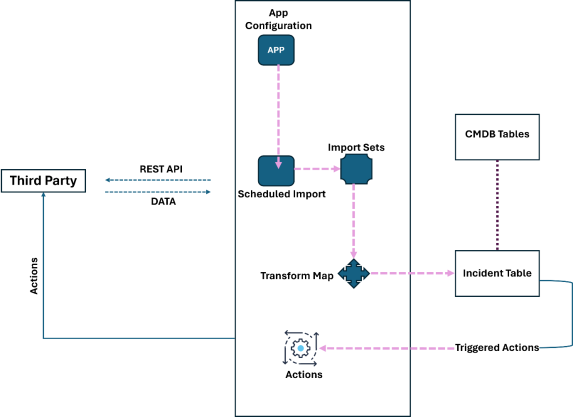
Step-by-Step Overview:
- Plugin Installation and Configuration: Install and configure the dedicated ServiceNow plugin within the target system to enable secure communication.
- Data Fetching via REST API: ServiceNow retrieves data using REST APIs for processing and synchronization.
- Scheduled Data Import: Configure flexible import schedules (e.g., every 10 minutes or 24 hours) to automate data syncing.
- Data Storage in Import Sets: Imported data is temporarily stored in import sets for staging before transformation.
- Data Mapping and Transformation: Data is mapped to ServiceNow ITSM fields via a Transform Map for accurate alignment.
- Data Storage in Incident Table: Incidents are recorded and managed within the Incident Table for tracking and analysis.
- Leveraging CMDB Data: Incident data links with Configuration Items (CIs) in the CMDB to assess impact and dependencies.
- Automated Actions: Incidents can trigger automated workflows (e.g., isolating malware-infected devices) to minimize disruption.
This architecture ensures that ServiceNow efficiently manages data flow and operational processes between integrated systems.
The Best ServiceNow Integrations for Enterprises
1. Jira Integration
Jira helps software teams manage projects and workflows. Integrating Jira with ServiceNow enables seamless communication, automated issue tracking, and enhanced visibility between IT and development teams.
2. Azure Integration
Microsoft Azure integration enhances IT operations by allowing ServiceNow to pull event and monitoring data from Azure resources, streamlining incident response and infrastructure management.
3. Splunk Integration
Splunk helps organizations analyze big data for performance insights. Integrated with ServiceNow, Splunk improves incident visibility and analytics, enabling faster detection and resolution.
4. McAfee Integration
McAfee Enterprise Security Manager integrates with ServiceNow for real-time monitoring, incident enrichment, and email parsing—providing enhanced visibility into security events and faster remediation.
5. Salesforce Integration
Salesforce integration offers bi-directional connectivity between CRM and ITSM systems. Sync cases, accounts, users, and opportunities for unified data management and reporting.
6. HR Management Systems Integration
Integrating HR management tools with ServiceNow automates processes like onboarding, leave management, and employee data synchronization, enhancing HR service delivery.
7. Communication Integration
ServiceNow’s advanced communication integrations include chat, phone, and email automation, allowing agents to respond quickly to customer needs. It supports ServiceNow Email, Phone, Calendar, and Chat Integrations for unified communication management.
These integrations demonstrate ServiceNow’s versatility and scalability, allowing businesses to optimize operations by seamlessly connecting with existing tools and systems.
Conclusion
ServiceNow integrations enable organizations to leverage their existing systems, workflows, and investments without additional overhead or data migration challenges. Enterprises can import and export data seamlessly while automating cross-platform workflows.