

The telecom industry is evolving rapidly to meet the changing demands of end users. Telecom Service Providers (SPs) began their 5G journey in 2018, aiming to deliver enhanced network coverage and capacity. However, to meet specific user requirements, telecom operators must not only migrate across cellular generations (2G–3G–4G–5G) but also upgrade their entire network architecture.
5G and beyond technologies are designed to support massive machine-type communications and ultra-low latency services. To meet these advanced 5G requirements, a complete end-to-end network transformation is necessary — encompassing the Radio Access Network (RAN), transport, and core layers. The telco industry is rapidly transitioning toward a virtualized Radio Access Network (vRAN), Open RAN, and service-oriented Core Network (5G Core). Advancements in transport architecture play a key role in efficiently delivering reliable 5G services.
Let’s explore 5G transport technologies and the key advancements shaping next-generation transport architectures.
What is an xHaul Network?
A mobile communication network consists of three key segments: access, transport, and the core network. Each of these layers must evolve to support the technical requirements of 5G use cases such as Enhanced Mobile Broadband (eMBB), Ultra-Reliable Low-Latency Communication (uRLLC), and Massive Machine-Type Communication (mMTC).
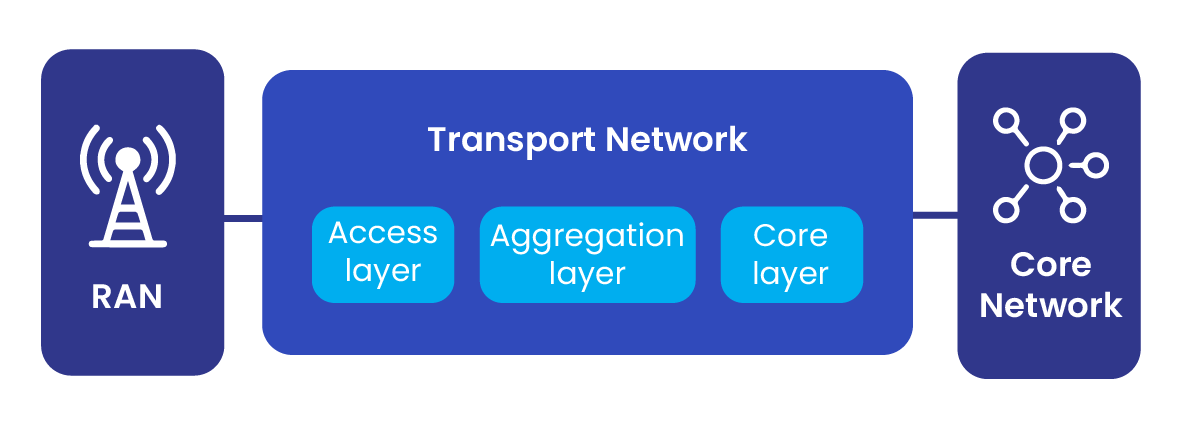
The transport network connects the access layer (RAN) to aggregation data centers and the core network. It manages data transfer and traffic between the RAN and the core to deliver services such as voice, video, and data applications. To meet the demands of 5G, the transport network must evolve in terms of bandwidth, latency, flexibility, scalability, and intelligence.
For instance, eMBB requires peak data rates up to 20 Gbps, while mMTC must support one million devices per square kilometer. Transport links must deliver:
- 10–50 Gbps at the access layer
- 100–400 Gbps at the aggregation layer
- 400 Gbps and beyond at the core layer
Similarly, uRLLC services demand end-to-end latency below 1 millisecond — necessitating advanced transport technologies to support diverse 5G scenarios.
The 5G transport network, or xHaul, includes three components: fronthaul, midhaul, and backhaul. In LTE (4G), the fronthaul connected Remote Radio Heads (RRHs) to centralized Baseband Units (BBUs), while the backhaul connected BBUs to the Evolved Packet Core (EPC).
In 5G, BBUs are disaggregated and virtualized into Centralized Units (CUs) and Distributed Units (DUs):
- Fronthaul – Connects Radio Units (RUs) to DUs.
- Midhaul – Connects DUs to CUs.
- Backhaul – Connects CUs to the 5G Core.
Learn more about the 5G Core in our blog: 5G Service-Based Architecture.
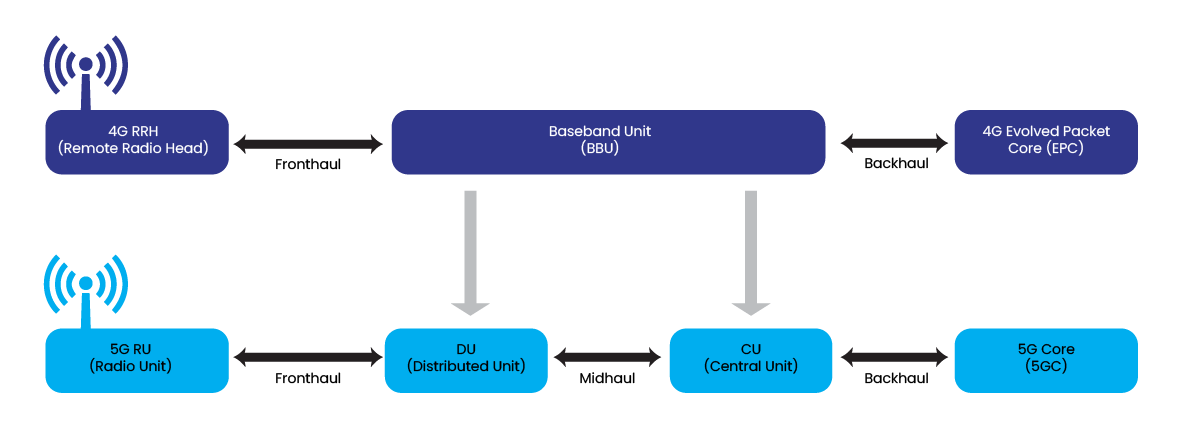
The 5G RAN can be deployed flexibly based on operator needs. The CU–DU interface (Higher Layer Split) is delay-tolerant, while the RU–DU interface (Lower Layer Split) requires high bandwidth and extremely low latency. The placement of RU, DU, and CU depends on service demands — for example, in uRLLC services, these elements must be closer to the end application.
To know more about 5G RAN, read our eBrief: Intelligent and Automated 5G RAN.
Low-latency applications demand new network topologies and flexible, scalable transport frameworks. Mobile Network Operators (MNOs) are exploring innovative xHaul transport solutions — both wired and wireless — to deliver reliable and efficient 5G services. Technologies such as Network Function Virtualization (NFV), Software-Defined Networking (SDN), and Network Slicing enhance 5G xHaul flexibility, scalability, and intelligence. Explore more on SD-WAN.
Key 5G xHaul Transport Technologies
- Microwave: Provides gigabit bandwidth with ultra-low latency (as low as 25 microseconds per site) and supports slicing. Using SDN, microwave transport achieves flexible and intelligent operations. It continues to evolve with technologies like adaptive modulation, dual-band antennas, and carrier aggregation. It’s ideal for Private 5G Networks.
- Fiber Optics: Enables ultra-high bandwidth and low-latency connectivity. As 5G requires processing massive IoT data and operating across diverse frequency bands (sub-6GHz to 24GHz), fiber optics remains the most reliable medium for high-speed data transfer.
- Ethernet-based Fronthaul: The most challenging 5G interface — between RU and DU — now uses packet-based eCPRI to support 5G NR and massive MIMO systems. This reduces operational costs and scales bandwidth efficiently based on traffic demands.
- Integrated Access Backhaul (IAB): A wireless backhaul solution ideal for dense 5G deployments. It offers flexible, scalable connectivity while maintaining performance with minimal backhaul hops.
- Satellite: In regions where fiber connectivity is impractical, satellite or Non-Terrestrial Networks (NTN) provide essential backhaul coverage, especially in rural and remote areas.
- Time-Sensitive Networking (TSN) Ethernet: Ensures time synchronization across fronthaul and backhaul networks, supporting ultra-low latency and minimal congestion — ideal for mission-critical 5G applications.
In Brief
Next-generation 5G technologies are enabling revolutionary applications — from autonomous vehicles and smart factories to telemedicine. To meet stringent requirements for bandwidth, latency, and reliability, the entire telecom architecture must evolve — from access to transport to core. A flexible, scalable, and resilient 5G transport framework is essential for achieving these goals.
The evolution of 5G networks will bring more distributed, virtualized, and open systems — integrating slicing techniques and precise synchronization. Efficient 5G xHaul networks will support high bandwidth, low latency, and scalability for diverse service demands.
Calsoft, a technology-first company and pioneer in virtualization, SDN, SD-WAN, and cloud computing, empowers telecom service providers to build innovative, future-ready solutions that lead network transformation.
Contact our 5G experts to learn more about optimizing your 5G network architecture.
References
[1] 5G Transport Network – Huawei
[2] Spotlight on 4G/5G Backhaul Networks – Ciena