

The most exciting feature of 5G networks is their ability to provide tailored solutions for diverse use cases such as ultra-Reliable Low-Latency Communications (URLLC), enhanced Mobile Broadband (eMBB), and massive Machine Type Communication (mMTC). To meet these varying requirements, network transformation plays a key role — and at its heart lies Network Slicing technology.
Understanding Network Slicing
Network slicing is a smart way to partition a physical network into multiple virtual networks — each optimized for a specific industry, business, or application — enabling multi-tenancy. It allows service providers to create isolated logical networks on shared infrastructure to support different service needs efficiently.
In legacy networks, the end-to-end connection from the user to the application (via RAN and Core Network) operated as a single static pipeline that defined Quality of Service (QoS). Network slicing replaces this legacy approach with a flexible, on-demand, service-based architecture (SBA) — the foundation of modern 5G networks.
Keep reading to explore the concept of network slicing, its key components, and management models.
Slice Selection and Structure
The process of slice selection is central to network slicing. With 5G, multiple network instances can be dynamically created, enabling several logical connections across different users and applications. These slices allocate dedicated physical and virtual network resources across all layers — from devices and RAN to transport, edge, core, and application levels.
The three primary layers of a network slice are:
- Service Instance Layer
- Network Slice Instance Layer
- Resource Layer
Additional key components include:
- Slice Identification and Selection: Achieved through Single Network Slice Selection Assistance Information (S-NSSAI). An NSSAI can contain up to 8 S-NSSAIs, each defining a distinct slice.
- Network Slice Instance (NSI): As defined by 3GPP, an NSI is a group of network functions and associated compute, storage, and network resources configured to meet a specific service requirement. Each NSI can contain one or multiple Network Slice Subnet Instances (NSSIs).
- NSSI: Responsible for managing its associated NSI and ensuring seamless communication services across connected components.
Life Cycle of a Network Slice
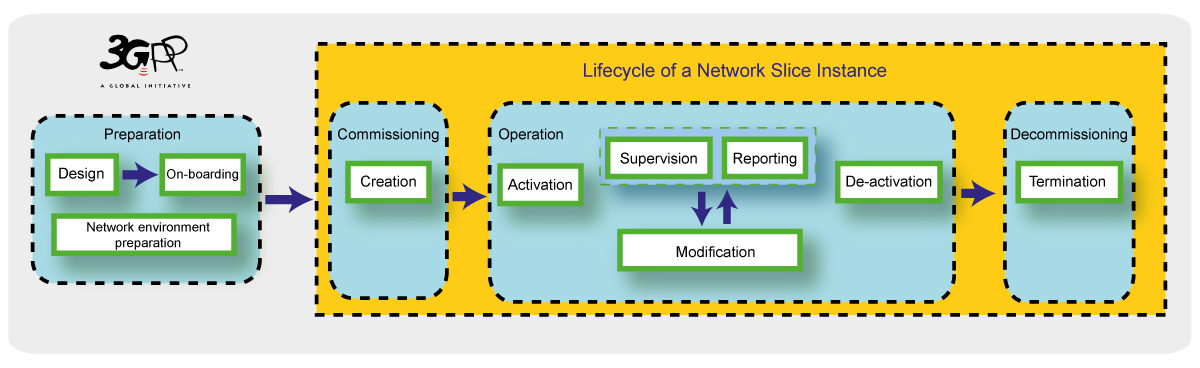
The life cycle of a network slice includes the following stages:
- Preparation: The slice is not yet instantiated. This stage involves defining the blueprint, including QoS, reliability, security, and connectivity parameters required for upcoming services.
- Commissioning: The slice is instantiated and activated. Resources are allocated to meet defined requirements.
- Operation: The slice is monitored to ensure optimal performance. Adjustments, such as scaling network functions, are made dynamically based on demand.
- Decommissioning: The slice is deactivated once no longer needed, freeing up resources for other uses.
Management Models for Network Slicing
There are two primary management models for implementing network slicing, as illustrated below.
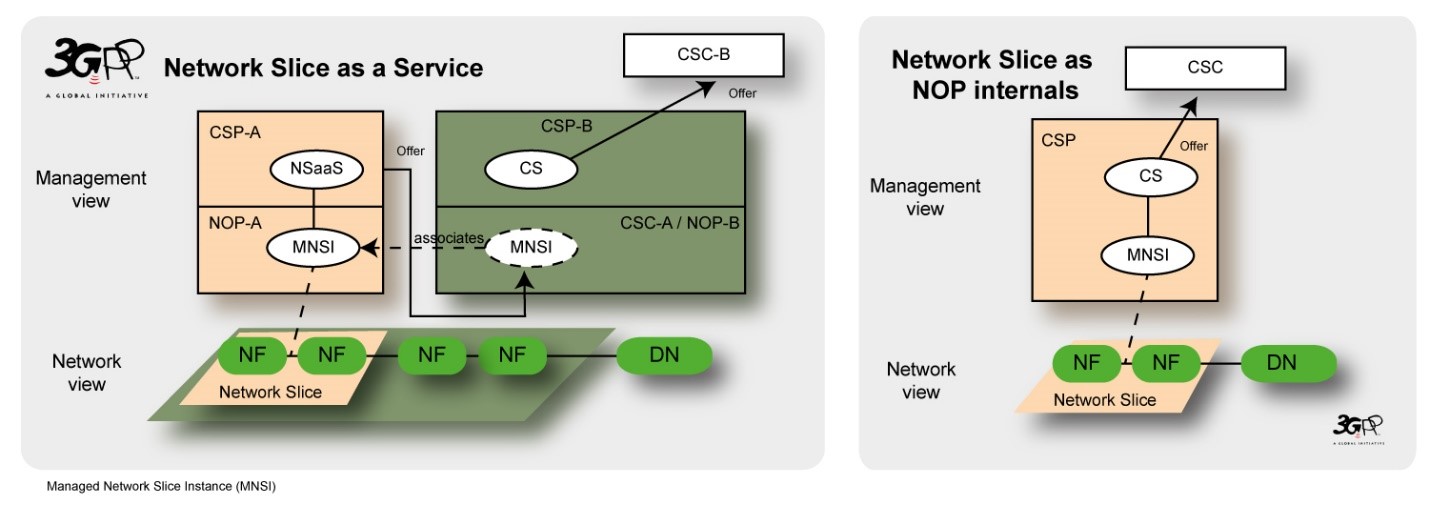
- Network Slice as a Service (NSaaS): In this model, a Communication Service Provider (CSP) offers network slicing as a service to a Communication Service Customer (CSC). The CSC can use, monitor, and manage the slice instance (Managed Network Slice Instance - MNSI) to deliver communication services on top of it.
- Network Slices as Network Operator Internals: Here, the CSP internally deploys network slices to serve customers. These slices are not visible to CSCs but can be monitored via exposed APIs for performance, fault management, and service status.
In a Nutshell
5G network slicing is a revolutionary technology with the potential to transform the way we live, interact, and work. As 5G adoption accelerates, network slicing will become a critical enabler for service providers to deliver ultra-personalized, efficient, and reliable connectivity.
At Calsoft, we actively contribute to advancing telecom innovation through our expertise in NFVI automation, open-source integration, Telco Cloud architecture, VNF engineering, and NFV orchestration. Our team also supports Telco platform validation using open-source technologies. Talk to our Experts for more details.
References
[1] Management, Orchestration, and Charging for 5G Networks (2018)