

Enterprises in the digital era are focused on increasing operational efficiency while reducing IT costs. From application releases to customer support, every single aspect related to IT demands rapid solutions that reduce manual work and deliver an enhanced experience. Today, a large number of organizations are looking for agile and flexible technology solutions to gain a competitive advantage in the market. This is exactly where IT infrastructure automation comes into play.
In a digital world, bringing high-quality products into the market as quickly as possible has displaced all other business priorities. Organizations that successfully accelerate their product development processes stay ahead of the curve.
Yet, it takes days (or even weeks) from the time a request is made to when the service is fully deployed — leading to an ever-increasing backlog of infrastructure-related requests. Response and turnaround times suffer as a result.
Improving IT speed and agility while reducing complexity is a difficult undertaking. The right team, tools, and infrastructure are required to attain this improvement.
So, the million-dollar question is — how do teams accelerate the process? The answer is by embracing the world of infrastructure automation. Let’s explore what infrastructure automation is and how it benefits the IT industry.
What is Infrastructure Automation and Why Adopt It?
Before we jump into the concept of infrastructure automation, it is important to understand the basic terminologies related to it:
- Infrastructure: The IT ecosystem consisting of both hardware and software elements — such as servers, storage, networking, and computing devices.
- Provisioning: The process of making the infrastructure available to end users.
- Configuration: Setting up the infrastructure, including connecting and configuring databases and networks.
- Automation: Automating infrastructure tasks such as setting up network devices, users, and software installations.
- Orchestration: Managing several automation tasks to streamline the overall workflow.
In IT infrastructure automation, the terms Infrastructure as Code (IaC) and Continuous Integration/Continuous Deployment (CI/CD) are the two key approaches embraced by enterprises to deliver infrastructure and applications faster and securely.
The use of software or code to set up and configure the infrastructure of the process is known as IaC. CI/CD modernizes and speeds up the software development lifecycle. Continuous Integration automatically integrates code changes into a shared repository, helping identify issues early in the development process. Continuous Deployment automates the delivery of code to testing and production environments.
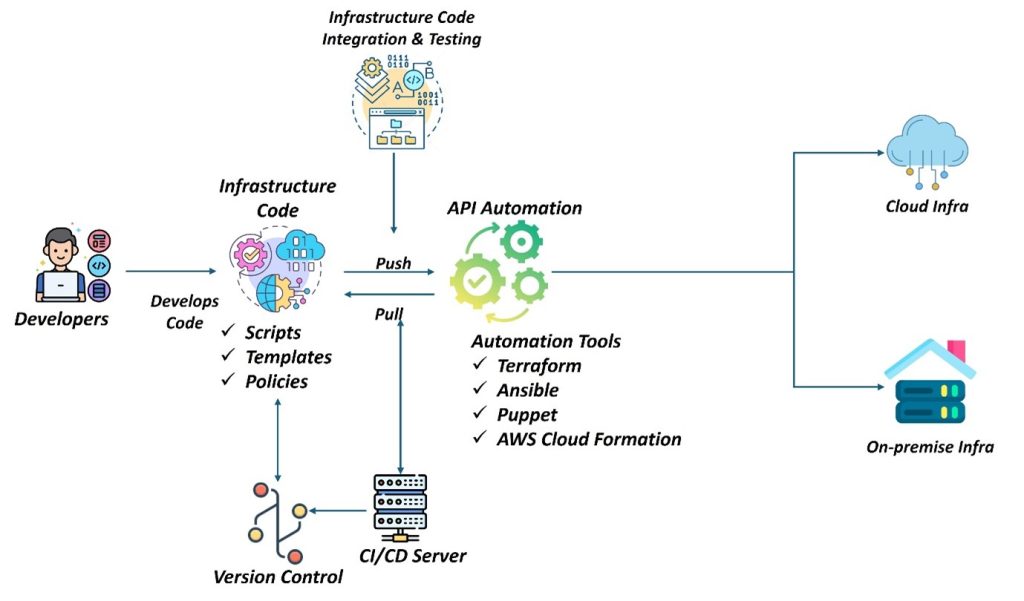
The developer team writes the infrastructure code using an appropriate programming language. The infrastructure code defines the environment in a text file, allowing for version control. This enables visibility into code changes and modifications over time. With the help of IaC tools, the code runs and performs essential functions, realizing automated infrastructure provisioning and deployment. Integrating CI/CD with IaC facilitates continuous and automated deployments.
Now, let’s dive deeper into infrastructure automation and how it benefits organizations in meeting dynamic market trends.
Infrastructure Automation is Transforming Product Development
Managing and provisioning workloads — whether on-premises or in a cloud environment — consumes valuable development time, especially when done manually. An ad-hoc, reactive approach to infrastructure provisioning has unfortunately become the norm. This often leads to overworked teams, higher chances of error, and delayed time-to-market.
The result? Poor customer satisfaction, weakened competitive position, and damaged brand reputation. The solution? Infrastructure automation!
The infrastructure automation process simplifies human interaction with IT systems by building functions that can be utilized by other software and automating repetitive tasks.
Infrastructure automation is rapidly transforming the product development landscape. Automating server provisioning, configuration management, and code deployments enables faster application delivery while reducing human error and improving consistency. Using practices such as IaC, infrastructure automation helps teams deploy new applications or update dependencies more efficiently. Since it automatically carries out repetitive tasks, manual efforts are minimized, allowing teams to adapt to diverse on-premises or cloud-based infrastructures.
Infrastructure automation also brings uniformity in deployments and helps orchestrate changes across environments quickly and effectively, enabling developers to focus on building quality, feature-rich software.
Benefits of Infrastructure Automation
Automated infrastructure provisioning can have a significant impact on the bottom line. Since all manual steps and interventions are eliminated, teams can achieve immutable releases with zero downtime. Here are some key benefits:
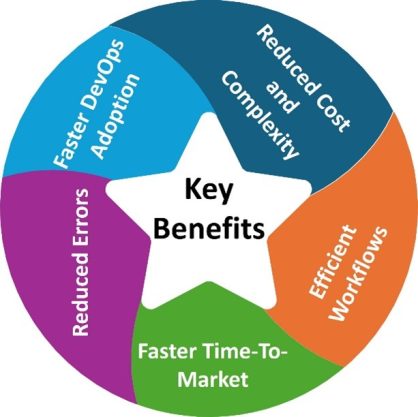
Reduced complexity and costs: One of the most undeniable benefits of infrastructure automation is the reduction in the complexity of provisioning and managing IT infrastructure. Unlike traditional approaches that required significant investment in planning, customization, and maintenance, automation is a cost-effective solution. It reduces administrative burden and helps IT teams provide immediate value.
Automation also eliminates the need for large teams to perform manual steps during product development. This leads to savings in staffing costs and improvements in quality — especially for organizations with large, complex infrastructures.
Faster DevOps adoption: Automation is a core element of DevOps. Infrastructure as Code (IaC) helps DevOps teams automate infrastructure, eliminating manual procedures. This practice helps enterprises achieve agility and scalability, reducing the complexities of infrastructure management.
More efficient workflows: Automating IT provisioning tasks increases efficiency and accuracy. Teams can set conditions to provision infrastructure only when necessary. Each task within a workflow can have its own dependencies, giving teams more control over how infrastructure is provisioned.
Faster delivery: Since infrastructure automation automates IT provisioning, it drastically reduces the time and effort required to set up environments. Teams can start building products sooner, accelerating time-to-market and staying ahead of competitors.
Reduced error: Infrastructure automation minimizes the risk of human error associated with manual server provisioning. Since infrastructure is provisioned automatically, it ensures accuracy, reliability, and consistent environments.
Improved time-to-market: Automation supports streamlined software releases and faster development lifecycles. For enterprises to deliver better customer experiences and remain competitive, automation is essential.
Wrapping Up
When it comes to driving value faster, automating repetitive tasks enables IT teams to focus on what truly matters. In the world of product development, IT infrastructure automation holds immense promise. By automating the provisioning and maintenance of complex IT environments, infrastructure automation can transform nearly every aspect of on-premises and cloud operations.
As part of Calsoft’s Automation & Integration expertise, we help customers analyze existing systems and identify areas where automation can drive efficiency. Embrace infrastructure automation today to make IT deployments more efficient, reduce errors, and improve time-to-market.
Looking for automated infrastructure deployments and better orchestration?