

Cloud-native is no longer an emerging trend; it is the operating baseline for enterprises competing at digital speed. Yet despite widespread adoption, many organizations still struggle to move beyond pilots into production-scale, business-critical deployments.
Commonly referred to as being “born in the cloud,” the cloud-native approach now encompasses the best of modern software development techniques such as DevOps, Containerization, Microservices, Agile methodology, and more. According to the Cloud Native Computing Foundation (CNCF), “cloud-native technologies empower organizations to build and run scalable applications on dynamic cloud environments.”
Since the pioneering success of cloud-native architecture by streaming giant Netflix, many technology companies and application developers have adopted this approach to build efficient cloud applications. Promising a rapid release cycle and improved workload management, cloud-native apps are powering digital transformation — enabling businesses to move from being a “support system” to being the “business itself.” This blog is for CTOs, digital transformation leaders, and VP-level engineering executives who are moving from cloud adoption to cloud optimization — and need a practical, decision-grade framework to do it right.
Operationalize cloud value with resilient design, scale control, and visibility
The leadership challenge: Why cloud-native stalls at scale
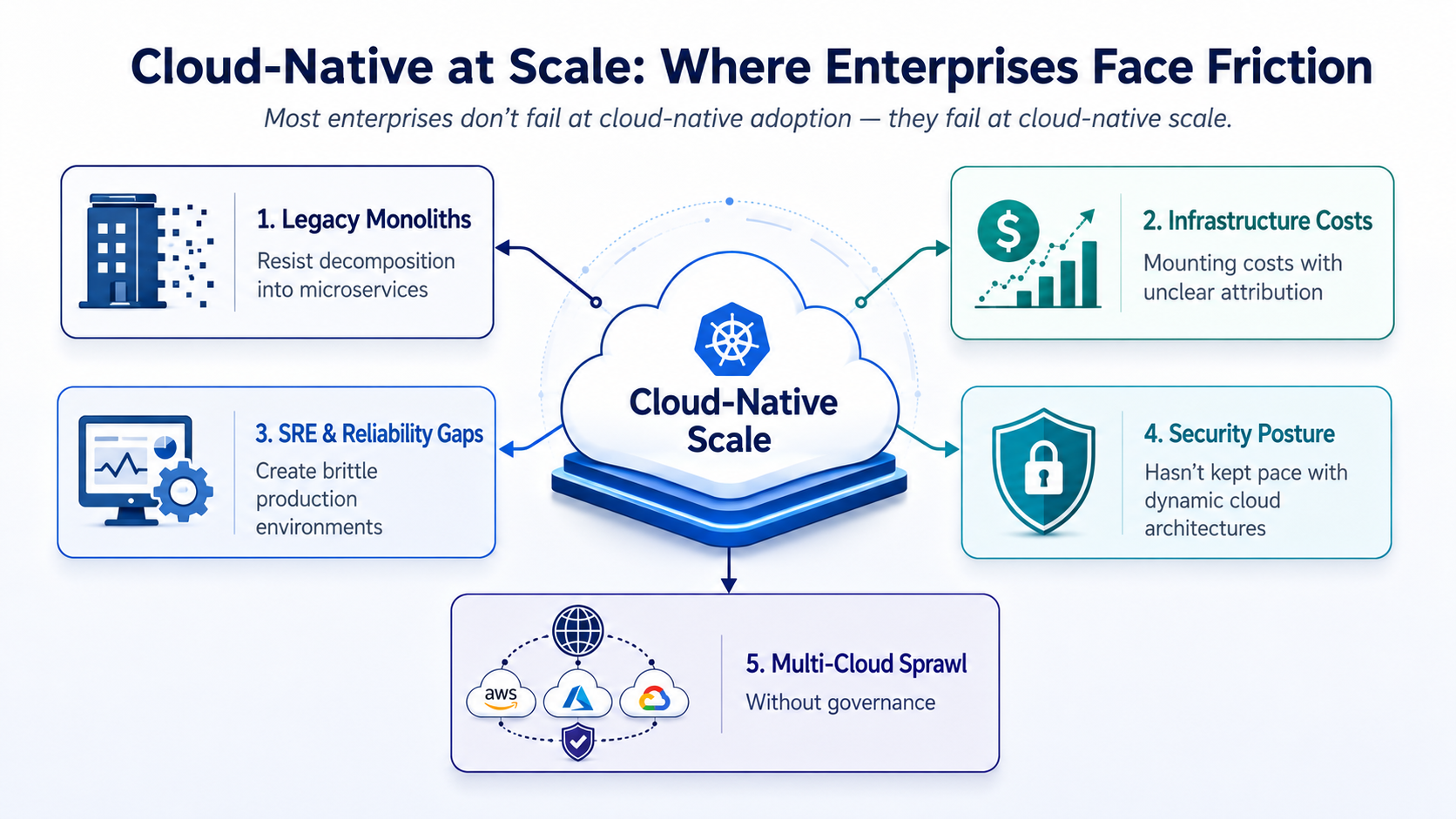
Cloud-native application development is the art of building and managing modern applications designed to fully leverage cloud computing. It supports the idea of developing an app from inception to deployment entirely within a cloud model.
With rising competition, businesses aim to build scalable, agile, and resilient applications that can evolve quickly to meet customer demand — and cloud-native technologies make this possible without compromising service quality.
Going cloud-native can be challenging. To simplify this journey, Calsoft adopt cloud-native practices.
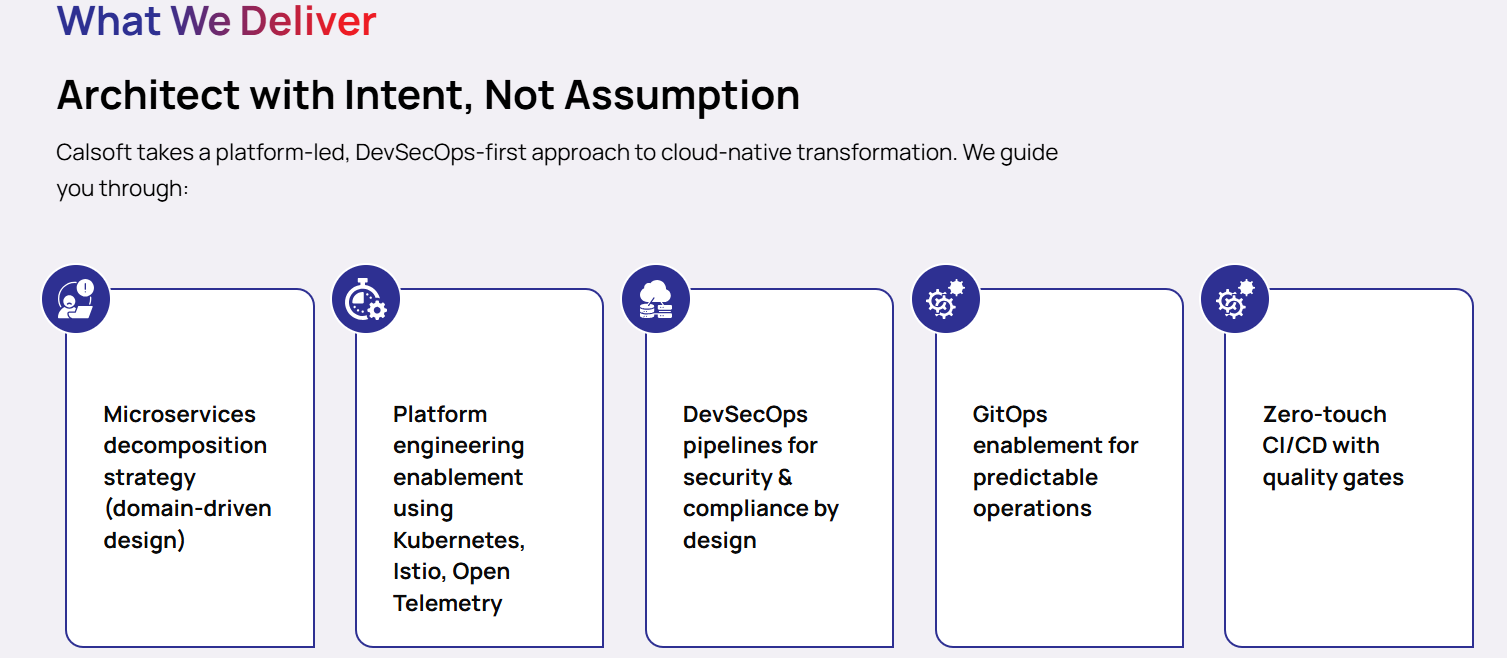
How Calsoft helps enterprises build cloud-native at scale
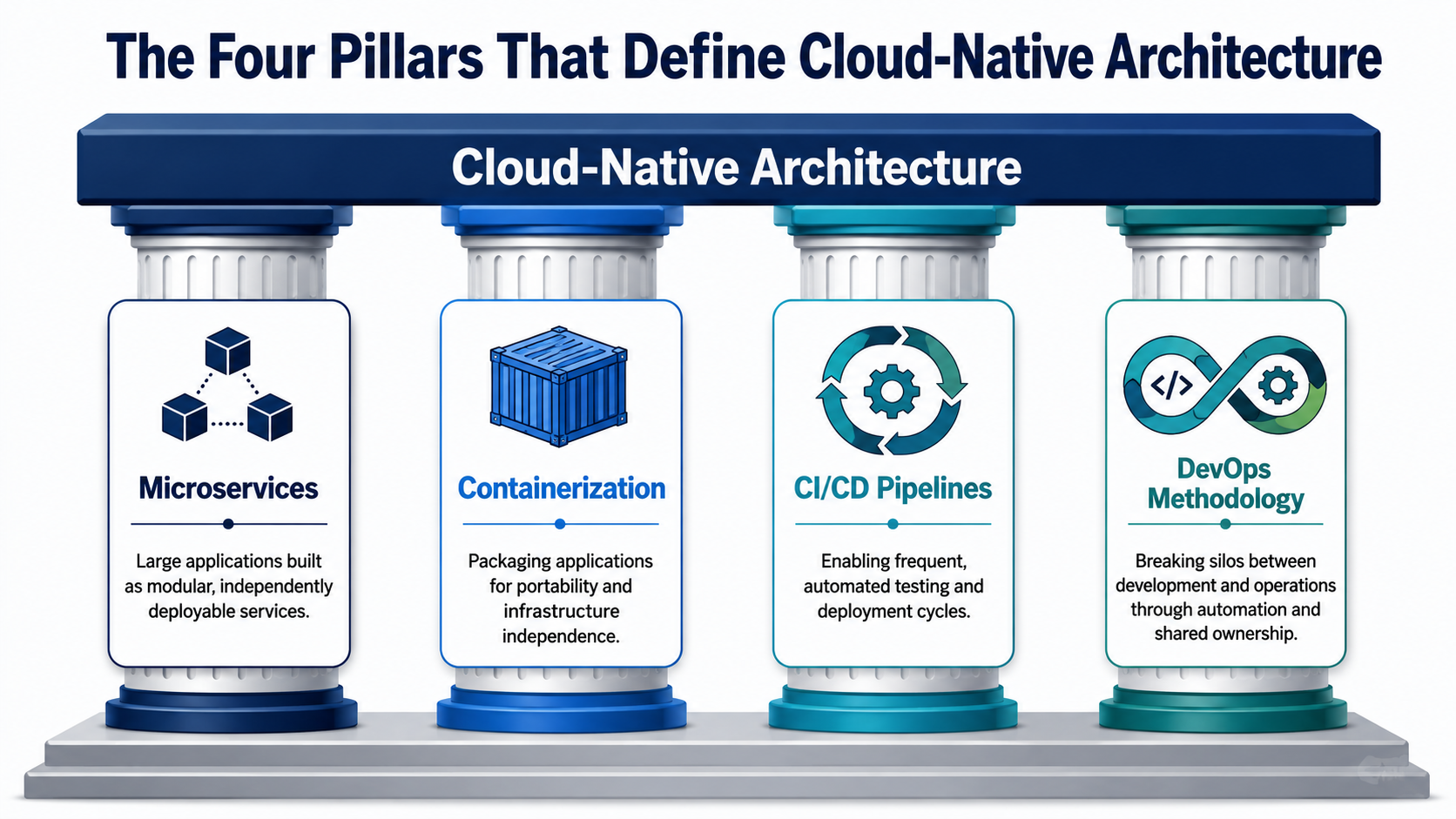
The cloud-native development process is usually based on the following four key principles:
- Microservices: Large applications are built as a suite of modular, independent services.
- Containerization: Software containers package and isolate applications so they can run independently of the underlying infrastructure.
- Continuous Integration and Delivery (CI/CD): Enables frequent testing and deployment of smaller code changes.
- DevOps Methodology: Automates the application lifecycle and enhances collaboration between development and operations teams.
Cloud-native apps differ from cloud-based apps. While the latter simply operate in the cloud, cloud-native apps are optimized for scalability, elasticity, and automation — truly leveraging the cloud’s full potential.
5 Core Elements of Cloud-Native Applications
The five core elements essential to achieve optimal performance and scalability in cloud-native applications.
- Application Design: Cloud-native apps are designed for speed, adaptability, and flexibility using microservices architecture. Microservices allow individual components to be developed and updated independently. RESTful APIs enable communication between services, acting as the “glue” that binds them together.
- DevOps: DevOps bridges gaps between development and operations teams, ensuring faster deployment cycles by automating workflows and breaking down silos. Techniques like Value Chain Mapping (VCM) help optimize development pipelines.
- Operational Design: Microservices simplify deployment and maintenance. Changes can be rolled out or reverted independently without affecting the entire application.
- Quality Assurance (QA): QA is integrated early into development, ensuring issues are detected sooner. Developers are responsible for testing new functionalities, while QA teams focus on performance, integration, and compatibility testing.
5 Strategic considerations for cloud-native at enterprise scale
Cloud-native applications are built from the ground up for the cloud. While there are no strict rules, following best practices ensures scalability, efficiency, and success.
1. Go serverless strategically
Serverless computing enables developers to run code without managing servers. It allows automatic scaling, reduces operational overhead, and improves cost efficiency. But serverless-first is not always the right call — vendor lock-in, cold start latency, and observability gaps can create hidden complexity at scale
2. Embrace microservices with domain-driven design
Build modular applications where each service focuses on a specific business goal. Microservices enhance scalability, fault tolerance, and flexibility. But poorly bounded services create distributed monoliths. Domain-Driven Design (DDD) is what separates high-performing microservices architectures from fragmented ones. With teams working across multi-cloud environments, service mesh adoption is becoming essential for traffic management and zero-trust security between services.
3. Choose runtimes and frameworks for long-term maintainability
Selecting the right language or framework is critical to aligning with your app’s goals and performance needs. Consider runtime compatibility and ecosystem support. With AI-assisted development tools becoming mainstream, language selection should also account for LLM tooling support and ecosystem documentation quality.
4. Automate the entire release pipeline, including security
Implement CI/CD pipelines for faster releases. CI merges code frequently with automated testing, while CD ensures seamless production deployment. Policy-as-code and supply chain security are becoming requirements for enterprises in regulated industries including healthcare, fintech, and government
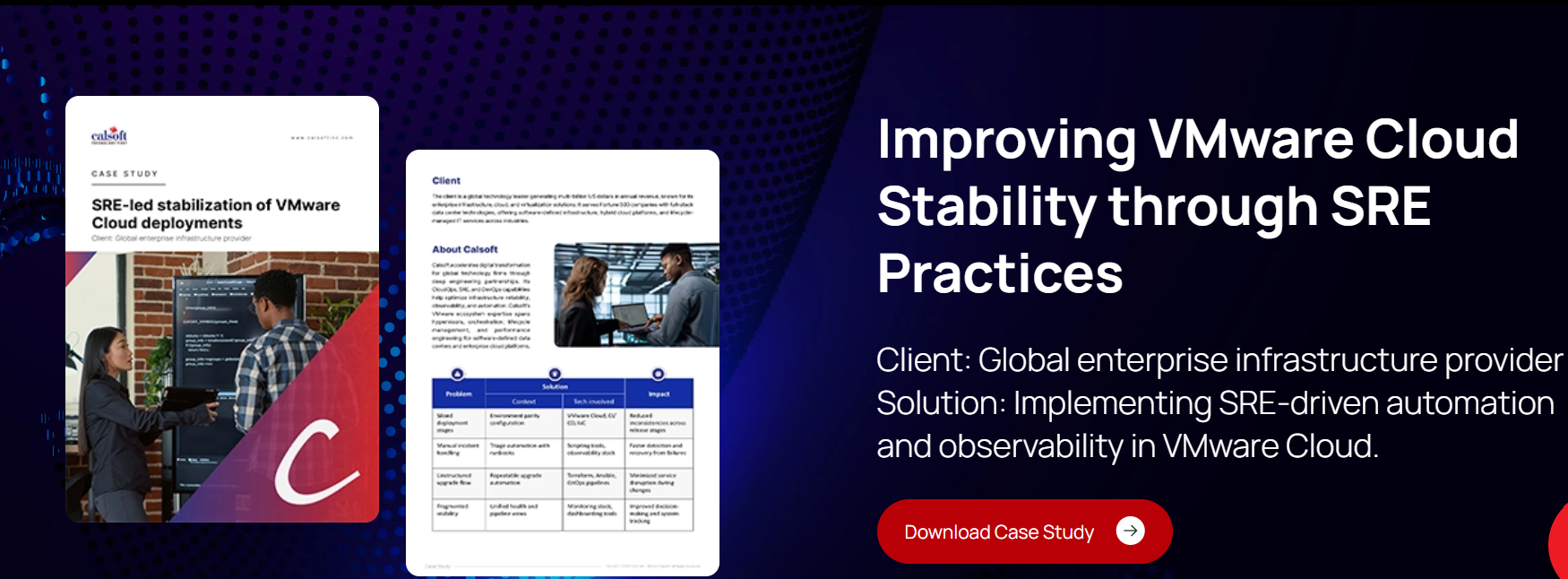
5. Embed SRE practices
Site Reliability Engineering is not an ops function bolted on post-deployment. The most resilient cloud-native organizations define SLOs and error budgets during the design phase and hold engineering teams accountable to them throughout delivery. AIOps and automated remediation are maturing rapidly. Leading enterprises are embedding ML-driven anomaly detection and self-healing capabilities into observability stacks to reduce MTTR significantly.
Conclusion
Cloud-native is not a destination is a continuous operating model that demands architectural discipline, engineering excellence, and leadership alignment. The organizations winning at cloud-native are those who have operationalized it most effectively. The five practices outlined above serverless strategy, disciplined microservices, intentional runtime selection, security-embedded pipelines, and proactive SRE, form the framework that separates cloud-native maturity from cloud-native aspiration. If you want to future-proof your software development strategy, it’s time to embrace cloud-native practices.
At Calsoft, we partner with engineering leaders to close that gap, combining deep product engineering expertise with cloud-native architecture experience to deliver environments built to scale, built to last, and built to perform.