

Somewhere in your portfolio there’s an application nobody wants to touch. It still runs. Nobody’s rewritten the invoicing module in six years, because the last engineer who tried broke payroll for three days. That’s not a technology problem. That’s a decision nobody wanted to own.
What is an application modernization strategy
An application modernization strategy is a structured plan for assessing, prioritizing, and rebuilding legacy applications based on business value, technical condition, risk, cost, and what the business actually needs next. Not what’s easiest to leave alone.
It is not the same thing as migration. Migration moves a system from one server to another. Modernization changes what that system costs you, who controls its roadmap, and how fast your team can change it. A quarter spent moving a legacy app to the cloud can end with the exact same maintenance bill, just addressed to a different vendor. That distinction gets lost in most vendor pitches, on purpose.
Why this sits above any one team
Ask a CISO why modernization matters and you’ll hear about breach liability. Ask a CFO, and you’ll hear about unpredictable spend. Ask an engineer, and you’ll hear about a codebase nobody fully understands anymore. All three are describing the same system.
Advanced’s 2020 Mainframe Modernization Business Barometer surveyed large enterprises across the US and Europe and found that 74% had started a legacy system modernization project and failed to complete it. The report’s own explanation wasn’t a lack of technical skill. It was a mismatch between what leadership wanted and what the technical team was actually funded to do.
That number should worry anyone about to greenlight a modernization budget before agreeing on what success looks like.
There’s also no credible, industry-wide figure for what a typical application modernization project costs or how long it takes. Too much depends on codebase size, how tangled the dependencies are, and which approach gets picked per application. Anyone quoting you a single number before seeing your portfolio is guessing, not estimating.
7 steps to build the strategy
The steps below only work if your CTO, CIO, CISO, and VP Engineering are making each call together, not handing it off from one desk to the next.
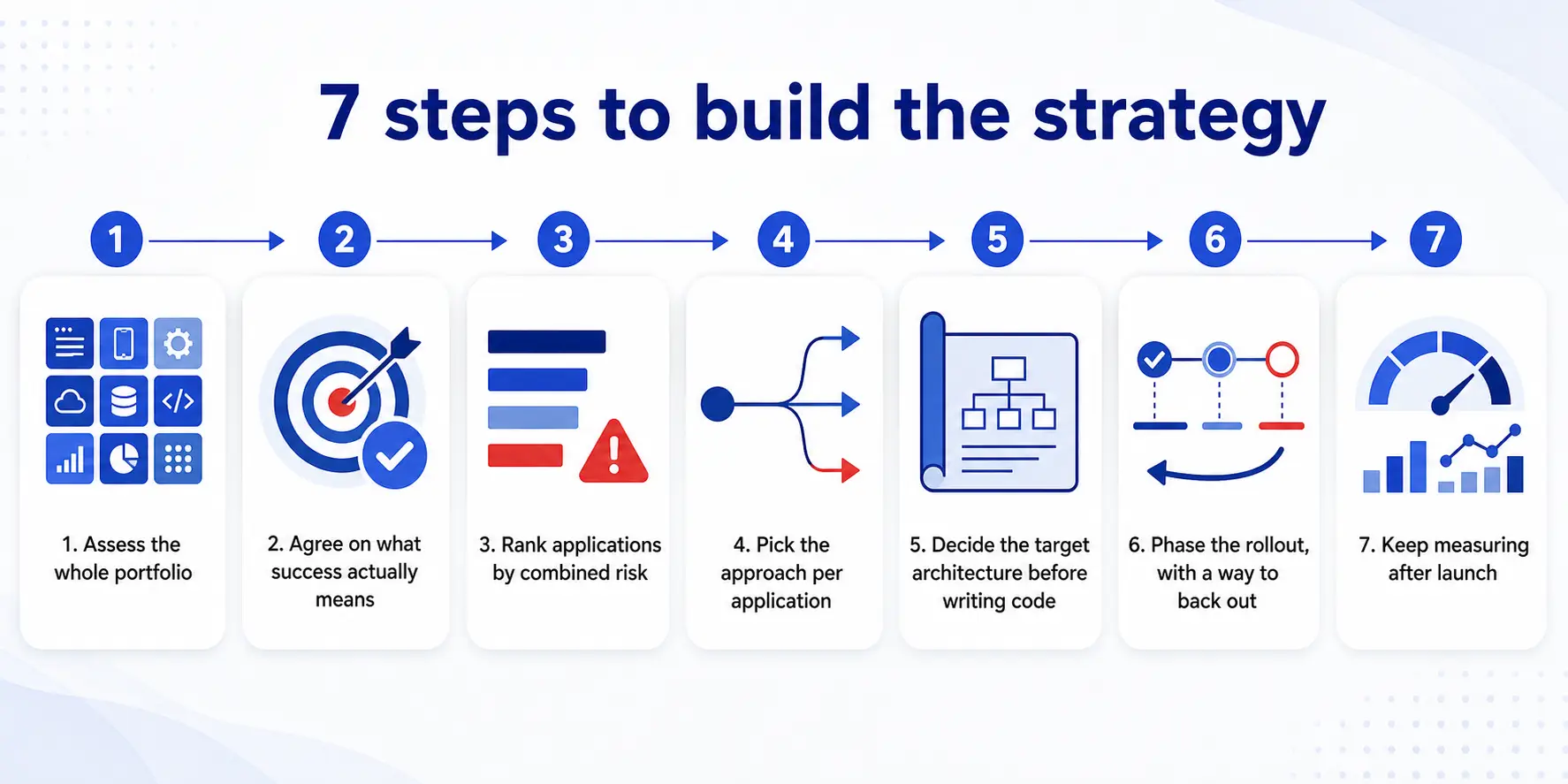
Assess the whole portfolio
Score every application the same way: business criticality, technical health, compliance exposure. Not just the ones already on fire. Internal teams tend to rate their own systems kindly, which is one reason an outside application modernization assessment usually surfaces something the internal review missed.
Agree on what success actually means
The CFO wants predictable cost. The CISO wants audit readiness. Engineering wants faster releases. Write all three down before scoping anything, and settle the trade-offs on paper. This is the step the Advanced report points to when it talks about misalignment.
Rank applications by combined risk
Not by whichever team complains loudest this quarter. A system carrying real compliance exposure should outrank a system that’s simply old.
Pick the approach per application
Infrastructure-as-a-service (IaaS) keeps control with you and keeps the operational burden with you too. Platform-as-a-service (PaaS) trades that burden for coupling to a vendor’s pricing and release schedule. Software-as-a-service (SaaS) moves fastest and hands over the most control. None of these is automatically right. The real question is which liability your team can actually carry.
Decide the target architecture before writing code
Monolith or modular. How much of the stack lives with one vendor. This decision is harder to walk back than almost anything else on this list.
Phase the rollout, with a way to back out
LeasePlan, a vehicle leasing company operating across roughly 30 countries, wrote off close to €98 million in 2019 after abandoning a multi-year SAP consolidation project. The plan had folded 35 country-level systems into one system in a single push, instead of in stages. A phased roadmap with a defined rollback point is the difference between a contained failure and a write-off that size.
Keep measuring after launch
Modernization isn’t a project with an end date. It’s a capability with a budget line. Skip this step and today’s modern architecture becomes next decade’s legacy system.
The 6 Rs, and who actually uses this framework
Vendors love this framework and disagree about what belongs in it. Gartner’s original 2011 model had five options. AWS extended it to 6: rehost, replatform, repurchase, refactor, retire, retain. Microsoft’s current Cloud Adoption Framework groups its own guidance into five: rehost, refactor, rearchitect, rebuild, and replace. If someone tells you Microsoft invented 'the six Rs,' they’re wrong, or they’re selling something.
Here’s a version built around what each path does to your lock-in and cost, not around whose logo is on the slide.
-
Rehost moves the application with minimal change. Fastest option. You also keep every inefficiency that was already there, just on a new bill.
-
Replatform makes targeted changes for some cloud-native benefit. Moderate cost. It also couples you to that platform vendor’s pricing for years.
-
Refactor changes the code to fit cloud-native patterns without a full rebuild. More expensive upfront. You keep more control long-term.
-
Rebuild starts over. Highest cost, longest timeline, and the only option that actually clears technical debt, the accumulated cost of shortcuts taken to ship faster earlier, instead of just relocating it.
-
Retire turns the application off. Cheap, fast, and consistently underused relative to how much of a typical enterprise portfolio actually qualifies.
-
Retain means doing nothing, on purpose, with a date to revisit the decision. Without that date, retain just means nobody decided.
Building this as a roadmap, not a single project
Assessment first. Then one pilot, on a contained, lower-risk system, to catch integration problems while the blast radius is still small. Then a first wave across a wider but still bounded set of applications, each phase with its own rollback point defined before work starts. Then the rest of the portfolio, resequenced using real cost data from the earlier phases. Then it keeps running, because an application modernization roadmap doesn’t really end. It becomes part of how the organization operates.
What actually moves the needle technically
Containers make an application portable across infrastructure providers, which matters most the moment you’re negotiating a contract renewal. APIs designed in from the start, rather than bolted on later, cut the cost of connecting whatever gets built next. Microservices speed up deployment at the cost of more operational complexity to manage day to day. None of these fixes a bad decision made back at step four. They just make a good one faster to execute.
What to prioritize first
Score everything on the same six things: business value, technical health, compliance risk, dependencies, how hard it actually is to change, and expected return. A system with real revenue impact and poor technical health usually wins that ranking. A system that’s merely old, connected to nothing critical, and cheap to leave alone usually doesn’t, and that’s fine.
None of this gets easier by waiting. The assessment gets more expensive every year it’s deferred, not less. Since 1998, Calsoft has worked as an application modernization partner across industries and geographies. If your portfolio needs an assessment before it needs a decision, look at our application modernization services, or contact our team.
FAQ’s
What is application modernization?
Updating the architecture, platform, or code of an existing application to meet current performance, security, and cost requirements, instead of leaving it unchanged or replacing it entirely.
What is an application modernization strategy?
A structured plan for assessing, prioritizing, and rebuilding legacy applications based on business value, technical condition, risk, cost, and future requirements. Covered in full above.
What are the 6 Rs of application modernization?
Rehost, replatform, refactor, rebuild, retire, retain. Gartner, AWS, and Microsoft each define the framework slightly differently. See the section above for the actual sourcing.
What is the difference between application modernization and application migration?
Migration moves a workload from one environment to another. Modernization changes what it costs, who controls it, and how fast you can change it. A project can migrate without modernizing anything.
How do you prioritize legacy application modernization?
Score each application on business value, technical health, compliance risk, dependencies, complexity to change, and expected return, then sequence by combined score, not by which team is loudest.
How long does an enterprise application modernization project take?
There’s no verified industry-wide figure. A single rehost can take weeks. A full rebuild of a business-critical system commonly runs well over a year. Portfolio-wide programs run for years, by design.
How much does application modernization cost?
No credible source publishes a reliable average across industries, because it depends entirely on codebase size and which of the 6 Rs applies to each system. Treat any number offered before an assessment as a guess.